Miller-B Coastal Snowstorm Pattern Targets New Jersey, New York, Massachusetts, and Maine During Rare East Coast Setup
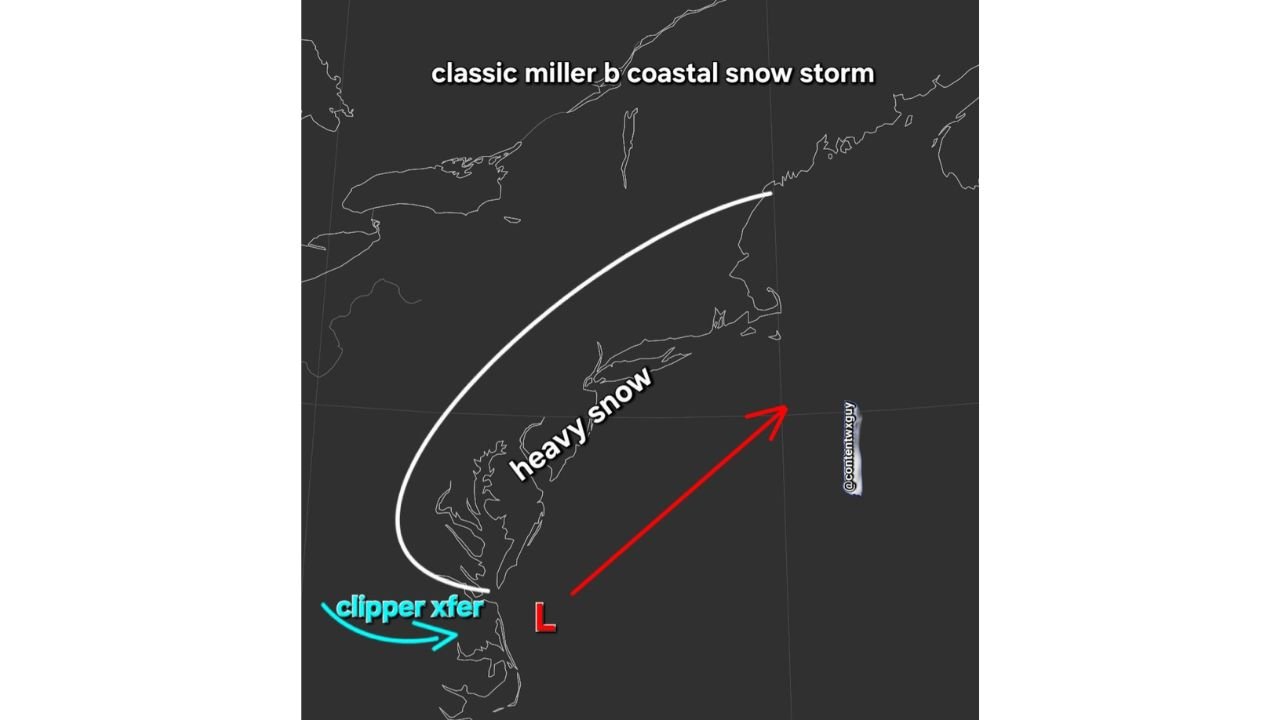
UNITED STATES — The weather setup shown in the latest analysis highlights a classic Miller-B coastal snowstorm pattern, a configuration that historically produces heavy snow along parts of the Mid-Atlantic and Northeast coastline, but only under very specific atmospheric conditions. According to the data shown, this type of pattern is uncommon, occurring once every 6–7 years on average, with extended clusters appearing roughly once every 30 years.
The maps and annotations clearly indicate a clipper system transferring energy to the coast, allowing a new low-pressure system to strengthen offshore — the defining feature of a Miller-B storm. When this happens, inland energy weakens while coastal development intensifies, focusing snowfall near the Atlantic shoreline rather than far inland.
How the Miller-B Setup Works in This Pattern
The data visualization shows a primary low pressure (L) weakening inland, while energy shifts eastward toward the Atlantic Ocean. This transfer allows a secondary coastal low to develop and track northward just offshore.
In this configuration:
- Cold air is already in place across the Northeast.
- Moisture is pulled northward from the Atlantic.
- The strongest lift occurs near the coast.
This combination is why New Jersey, Long Island (New York), eastern Massachusetts, and coastal Maine are highlighted as the most vulnerable areas for heavy snow, while regions farther inland may see less impact or mixed precipitation.
Heavy Snow Axis Focused Along the Coast
The curved white track shown in the image outlines the primary heavy snow corridor, running from:
- Southern New Jersey
- Through Long Island and coastal New York
- Into eastern Massachusetts
- And potentially coastal Maine
This is a textbook Miller-B signature, where snowfall intensity increases closer to the coastline instead of farther west. The red arrow in the graphic represents strong moisture transport, which is essential for turning this setup into a high-impact snow event.
However, the data also emphasizes that not every Miller-B produces a major storm — many fail due to timing issues, weak moisture return, or poor phasing between systems.
Why These Storms Are Rare — and Not the Norm
The accompanying text explains an important climatological reality:
Most winter seasons are benign, and Miller-B storms are the exception, not the rule.
While some years see back-to-back events, the long-term average strongly favors:
- Infrequent coastal snowstorms
- Long gaps between truly major East Coast snow events
- Many winters with little or no Miller-B activity
This context is critical, because it explains why even when the pattern appears on models, confidence remains low until late stages.
What This Means Going Forward
Based strictly on the data shown:
- This pattern does not guarantee a major snowstorm.
- Coastal states should monitor updates closely.
- Small track shifts could dramatically change snowfall totals.
- Inland areas are less favored than coastal zones.
The setup is meteorologically significant, but still conditional, relying on precise timing and alignment.
Final Takeaway
This data highlights a rare but well-known coastal snowstorm mechanism, with New Jersey, New York, Massachusetts, and Maine positioned closest to the potential impact zone. While history shows these setups can produce memorable storms, the same history also reminds us that most fail to fully materialize.
Residents along the Northeast coast should stay alert, but measured — this is a pattern worth watching, not panicking over.
If you follow weather trends closely or enjoy understanding the science behind major winter setups, stay connected with ChicagoMusicGuide.com for clear, data-driven breakdowns of complex weather patterns — and share your thoughts on whether this setup looks familiar to past coastal snow events you’ve experienced.