California, Oregon, and Washington Face Elevated Earthquake Monitoring as Seismic Activity and Strain Signals Increase Along West Coast
UNITED STATES — Recent seismic data and monitoring trends are drawing increased attention to California, with broader implications for Oregon and Washington, as analysts note an unusual pattern of energy buildup along the U.S. West Coast heading into early 2026.
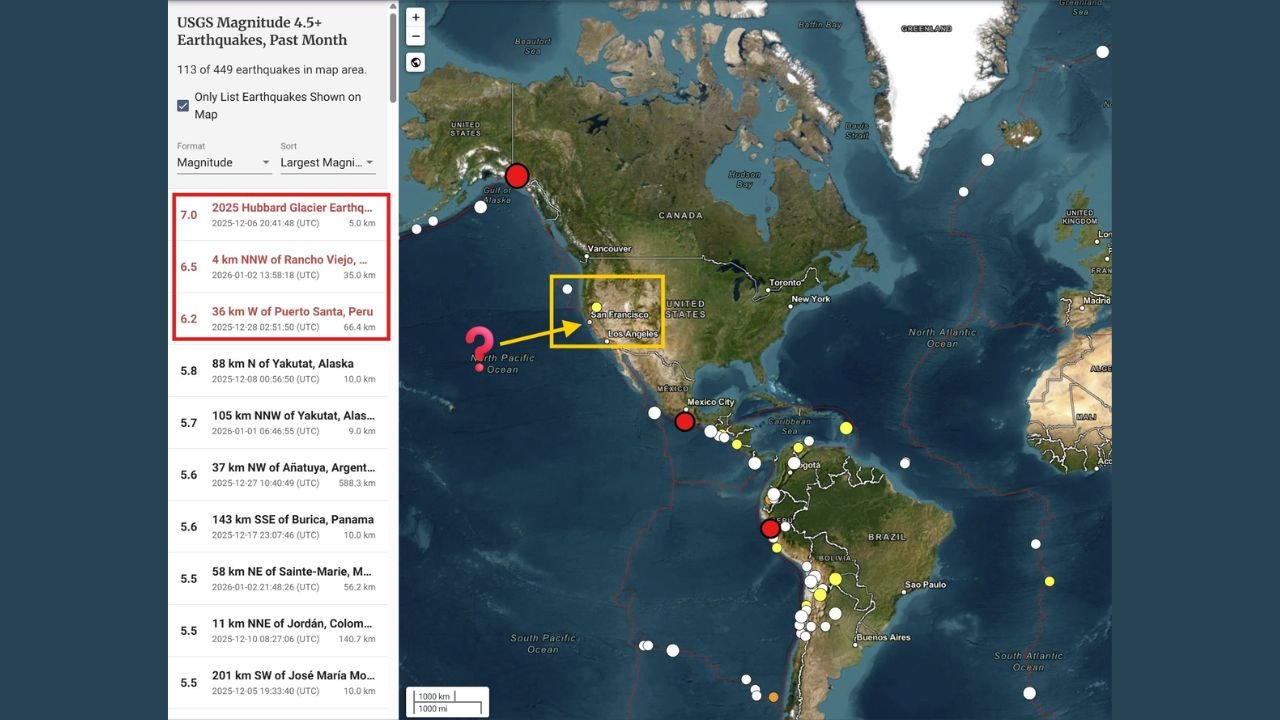
Maps from USGS earthquake tracking show a notable cluster of magnitude 6.0+ earthquakes across the Pacific Rim over the past month — including Alaska, Mexico, and parts of South America — while California itself has not yet recorded a comparable release during this period. Some independent analysts interpret this as a potential strain-loading phase rather than a confirmation of an imminent event.
What the Recent Seismic Data Shows
According to the past 30 days of global seismic records:
- Multiple M6.0–7.0 earthquakes have occurred across the North Pacific and South Pacific regions
- Significant events were recorded near Alaska (Gulf of Alaska) and western Mexico
- California, despite its active fault systems, has remained comparatively quiet at higher magnitudes
This pattern has prompted discussion around a possible “missing release” scenario, where accumulated tectonic stress has not yet been relieved locally.
Why Northern California Is Being Watched More Closely
Independent seismic observers are highlighting Northern California as an area to monitor more closely than Southern California, based on:
- Proximity to the Calaveras Fault and San Andreas Fault
- Ongoing hydrological loading from recent and ongoing heavy rainfall
- Elevated groundwater saturation, which can influence stress along fault zones
While none of these factors independently predict an earthquake, their overlap increases scientific interest, particularly when combined with regional seismic energy transfer patterns.
Pacific Northwest Also on the Radar
Beyond California, attention also extends northward:
- Oregon and Washington continue to sit atop the Cascadia Subduction Zone
- Analysts note the possibility of a moderate “ping” or stress adjustment along offshore fault systems
- No official alerts have been issued, but the region remains under long-term monitoring due to its known seismic history
External Factors Being Discussed
Some analysts are also noting coinciding environmental factors, including:
- King tides linked to recent lunar phases, which can slightly increase vertical ground stress
- A G1-level geomagnetic storm recorded within the last 24 hours, capable of enhancing electrical currents in conductive subsurface materials
It’s important to note that mainstream scientific agencies do not treat these factors as direct earthquake triggers, but they are sometimes discussed in broader stress-analysis models.
What This Means Right Now
At this time:
- No official earthquake warnings have been issued for California, Oregon, or Washington
- The situation represents heightened monitoring, not a confirmed forecast
- Preparedness — not panic — remains the recommended approach
Emergency agencies continue to advise residents along the West Coast to review earthquake safety plans, maintain emergency kits, and stay informed through official channels like USGS and state emergency management offices.
The Bigger Picture
January is historically an active month for weather and geological transitions, and experts emphasize that seismic risk is ongoing in West Coast states regardless of short-term patterns. While some analysts believe the late January window deserves closer observation, uncertainty remains high.
Residents are encouraged to rely on verified data, avoid sensational claims, and focus on preparedness rather than prediction.
What’s your take on the recent seismic patterns along the West Coast? Do you think California is due for a larger release — or is this just another quiet stretch? Share your thoughts and stay informed with the latest regional updates on ChicagoMusicGuide.com.