Power Outages Climb Across Louisiana, Mississippi, Tennessee, Alabama, Georgia, and the Southeast as Ice Storm Leaves Nearly 1 Million Without Electricity
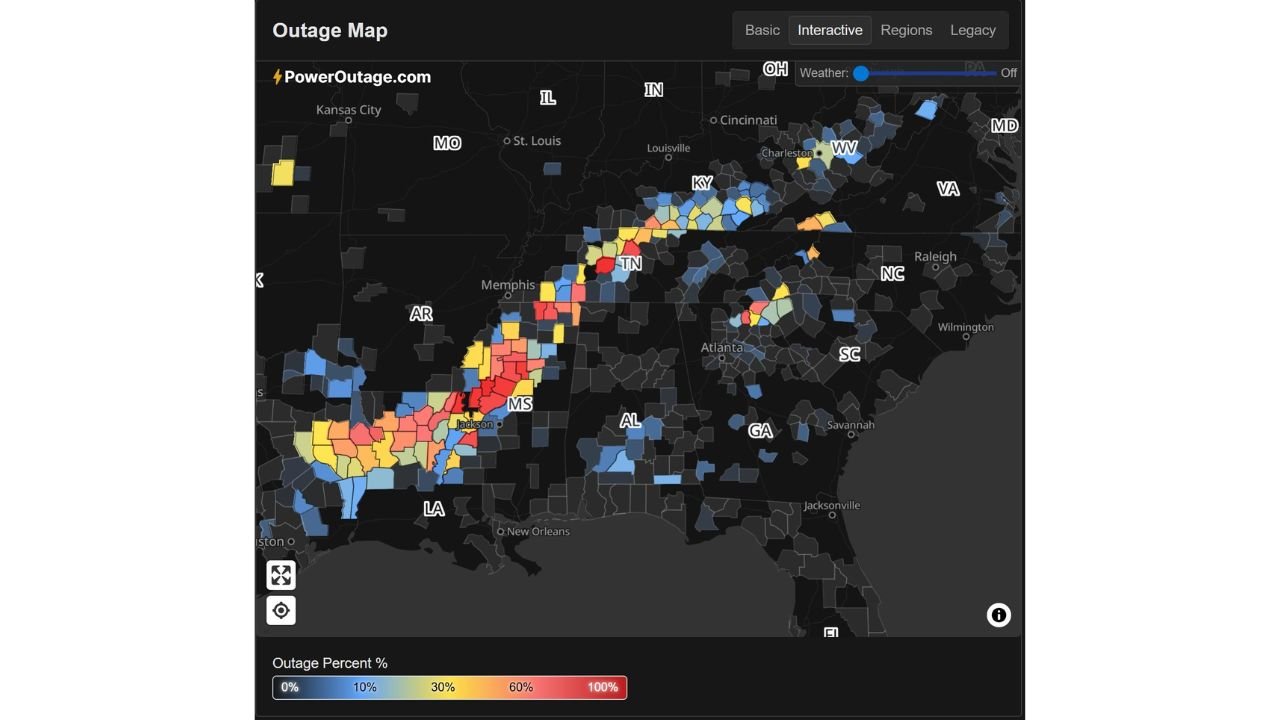
UNITED STATES — A dangerous winter ice storm continues to disrupt large portions of the South and Southeast, with nearly one million customers without power as of early evening. While some local areas have avoided the worst impacts, outage data shows widespread electrical failures stretching from Louisiana and Mississippi through Tennessee, Alabama, Georgia, Kentucky, and parts of West Virginia, as heavy ice accumulation overwhelms trees and power infrastructure.
The outage snapshot, taken around 7:07 p.m., reflects ongoing damage from freezing rain and a rapidly advancing flash freeze, compounding recovery efforts across multiple states.
Mississippi and Louisiana See the Highest Concentration of Outages
Outage maps show Mississippi as the hardest-hit state, particularly across central and northern counties, where ice accumulations exceeding two inches have brought down power lines and snapped tree limbs. Several counties are showing outage percentages exceeding 60 to 80 percent, indicating widespread infrastructure failure.
In Louisiana, especially across the northern and central parts of the state, outages remain extensive as ice-coated trees continue to fall onto distribution lines. Utility crews face hazardous conditions as temperatures plunge and roadways freeze solid, slowing restoration timelines.
Tennessee and Kentucky Impacted Along a Narrow Ice Corridor
A pronounced outage corridor stretches northeast into Tennessee and Kentucky, following the same axis of freezing rain identified earlier by meteorologists. Portions of western and central Tennessee are reporting significant service disruptions, particularly near Memphis and along major transportation routes.
In Kentucky, scattered counties show elevated outage percentages as ice accumulation stresses rural power networks. Officials warn that restoration may be uneven, especially in hilly and wooded areas where access remains limited.
Alabama and Georgia Experience Growing Outages Ahead of Flash Freeze
While Alabama and Georgia initially avoided the worst structural damage, outages are increasing rapidly as a flash freeze sets in. As temperatures drop sharply, any remaining moisture on trees and lines is freezing solid, increasing weight and triggering delayed failures.
Metro areas including Birmingham, Montgomery, Atlanta, and surrounding suburbs are seeing scattered outages, with officials warning that numbers may rise overnight as ice hardens and winds shift.
Why Ice Storm Outages Take Longer to Restore
Unlike wind-driven storms, ice storms cause prolonged and cascading failures. Heavy ice adds extreme weight to power lines and poles, often breaking infrastructure in multiple locations at once. Even after precipitation ends, falling temperatures can worsen damage as ice contracts and snaps weakened materials.
Utility officials caution that restoration timelines may extend for several days, particularly in rural areas where crews must first clear debris before repairs can begin. The ongoing flash freeze also creates dangerous working conditions for repair teams.
Nearly 1 Million Outages Reflect Regional-Scale Impact
With outage counts approaching one million customers, this event ranks among the most disruptive winter power events in recent years across the South and Southeast. Emergency management agencies are urging residents to prepare for extended power losses, especially where ice accumulation has been most severe.
Residents are advised to conserve heat, avoid travel where possible, and check on vulnerable neighbors as temperatures fall into the teens and lower 20s overnight.
What Residents Should Expect Next
As colder air deepens across the region, additional outages remain possible even without new precipitation. Officials warn that road conditions will deteriorate overnight, making restoration efforts slower and more dangerous.
Warming centers are being opened in several counties, and utility providers are prioritizing hospitals, emergency services, and critical infrastructure where possible.
As the ice storm recovery continues and the flash freeze intensifies, conditions remain fluid across the South and Southeast. For continued updates on power outages, weather impacts, and regional recovery efforts, stay with ChicagoMusicGuide.com for the latest coverage.