Maryland, Virginia, West Virginia, Pennsylvania, Delaware, and New Jersey See Deepening Drought as 180-Day Rainfall Deficits Worsen Across the Mid-Atlantic
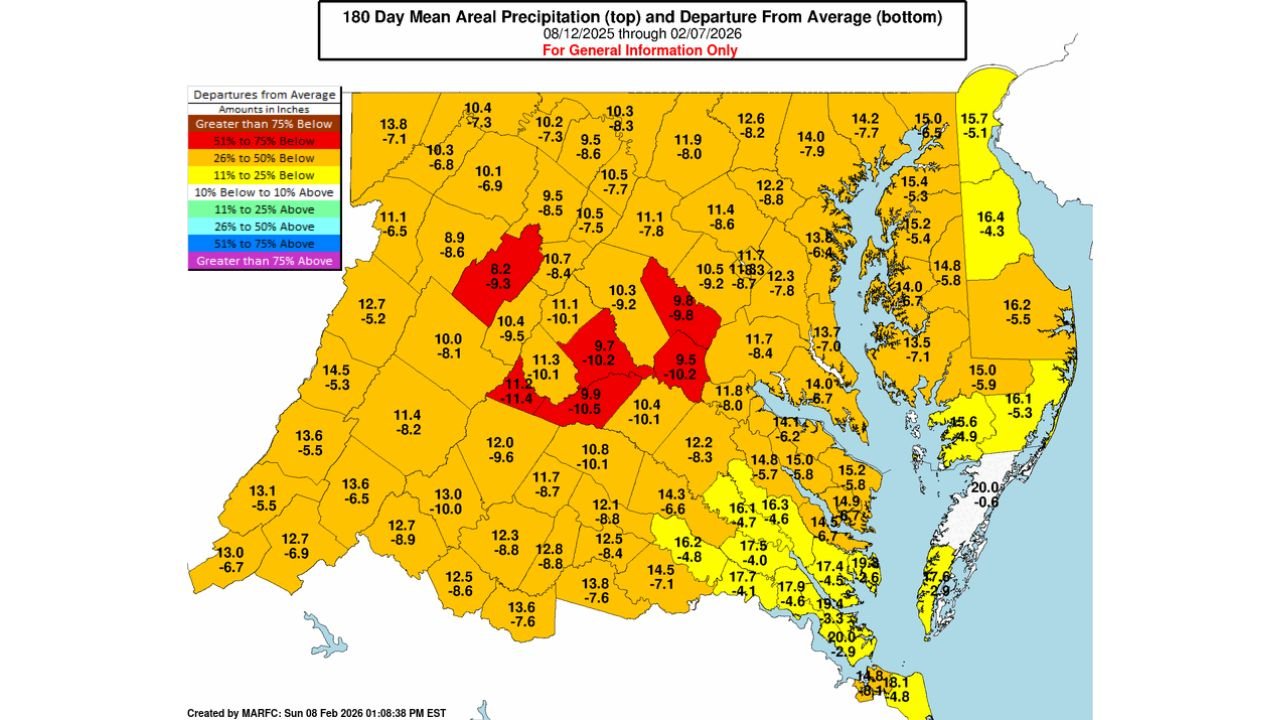
UNITED STATES — A new six-month precipitation analysis reveals a worsening drought pattern across the Mid-Atlantic, with Maryland, Virginia, West Virginia, Pennsylvania, Delaware, and New Jersey all running significantly below normal rainfall since August. The data highlights a persistent lack of moisture that has developed quietly through fall and winter, raising growing concerns as the region approaches spring.
Large portions of the interior Mid-Atlantic now fall into moderate to severe precipitation deficit categories, indicating that recent cold snaps and weak storm systems have failed to deliver meaningful moisture.
Six-Month Rainfall Totals Running Well Below Average
The 180-day precipitation data shows widespread deficits ranging from 5 to more than 11 inches below normal across much of the region. Central Virginia and central West Virginia stand out as some of the hardest-hit areas, with several counties measuring 50 to 75 percent below average rainfall, highlighted in red on the map.
Parts of Maryland and southern Pennsylvania also show notable deficits, generally ranging from 7 to 10 inches below normal, while Delaware and New Jersey remain below average despite slightly higher coastal totals.
This prolonged dryness reflects a pattern of missed storm opportunities rather than a single dry month.
Virginia and West Virginia Among The Most Severely Impacted
The most concerning signals appear across Virginia and West Virginia, where multiple counties are running over 10 inches below normal precipitation since mid-August. These deficits indicate long-term soil moisture depletion rather than surface dryness alone.
Even areas that typically benefit from winter systems have failed to recover, suggesting that cold air has arrived without the accompanying moisture needed to balance seasonal averages.
Hydrologists warn that when winter precipitation fails to recharge groundwater, spring rainfall becomes critical — and risky if it arrives too late or too unevenly.
Pennsylvania, Maryland, and Delaware Continue To Slide
Across Pennsylvania and Maryland, the data shows widespread rainfall shortfalls generally between 7 and 9 inches below normal, with only small pockets avoiding deeper deficits. Delaware, while slightly less extreme, remains solidly below average statewide.
These conditions suggest that even brief warm spells or snowmelt events are unlikely to meaningfully improve moisture levels without sustained rain. Rivers, reservoirs, and soil profiles remain under stress heading into late winter.
New Jersey Coastal Areas Fare Slightly Better, But Still Below Normal
While New Jersey’s coastal and southern counties show slightly higher precipitation totals compared to inland areas, they remain below average overall, typically by 4 to 6 inches. Northern and interior sections of the state show stronger deficits, aligning more closely with conditions in eastern Pennsylvania.
This uneven distribution highlights how storm tracks have repeatedly favored offshore systems, leaving inland areas dry.
Why The Dry Pattern Matters Moving Forward
A dry winter often goes unnoticed until impacts surface in spring. Reduced soil moisture can lead to lower streamflow, increased wildfire risk, and agricultural stress, particularly if spring rainfall is delayed or inconsistent.
With long-range forecasts showing a mostly dry pattern continuing, meteorologists caution that the region may enter spring already behind on moisture, increasing vulnerability to heat and early-season drought expansion.
What To Watch In The Coming Weeks
Forecasters will be monitoring for any sustained storm systems capable of delivering widespread soaking rainfall rather than brief, light events. Until then, the Mid-Atlantic remains in a fragile balance, relying heavily on late-winter and early-spring precipitation to prevent further deterioration.
Residents and local officials across Maryland, Virginia, West Virginia, Pennsylvania, Delaware, and New Jersey are encouraged to stay informed as conditions evolve.
For continued updates on regional weather trends, long-range outlooks, and how climate patterns may impact events and daily life, visit ChicagoMusicGuide.com for the latest coverage.