Southern California Basks in Record-Challenging February Heat as San Diego, Palm Springs and El Centro Surge Toward 90 Degrees
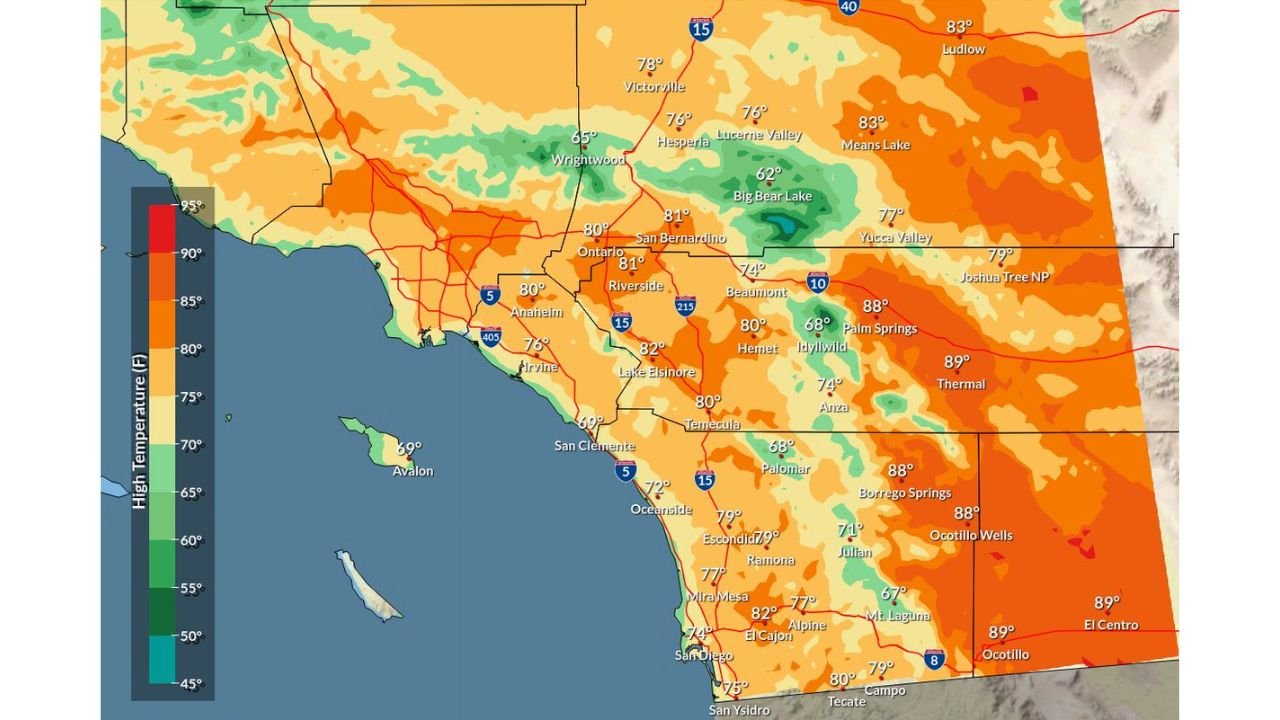
SAN DIEGO, CALIFORNIA — Unseasonably warm air pushed across Southern California on February 24, sending afternoon temperatures soaring well above normal for late winter and bringing some communities close to the 90-degree mark. The latest forecast map from the National Weather Service San Diego shows widespread 70s and 80s stretching from the coast to the deserts.
While much of the country remains in winter mode, Southern California residents experienced conditions that felt more like late spring. Forecasters even noted that the weather may feel “too nice” for February, highlighting just how unusual the warmth has become.
Desert Communities Lead the Heat Surge
The most dramatic warmth was concentrated across the Inland Empire and desert regions, where several cities approached record territory. Palm Springs reached 88 degrees, while nearby Thermal climbed to 89 degrees. El Centro and Ocotillo also topped out at 89 degrees, placing them among the hottest locations in the region.
Further north, Ludlow and Means Lake each reported highs near 83 degrees, reinforcing the pattern of widespread desert warmth. Even elevated desert communities like Yucca Valley and Joshua Tree National Park saw temperatures in the upper 70s.
These readings are significantly above the historical February averages, which typically fall into the mid-60s to low 70s for many of these areas.
Inland Cities See Spring-Like Conditions
Communities across Riverside County and San Bernardino County also experienced well-above-normal warmth. Riverside and San Bernardino reached 81 degrees, while Ontario climbed to 80 degrees. Lake Elsinore recorded 82 degrees, and Temecula reached 80 degrees.
In the high desert, Victorville rose to 78 degrees, and Hesperia and Lucerne Valley each hovered around 76 degrees. Even typically cooler mountain-adjacent areas such as Beaumont reached the mid-70s.
However, higher elevations remained notably cooler. Big Bear Lake peaked at just 62 degrees, and Wrightwood recorded 65 degrees, illustrating the sharp elevation-driven contrast across the region.
Coastal Areas Stay Mild but Warm for February
Closer to the coast, temperatures remained slightly moderated by ocean influence but were still warm for this time of year. San Diego reached approximately 74 degrees, while El Cajon climbed to 82 degrees. Alpine recorded 77 degrees, and Ramona saw highs near 79 degrees.
Further north in Orange County, Anaheim hit 80 degrees, and Irvine reached 76 degrees. Coastal communities such as Oceanside recorded 72 degrees, while San Clemente and Avalon both hovered around 69 degrees.
These values are several degrees above seasonal averages, which typically remain in the mid-60s along the immediate coastline during late February.
Mountain and Foothill Variations Remain Noticeable
The region’s topography played a clear role in shaping the temperature map. Idyllwild reached only 68 degrees, and Julian stayed near 71 degrees, significantly cooler than the nearby desert floor.
Similarly, Palomar Mountain remained at 68 degrees, and Mt. Laguna topped out at 67 degrees, offering relief from the warmer valley and desert heat.
This stark contrast between mountain elevations and lower desert valleys highlights Southern California’s microclimate diversity, even during widespread warm spells.
Why This February Warmth Stands Out
Late February typically marks a transitional period between winter storms and early spring warming. However, the current pattern has delivered sustained sunshine and limited cloud cover across Southern California, allowing temperatures to climb steadily during the afternoon hours.
With widespread highs in the upper 70s and 80s, and multiple locations approaching 90 degrees, the region is experiencing temperatures more typical of late April or early May.
For residents and visitors, the conditions offer ideal outdoor weather—but they also serve as a reminder that seasonal norms can shift dramatically under persistent high-pressure systems.
As Southern California continues to enjoy these warm, sunny skies, residents are encouraged to stay hydrated and remain aware of fire weather conditions, especially in dry inland areas.
As weather patterns continue to evolve across the West Coast, ChicagoMusicGuide.com will provide ongoing updates on temperature trends, regional climate shifts, and how changing conditions may impact communities and outdoor events nationwide.