Colorado Shatters February Heat Records in Springfield and Pueblo as California, Arizona and Texas Brace for Historic Winter Warmth
UNITED STATES — A dramatic temperature split is unfolding across the country, with record-breaking heat in Colorado while much of the East remains locked in colder-than-average air. The latest data shows extreme warmth surging across the western and central U.S., with forecasters warning that some of the hottest winter days in modern U.S. history could unfold in the coming days.
The most eye-catching numbers so far come from Colorado, where cities are rewriting February records.
Springfield and Pueblo Set February Heat Milestones
On the hottest February day ever recorded for parts of southeastern Colorado, Springfield reached 84 degrees, while Pueblo climbed to 83 degrees.
These values are exceptionally high for late February and stand in sharp contrast to historical averages, which typically remain in the 40s and 50s for much of the state this time of year.
The phrase “extreme contrasts” captures the situation perfectly. While Colorado sees summer-like readings, large sections of the eastern United States are still experiencing below-normal temperatures.
Temperature Anomaly Map Shows Massive West-to-East Divide
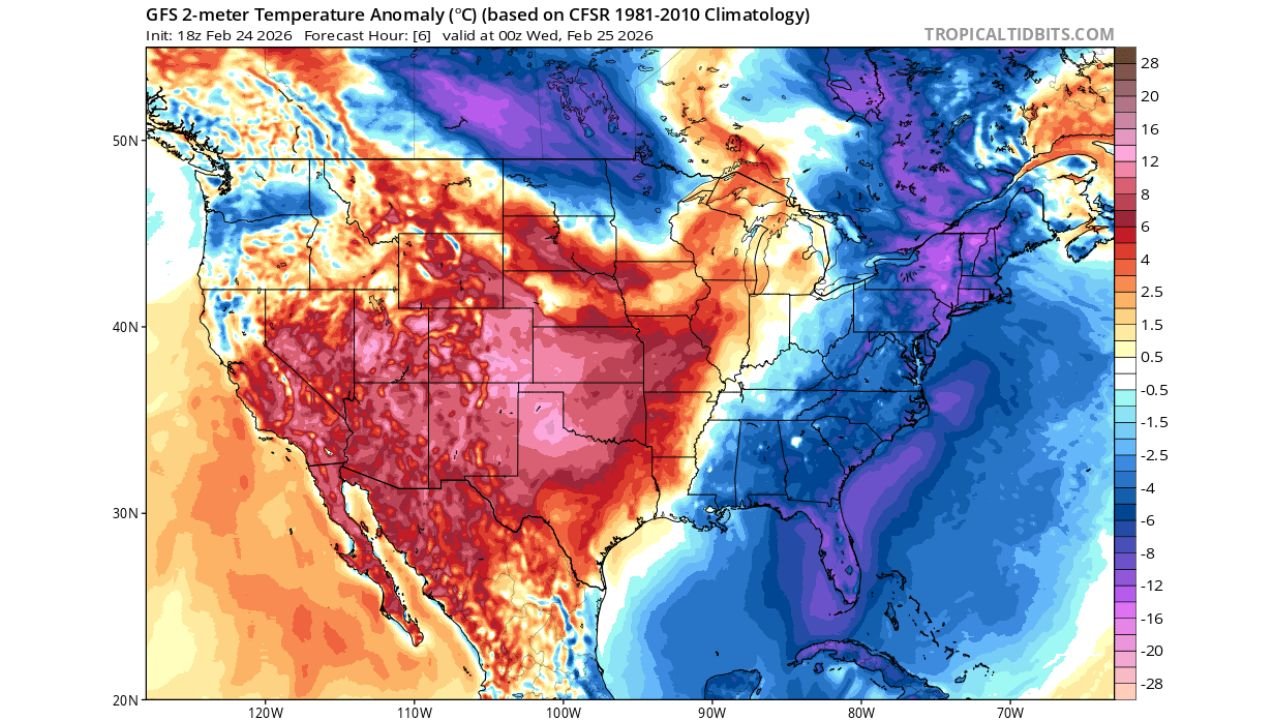
The 2-meter temperature anomaly map valid February 25 highlights the dramatic imbalance.
Deep red and pink shading blankets:
- California
- Nevada
- Arizona
- New Mexico
- Utah
- Colorado
- Texas
These colors indicate temperatures running 10 to 25+ degrees above normal in some areas.
Meanwhile, blues and purples dominate:
- The Northeast
- Parts of the Mid-Atlantic
- Portions of the Southeast
- Sections of the Great Lakes
This confirms a significant west-to-east temperature gradient across the continental United States.
Widespread 90s Expected in California, Arizona and Texas
Forecast guidance suggests that the upcoming days could deliver widespread 90-degree readings across:
- Southern California
- Arizona
- Parts of Texas
Some locations in the desert Southwest could even approach or briefly touch 100 degrees, an extraordinary milestone for meteorological winter.
In California, inland valleys and desert communities are likely to see the most intense warmth. In Arizona, cities such as Phoenix could surge well above seasonal norms. In Texas, especially across southern and western portions of the state, temperatures may climb into territory more typical of late spring.
Eastern U.S. Remains on the Cold Side
While the West and central U.S. bake in anomalous warmth, the East remains comparatively chilly.
The anomaly map shows:
- Below-normal temperatures across New York, Pennsylvania, New England, and parts of the Southeast
- Cooler-than-average air lingering along the Atlantic Coast
This reinforces the amplified ridge over the West and troughing in the East, a pattern that promotes extreme regional contrasts.
Why This Winter Warmth Is So Unusual
February is typically a transitional month, but readings in the 80s and 90s — and especially near 100 degrees — are highly uncommon across much of the western United States.
The combination of:
- Strong upper-level ridging
- Dry air masses
- Persistent sunshine
Has allowed temperatures to surge well beyond seasonal norms.
If forecast projections verify, some of these days could rank among the warmest winter readings on record for portions of California, Arizona, Texas, and Colorado.
What Comes Next
Such intense warmth raises several concerns, including:
- Elevated wildfire risk in dry areas
- Rapid snowmelt in mountain regions
- Increased stress on early-season vegetation
Meanwhile, the persistent East-West divide may continue until the broader atmospheric pattern shifts.
For now, the story is one of extremes: record heat in Colorado, expanding warmth across the Southwest, and lingering chill in the East.
As the forecast evolves, ChicagoMusicGuide.com will continue tracking major temperature milestones, historic anomalies, and developing weather patterns impacting communities across the United States.