California, Oregon, Washington, Nevada, Arizona, Utah, Colorado and New Mexico Just Lived Through the Warmest Winter in Western U.S. History
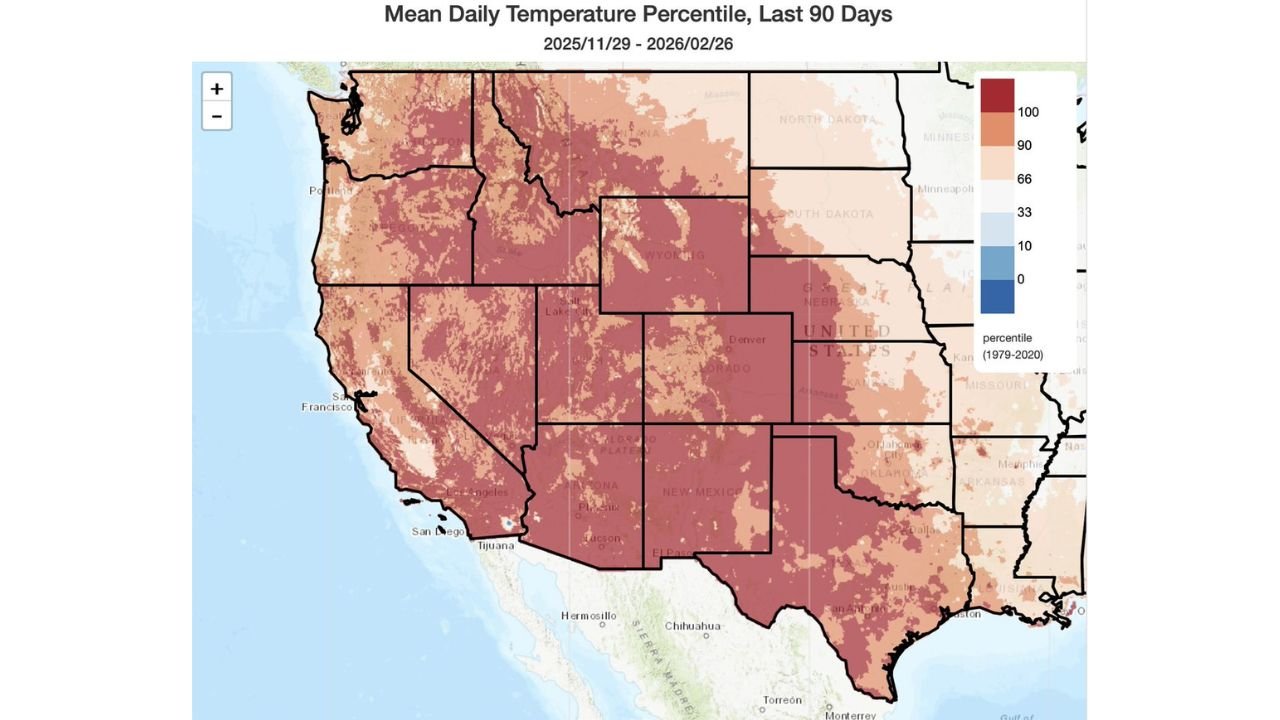
UNITED STATES — Winter 2025–2026 is now poised to go down as the warmest winter ever recorded across the Western United States, based on 90-day temperature percentile data spanning late November through late February.
The numbers are striking: vast portions of the West ranked in the 90th to 100th percentile for mean daily temperatures — meaning this winter was warmer than nearly every comparable winter in the modern climate record.
California to Colorado: Record Warmth Dominates
Temperature percentile maps covering November 29, 2025 through February 26, 2026 show deep red shading across:
- California
- Oregon
- Washington
- Nevada
- Arizona
- Utah
- Colorado
- New Mexico
- Wyoming
- Large portions of Texas
Many of these areas fall within the highest percentile category (near or at 100), indicating record or near-record warmth compared to the 1979–2020 baseline.
In simple terms: this winter was historically warm across nearly the entire Western half of the country.
Rockies and Desert Southwest Hit Hardest
Some of the most extreme anomalies appear across:
- The Rocky Mountains
- The Great Basin
- The Desert Southwest
- The Colorado Plateau
States like Arizona, Nevada and Utah show widespread 95th to 100th percentile readings.
Colorado and Wyoming also display unusually persistent warmth across mountain and plains regions alike.
Pacific Northwest Also Unusually Warm
Even typically cooler regions of:
- Washington
- Oregon
saw sustained above-normal temperatures through much of meteorological winter.
Snowpack concerns have grown in parts of the Cascades and interior mountain ranges as repeated warm episodes limited cold-season accumulation.
Contrast with the Central and Eastern U.S.
While the West experienced record warmth, portions of:
- The Upper Midwest
- The Great Lakes
- The Northeast
saw more mixed results, with some cooler-than-normal periods.
However, those colder intervals were not enough to offset the overwhelming warmth across the Western states when calculating national averages.
Why This Winter Was So Extreme
Persistent upper-level ridging over the West likely played a major role, allowing:
- Repeated warm air intrusions
- Reduced Arctic air penetration
- Fewer prolonged cold outbreaks
This pattern limited sustained winter cold across the western half of the country.
Implications Moving Forward
A winter this warm across:
- California
- Arizona
- Nevada
- Colorado
- Oregon
- Washington
raises important concerns about:
- Snowpack levels
- Spring runoff timing
- Drought risk
- Early wildfire season potential
These impacts will become clearer as spring progresses.
Bottom Line
Winter 2025–2026 will likely be remembered as the warmest winter ever recorded across the Western United States, with widespread 90th–100th percentile temperatures stretching from California to Colorado and from Washington to New Mexico.
Even if parts of the Midwest and Northeast felt cold at times, the West’s extreme warmth dominated the overall seasonal story.
Stay with ChicagoMusicGuide.com for continued seasonal and climate trend coverage as the nation transitions into spring.