Southern Kansas Thunderstorms Show Splitting Supercell Behavior Near Leon, Beaumont, and Douglas as Radar Detects Developing Hail
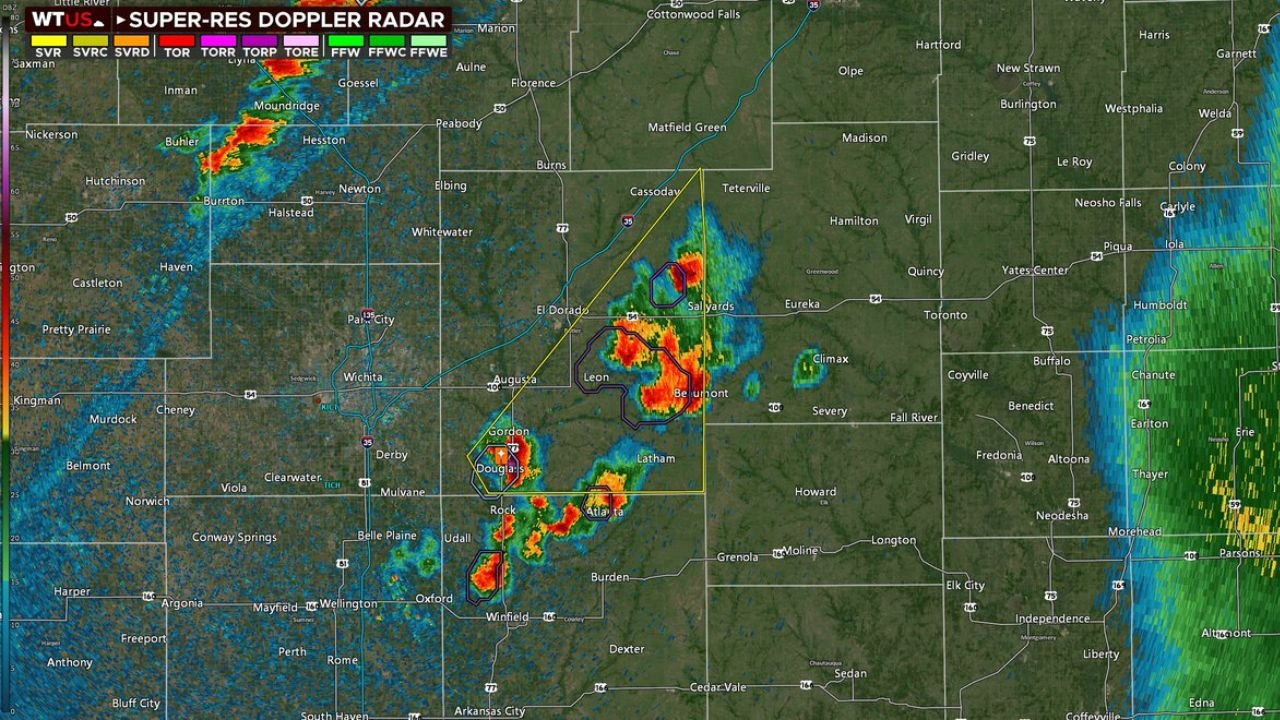
WICHITA, KANSAS — Meteorologists are closely monitoring a developing cluster of thunderstorms across southern Kansas, where radar imagery indicates several storms exhibiting splitting supercell behavior while producing pockets of hail. The storms are currently impacting areas near Leon, Beaumont, Douglas, and Atlanta, located east of Wichita and Augusta, with additional cells extending northward toward Newton, Hesston, and Moundridge.
High-resolution radar analysis shows that while the storms are producing strong reflectivity cores capable of generating hail, they have not yet fully organized into long-lived severe supercells. Meteorologists believe weaker atmospheric ascent and relatively stable surface conditions may be preventing the storms from reaching their full severe potential at this time.
Radar Detects Storm Splitting Across Butler County and Nearby Areas
Latest super-resolution Doppler radar imagery shows multiple storm cells forming and splitting across Butler County and surrounding parts of southern Kansas. This splitting behavior occurs when a thunderstorm divides into two rotating segments, typically moving in slightly different directions.
Storms currently producing the strongest radar signatures are located near Leon and Beaumont, where radar reflectivity suggests intense updrafts capable of supporting hail formation. Additional storms have developed farther south near Douglas and Rock, continuing a broken line of storms stretching southward toward Arkansas City and Oxford.
Meteorologists note that storm splitting often occurs when wind shear in the mid-levels of the atmosphere allows storms to rotate, but not always in a way that produces a dominant supercell. Instead, the storms may briefly intensify before weakening or reorganizing.
Hail Reports Possible as Storms Move East Across Southern Kansas
Radar reflectivity values within the strongest cells suggest hail production is already occurring within the storms, particularly within the red and orange radar cores observed near Beaumont and Leon.
While hail sizes have not been widely confirmed yet, meteorologists say the radar signatures indicate strong enough updrafts to support small to potentially moderate hailstones. Communities in the path of these storms, including Eureka, Climax, and areas east toward Fall River and Toronto, may see additional storms move into the region during the evening.
Storm motion suggests the cluster is gradually shifting east and southeast across Butler County, potentially affecting rural communities across Greenwood County and surrounding areas.
Atmospheric Conditions Limiting Full Storm Organization
Despite the hail-producing cores, meteorologists say the storms appear somewhat disorganized compared to typical severe outbreaks. Forecasters believe this may be due to weaker large-scale lift and modest surface instability, which can prevent thunderstorms from sustaining strong, long-lived rotation.
In environments with stronger atmospheric forcing, storms exhibiting splitting behavior can sometimes evolve into more organized supercells capable of producing large hail, damaging winds, or tornadoes. However, current observations suggest the storms in southern Kansas may remain somewhat transient and scattered, rather than consolidating into a larger severe storm system.
Still, meteorologists emphasize that conditions can change quickly, and storms showing early signs of rotation are being closely monitored.
Residents in Wichita, Augusta, Leon, Beaumont, Douglas, and nearby communities across southern Kansas are encouraged to remain aware of changing weather conditions as thunderstorms continue to develop across the region.
As meteorologists continue tracking the evolution of these southern Kansas thunderstorms, further updates will be issued if storms intensify or expand eastward. For continuing coverage of severe weather developments and atmospheric analysis across the United States, visit ChicagoMusicGuide.com.