Oklahoma, Kansas, Missouri, and Arkansas on Alert as Dual Tornado Zones Could Produce Strong Evening Supercells
UNITED STATES — Meteorologists are closely monitoring two developing tornado risk zones across the central United States, where atmospheric conditions may support rotating supercells and a few potentially strong tornadoes later today and tonight.
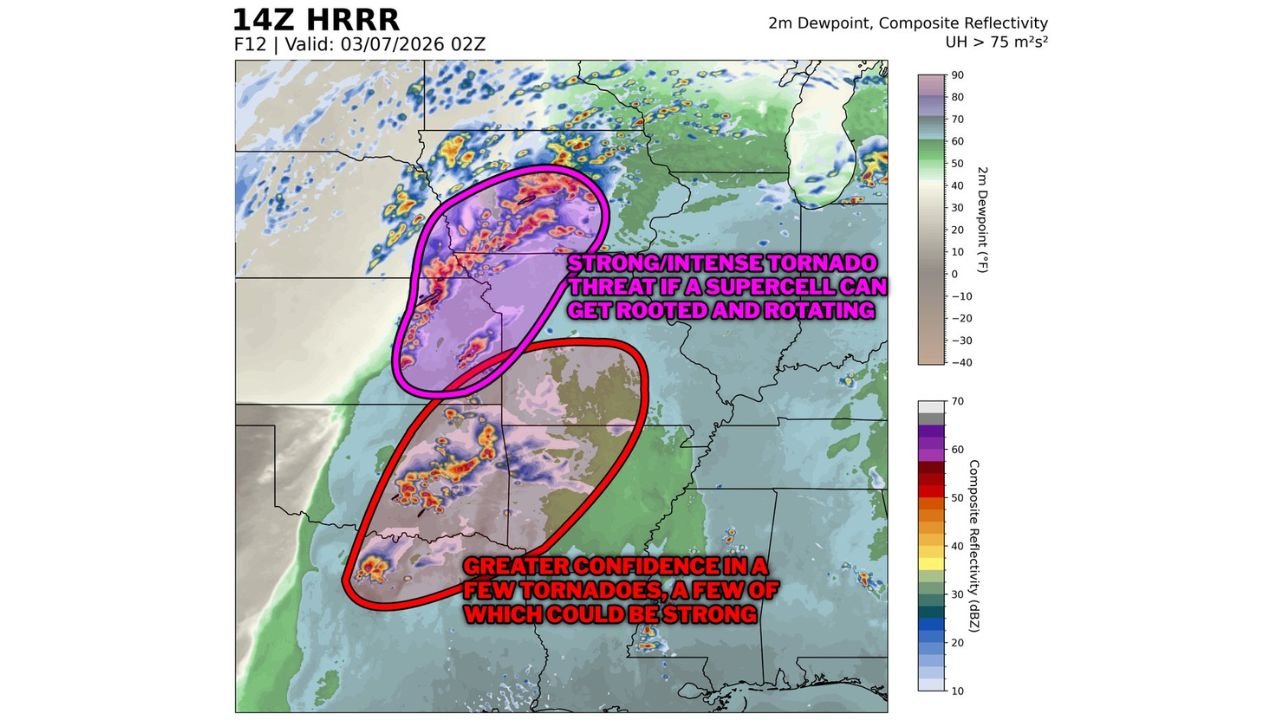
Forecast analysis highlights two key areas of concern stretching across Kansas, Oklahoma, Missouri, and Arkansas, where weather conditions appear favorable for organized thunderstorms capable of producing tornadoes.
Experts say the evolving storm setup may allow storms to develop in two different modes — a northern supercell corridor and a southern tornado zone — each carrying its own risks.
Northern Corridor Could Support Discrete Supercells
The first area of concern stretches across parts of eastern Kansas into western Missouri, where the structure of the developing storm system may allow individual thunderstorms to form ahead of the main cold front.
Meteorologists say the surface low-pressure system driving the storm setup appears somewhat diffuse, which may slow the movement of the associated cold front. While that might seem like a minor detail, it could actually create favorable conditions for storms to develop along small boundaries in the atmosphere.
Even modest lifting along the front may be enough to trigger discrete or semi-discrete supercells, which are individual rotating thunderstorms capable of producing tornadoes.
Upper-level atmospheric support is also expected to increase as the day progresses. The exit region of a strong jet stream at roughly 500 millibars could enhance storm development, while smaller disturbances in the mid-level flow may spark additional thunderstorm formation where surface boundaries intersect.
If storms become rooted in this environment, forecasters say intense tornadoes could be possible in localized areas.
Southern Zone Carries Potential for Several Tornadoes
A second tornado risk zone stretches farther south across central and eastern Oklahoma into parts of Arkansas.
Weather guidance suggests that storms developing in this region during the evening may organize differently compared to the northern corridor. While there is some uncertainty about the exact storm structure, meteorologists say the overall wind shear environment strongly supports tornado potential.
The presence of strong low-level wind shear means that any thunderstorm capable of maintaining rotation could produce tornadoes.
Forecast models indicate that several tornadoes could develop across this southern zone, with a few possibly becoming strong if storms remain organized.
Tornado Risk May Increase After Sunset
Forecasters say the evening and nighttime hours may bring an increased tornado risk, particularly as the atmosphere transitions into a nocturnal storm environment.
As nighttime approaches, strengthening winds just above the ground may encourage storms to become more cyclic, meaning they repeatedly produce rotating updrafts capable of generating multiple tornadoes.
Rather than producing a single long-lived tornado, storms in this environment may create multiple shorter-lived tornadoes in quick succession, which can still pose a serious threat to communities in their path.
Residents Urged to Monitor Conditions Closely
Because storms may develop rapidly and continue into the nighttime hours, meteorologists urge residents across Oklahoma, Kansas, Missouri, and Arkansas to remain alert for severe weather warnings.
Nighttime tornado events can be especially dangerous because storms are harder to see and people are more likely to be indoors or asleep.
Weather experts recommend ensuring that multiple alert methods are available, including weather apps, emergency alerts, or NOAA weather radios.
Meteorologists will continue watching radar trends and atmospheric conditions throughout the day as storms begin forming across the central United States.
Stay with ChicagoMusicGuide.com for continuing updates as this severe weather setup evolves and potential tornado-producing storms begin to develop across the Plains and Midwest.