NASA Map Pinpoints Potential Meteorite Fall Zones Across Klein, Spring and Imperial Oaks After Sonic Boom Over Houston, Texas
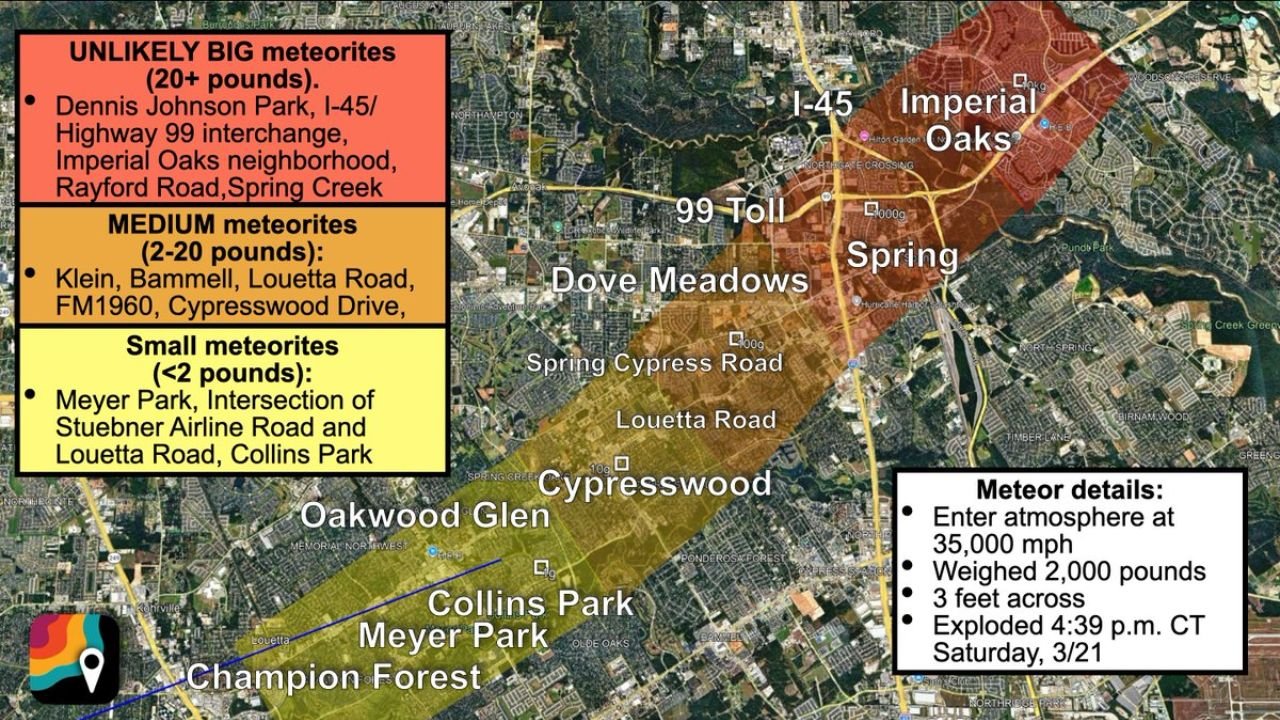
HOUSTON, TEXAS — Meteor hunters across northwest Houston now have a clearer target area after a NASA-backed analysis mapped where meteorite fragments may have landed following Saturday’s dramatic fireball and sonic boom.
The meteor, estimated to be about 3 feet across and weighing roughly 2,000 pounds, entered Earth’s atmosphere at approximately 35,000 mph before exploding overhead at 4:39 p.m. CT on Saturday, March 21. The explosion produced a sonic boom and released energy equivalent to 26 tons of TNT, according to NASA’s Meteoroid Environment Office.
Now, attention is turning to where surviving fragments may have fallen.
Northwest Houston Metro in Focus
The projected debris field lies on the northwest side of the Houston metro area, northwest of George Bush Intercontinental Airport, spanning neighborhoods between Highway 1960 and Highway 99 (Grand Parkway).
Communities highlighted within the potential fall zone include:
- Klein
- Spring
- Imperial Oaks
- Dove Meadows
- Cypresswood
- Oakwood Glen
- Champion Forest
- Collins Park
- Areas along Louetta Road
- Portions near the I-45 and Highway 99 interchange
Officials note that at least one medium-sized meteorite fragment has reportedly been recovered, though it caused property damage.
Fragment Size Estimates by Location
The color-coded map outlines where meteorites of varying sizes could be found:
Unlikely Big Meteorites (20+ pounds)
Potential areas include:
- Dennis Johnson Park
- I-45/Highway 99 interchange
- Imperial Oaks neighborhood
- Rayford Road
- Spring Creek
These darker red areas represent the trajectory where larger fragments could have landed, if any survived intact.
Medium Meteorites (2–20 pounds)
More probable zones include:
- Klein
- Bammel
- Louetta Road corridor
- FM 1960
- Cypresswood Drive
This orange band covers a heavily commercialized and residential corridor, meaning meteorites could potentially be found in yards, parking lots, or wooded patches.
Small Meteorites (Under 2 pounds)
The yellow-shaded region extends toward:
- Meyer Park
- Intersection of Stuebner Airline Road and Louetta Road
- Collins Park
These fragments would likely be much smaller but still scientifically valuable.
What to Look For
Recovered meteorites may:
- Feel unusually heavy for their size
- Be magnetic
- Have a dark, fusion-crusted exterior
Because the projected debris field crosses dense suburban neighborhoods, experts are encouraging residents in the highlighted areas to check yards, rooftops, and open spaces carefully.
A Rare Event Over Urban Texas
Meteor explosions of this scale are uncommon over major metropolitan areas. The combination of a visible fireball, a sonic boom, and a mapped debris field has generated significant interest among both scientists and amateur meteor hunters.
With confirmed recovery reports already surfacing, northwest Houston residents may be uniquely positioned to find pieces of a space rock that entered the atmosphere at tens of thousands of miles per hour just days ago.
For continued coverage of significant atmospheric and space-related events across the United States, stay with ChicagoMusicGuide.com.