More Than 1.4 Million Acres Already Burned in 2026 as Massive Wildfires Explode Across Texas, Oklahoma, Kansas and the South
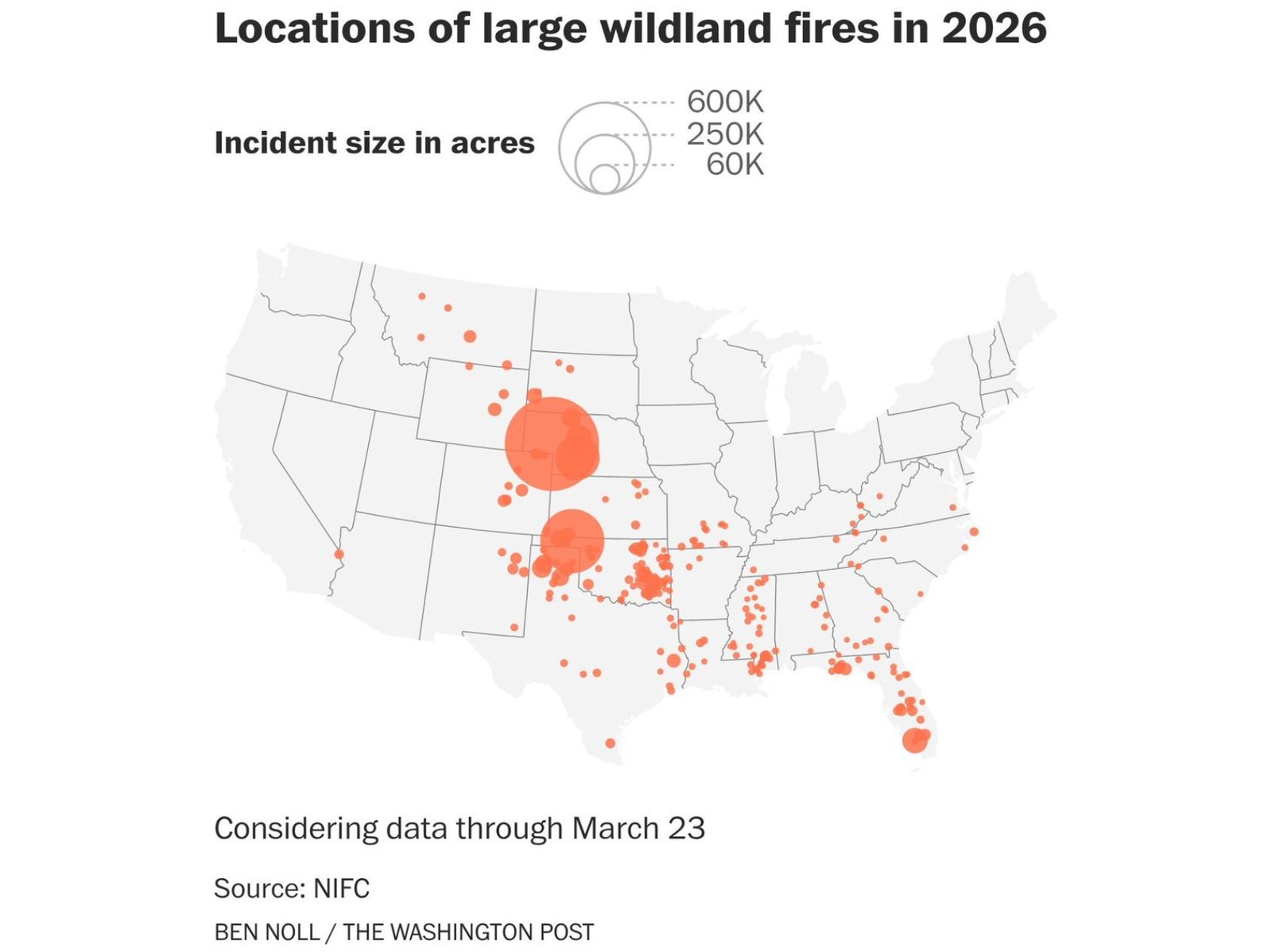
UNITED STATES — The 2026 wildfire season is already off to an alarming start, with more than 1.4 million acres burned nationwide through March 23 — and the bulk of that destruction concentrated across the Plains and the South.
New data mapping the locations of large wildland fires reveals clusters of significant fire activity stretching from Texas and Oklahoma northward into Kansas and portions of the central Plains, along with widespread outbreaks across the Deep South.
Plains and South See the Heaviest Fire Concentration
The geographic distribution of large wildfires shows a pronounced concentration across:
- Texas
- Oklahoma
- Kansas
- Eastern New Mexico
- Portions of Colorado
- The lower Mississippi Valley
- The Southeast, including parts of Alabama, Georgia and Florida
Several of the largest incidents — represented by the biggest circles on the national map — are centered in the central and southern Plains. Some of these fires have grown into massive events measured in the hundreds of thousands of acres.
Meanwhile, dozens of smaller but still significant fires are scattered across the Gulf Coast states and Southeast, underscoring how widespread this early-season activity has become.
Incident Sizes Signal Escalation
The fire map categorizes incidents by acreage, with some of the largest events exceeding 250,000 to 600,000 acres in size.
The presence of multiple large-scale fires so early in the year highlights the intensity of the conditions fueling these outbreaks. Many of the most expansive fires appear across open grassland regions of Texas and Kansas, where wind-driven flames can spread rapidly over dry terrain.
Snowpack Loss Adds to Western Concern
Compounding the threat is a rapidly dwindling snowpack across parts of the West. Hot, dry conditions combined with reduced mountain snow accumulation are increasing concern that fire activity could expand beyond the Plains as summer approaches.
Snowpack plays a crucial role in maintaining soil moisture levels into late spring. When it melts early or remains below average, vegetation can dry out weeks ahead of schedule — creating a longer window for fire ignition and spread.
A Season That’s Just Beginning
While fire activity typically ramps up in late spring and summer, 2026 has already seen a significant early-season burn footprint. The 1.4 million acres burned through late March suggests that conditions are primed for continued activity if heat and wind persist.
With large fire clusters already established across Texas, Oklahoma and Kansas — and scattered outbreaks across the South — emergency officials and meteorologists are watching closely as the calendar moves deeper into spring.
ChicagoMusicGuide.com will continue tracking wildfire trends nationwide as the 2026 season develops.