Oklahoma Heat Records Shattered as Beaver Hits 105°F and Slapout Ties All-Time March High in Historic Temperature Surge
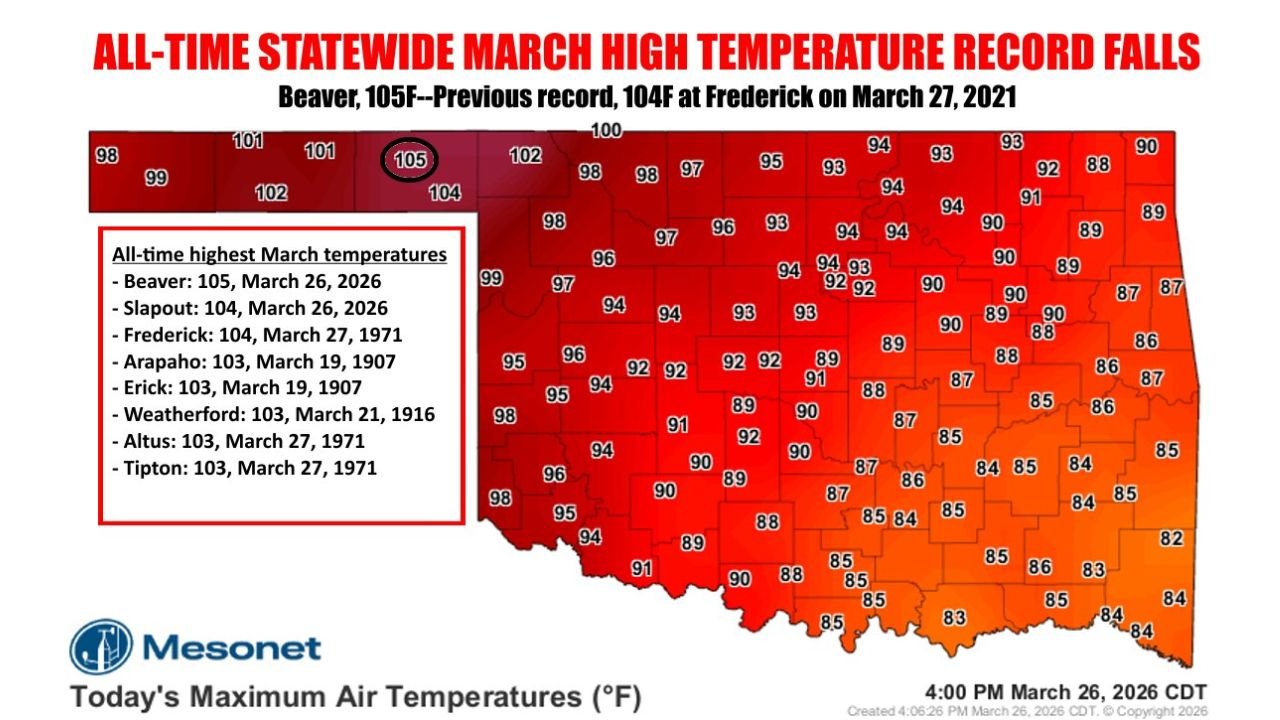
OKLAHOMA — A historic heat surge across Oklahoma has rewritten the record books, as Beaver reached 105°F, breaking the previous all-time statewide March high of 104°F set in Frederick in 1971. At the same time, Slapout recorded 104°F, tying the long-standing record and marking one of the most extreme early-season heat events ever observed in the state.
The unprecedented temperatures highlight an unusually intense warm pattern for late March, with readings more typical of peak summer than early spring.
Beaver Sets New All-Time March Temperature Record
The most notable milestone came from Beaver, Oklahoma, where temperatures soared to 105°F on March 26, officially establishing a new statewide record for the month of March. This breaks a record that had stood for more than five decades, underscoring the magnitude of the heat event.
The previous record of 104°F in Frederick, set on March 27, 1971, had long been considered one of the most extreme March benchmarks in Oklahoma. Surpassing that value places this event among the most significant temperature anomalies in state history.
Such extreme heat this early in the year is rare, as March typically features more moderate conditions before the onset of summer heat.
Slapout Ties Historic Record as Heat Expands Across State
In addition to Beaver’s record-breaking heat, Slapout, Oklahoma reached 104°F, tying the previous all-time March high. This marks a rare occurrence where multiple locations approach or reach historic temperature thresholds during the same event.
The broader temperature map shows widespread 90s across much of Oklahoma, with several areas nearing or exceeding the upper 90s and low 100s, indicating that the extreme heat was not isolated but part of a larger regional pattern.
Other historic March temperature records listed across the state include locations such as Arapaho, Erick, Weatherford, Altus, and Tipton, many of which recorded highs above 103°F in past years, further emphasizing how exceptional this latest event has become.
Widespread Heat Signals Unusual Late March Pattern
The scale of the heat across Oklahoma points to a strong and persistent warm air mass, allowing temperatures to climb well beyond seasonal averages. The presence of widespread 90-degree readings, combined with localized extremes above 100°F, reflects a pattern more commonly seen in late spring or summer.
This type of temperature surge can have widespread impacts, including increased fire risk, early-season heat stress, and strain on infrastructure, especially when it occurs outside of typical warm-season months.
The intensity of the heat also raises questions about whether additional records could be challenged if similar conditions persist.
What This Means for Oklahoma and Surrounding Regions
For residents across Oklahoma, this event serves as a reminder of how quickly weather conditions can shift during the transition from winter to spring. The combination of record-breaking heat and widespread high temperatures highlights the volatility of seasonal patterns.
While temperatures may fluctuate in the coming days, this event will likely stand as one of the most notable March heat events on record, particularly given the new statewide benchmark set in Beaver.
Neighboring regions may also experience elevated temperatures, though Oklahoma remains at the center of this historic heat outbreak.
As extreme weather patterns continue to develop across the United States, staying informed is essential. For more updates on record-breaking temperatures, regional weather trends, and major climate events, visit ChicagoMusicGuide.com.