New York, Pennsylvania, Ohio, and New England Highlighted in Early GFS Projection of a Potentially Massive Christmas Eve Coastal Snowstorm as Atmospheric Signals Support a Late-December Big Storm Pattern
NORTHEAST U.S. — A Pair of Long-Range Model Runs Point to the Possibility of a Major Christmas Eve Snowstorm, but Forecast Confidence Remains Very Low
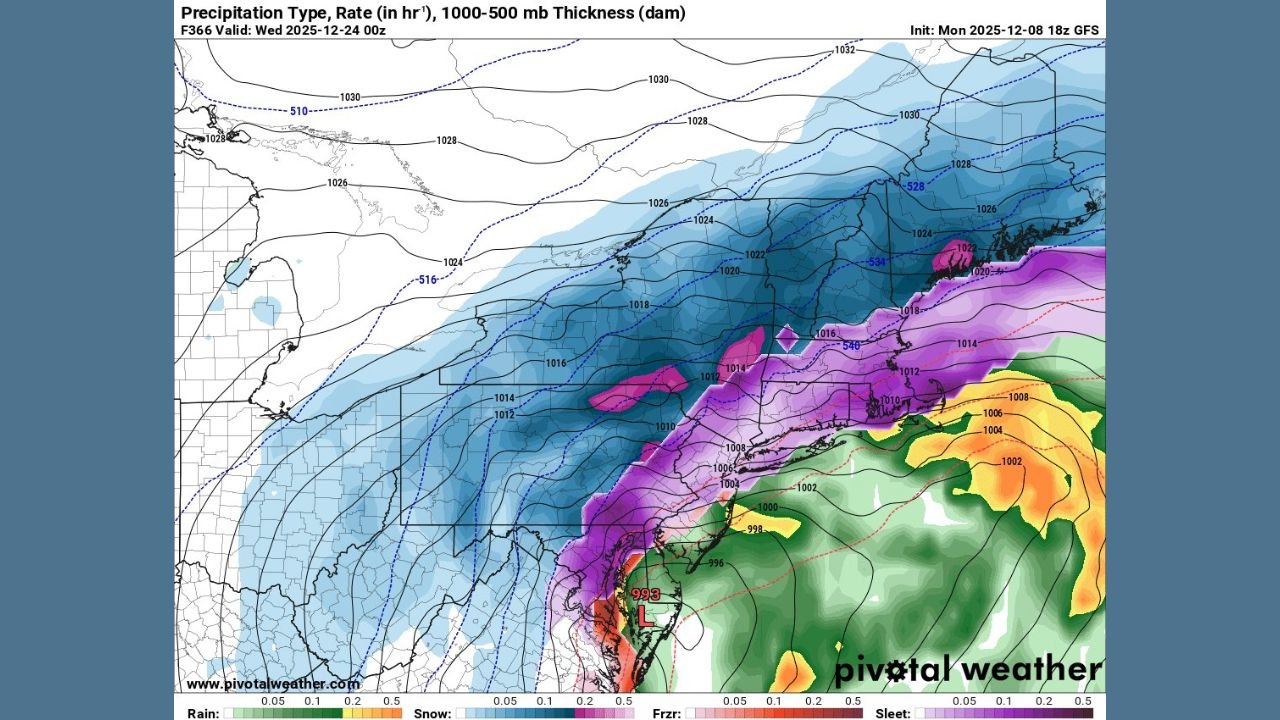
A new sequence of model outputs — particularly the 18z GFS runs — has generated widespread attention this week after depicting a massive, high-impact coastal snowstorm targeting New York, Pennsylvania, Ohio, and large portions of New England on Christmas Eve.
The first run highlighted a tightly wound coastal low producing widespread heavy snow across the region, while the subsequent snowfall projection map showed astonishing totals between 20 and 55 inches, with isolated peaks near or above 60 inches — the type of event that, if real, would become one of the most significant late-December storms in modern history.
But meteorologists stress a critical point:
The likelihood of this exact scenario verifying is extremely small.
Still, the model continues to show an atmospheric environment that could support a major storm sometime in late December or early January.
Why This Model Run Still Matters — Even if It Won’t Verify Exactly
Experts examining the run note that while the map’s exaggerated totals should not be taken literally, the storm track, structure, and timing align with several known winter signals:
- A negative QBO phase
- Ongoing La Niña influences
- A track hugging close to the coastline
- A rapidly deepening low east of the Mid-Atlantic
- A strong high-pressure area feeding cold air into the interior Northeast
This exact pattern was previously highlighted in long-range winter forecasts as the type conducive to major coastal storms, especially from late December through mid-January.
Atmospheric Clues Supporting a Big Storm Window
Meteorologists point to several supporting factors:
1. The SOI (Southern Oscillation Index) Crash
A rapidly tanking SOI is often associated with upcoming significant U.S. winter storms.
The ongoing decline increases the likelihood of a strong synoptic event forming soon — though not necessarily on Christmas Eve.
2. Seasonal Climatology
The period between December 20 and January 15 is historically favorable for large East Coast snowstorms, especially during La Niña winters.
3. Expected Coastal Track Pattern
Long-range research suggests that the favored storm track this season will remain close to the coastline, similar to what the GFS run depicts.
4. Model Behavior Patterns
Meteorologists often note that when the atmosphere supports major storm formation, long-range models sometimes begin hinting at large events — even if the exact solution does not verify.
What the GFS Shows: A Nor’easter-Type System With Widespread Extreme Snowfall
The snowfall map from the latest run presents a truly enormous potential storm footprint:
New York
- Projected totals between 30 and 55 inches across upstate and interior regions
- Widespread heavy snow across the Adirondacks, Catskills, and Finger Lakes
Pennsylvania
- Most of the state sits under 25–45 inches, including central and northern regions
- This would create crippling travel disruptions if verified
Ohio
- Widespread 10–25 inches, with heavier banding toward the east
- Snow amounts drop sharply westward as the storm pulls away
New England (MA, CT, VT, NH, ME)
- One of the hardest-hit areas in the model
- Totals range from 30 to more than 55 inches, depending on elevation and banding
- Coastal areas receive less, but still significant, accumulation
Again — these totals are not a forecast. They reflect a dramatic model representation of a worst-case scenario if atmospheric conditions aligned perfectly.
What Would Happen If a Storm of This Scale Materialized?
Even a scaled-down version of the GFS depiction would cause:
- Major air travel disruptions across NY, NJ, PA, MA, and CT
- Widespread highway closures
- Blizzard-like conditions in inland regions
- Power outages from heavy, wet snow
- Serious complications for holiday travel on December 23–25
If the system tracked slightly offshore, snowfall totals could shift dramatically — either intensifying or diminishing based on the storm’s proximity to the coast.
Why Forecasters Are Not Calling This a Prediction
Meteorologists emphasize:
- This is not a reliable forecast at 384 hours out
- A single model run cannot be used as guidance
- Large storms shown at long range often disappear entirely
- The real value lies in the pattern signal, not the specific solution
Still, the consistency of atmospheric indicators suggests that a significant winter storm during late December or early January is within the realm of possibility, even if this exact Christmas Eve scenario does not occur.
What Residents Should Do Now
Residents across New York, Pennsylvania, Ohio, Massachusetts, Connecticut, Vermont, New Hampshire, and Maine should:
- Monitor forecasts over the next 7–10 days
- Avoid making or canceling Christmas travel plans solely based on early model images
- Pay attention to whether future model runs show consistency
- Prepare for the potential of strong winter storm activity later in the month
Awareness — not alarm — is the appropriate response at this stage.
Stay connected with ChicagoMusicGuide.com for ongoing analysis of late-December storm trends, evolving model signals, and updated Northeast winter weather coverage.