
California, Arizona, Nevada, Utah, Colorado, and Texas Could Shatter All-Time March Records as Expanding 500mb Heat Dome Engulfs the Western and Central United States
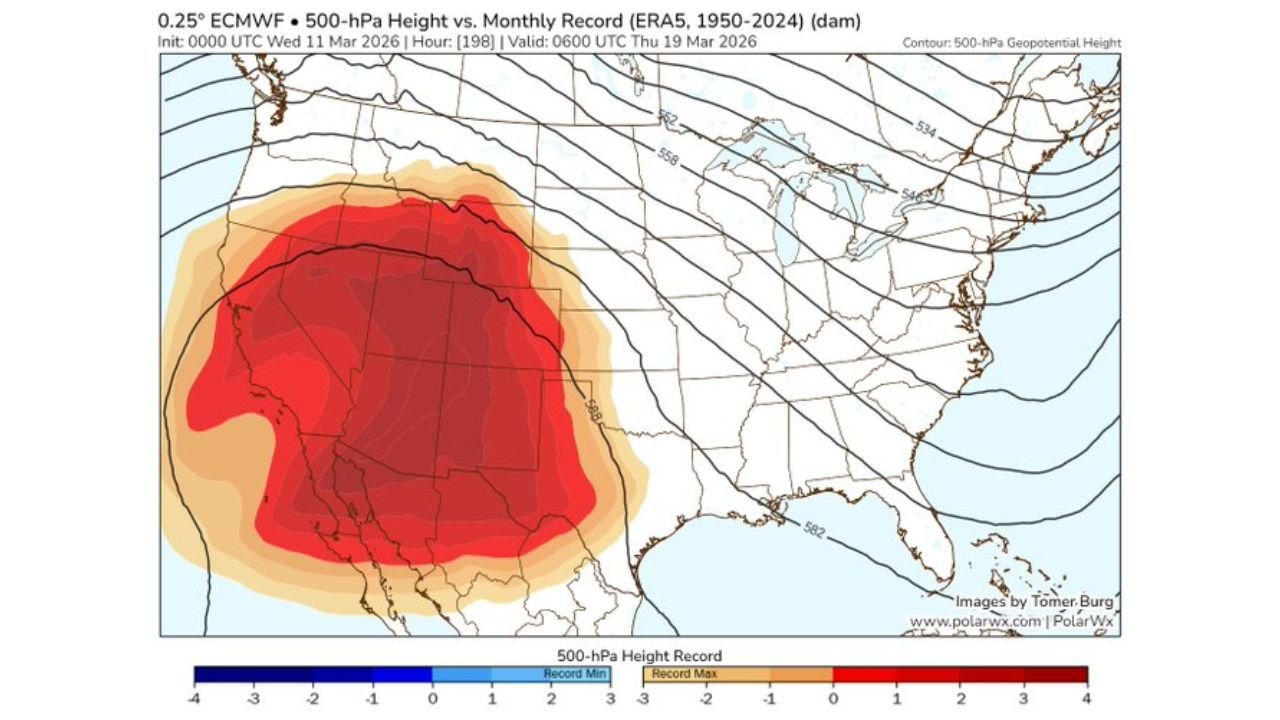
PHOENIX, ARIZONA — A powerful and potentially record-breaking 500mb heat dome is forecast to establish itself over the Western United States beginning late this weekend before expanding eastward through next week, placing multiple states at risk for historic March temperatures. Forecast ensemble guidance shows a deeply amplified ridge centered over California, Arizona, Nevada, Utah, Colorado, and Texas, with atmospheric height anomalies strong enough to challenge or even break all-time March records across a broad region.
Meteorological projections indicate that this ridge may not only intensify but also persist, creating a prolonged period of unusually warm and dry conditions for mid-March.
500mb Ridge Signals Record-Level Atmospheric Heights
Upper-level analysis highlights a pronounced 500mb height anomaly centered over the Desert Southwest and Four Corners region. Deep red shading across Arizona, Nevada, Utah, and southeastern California reflects exceptionally high geopotential heights — a classic marker of a dominant heat dome.
Both ECMWF and GEFS ensemble means depict:
- Strong positive height anomalies over the Southwest
- Expansion eastward into Colorado and Texas
- Suppressed storm tracks across much of the country
One forecast panel comparing projected 500mb heights to historical March records suggests that parts of the Southwest may approach or exceed long-standing upper-level records for this time of year.
When upper-level ridging reaches this magnitude in March, it often translates to widespread surface heat anomalies well above seasonal norms.
Heat Dome Expected to Expand Eastward
Initially centered over California, Arizona, and Nevada, the ridge is forecast to expand into the Central United States, including:
- Utah
- Colorado
- New Mexico
- Texas
- Portions of the Plains and Midwest
This eastward expansion could broaden the footprint of record-challenging warmth.
As the ridge strengthens, northwest flow patterns weaken, effectively blocking Pacific storm systems and cutting off meaningful Gulf moisture transport. The result is likely to be calm, dry, and increasingly warm weather across much of the western half of the country.
Historic March Warmth Possible
Forecasters emphasize that this is not a typical early-spring warm spell. The magnitude of the ridge suggests that some locations could see temperatures rarely observed in March.
In Arizona and southeastern California, desert communities may experience highs more consistent with late spring or early summer. Meanwhile, Utah and Colorado could see temperatures well above average for several consecutive days.
If the ridge maintains its projected strength, certain cities across the Southwest and southern Rockies could approach or break all-time March records, not just daily records.
Dry Pattern Likely to Dominate
With the heat dome in place, precipitation chances across much of the West and central U.S. are expected to diminish significantly. Suppressed Gulf moisture and a weakened storm track mean limited frontal passages and reduced convective activity.
This could lead to:
- Extended dry periods
- Accelerated snowmelt in mountain regions
- Elevated early-season fire weather concerns
While parts of the Eastern United States may see cooler or more unsettled conditions, the Western and Central states remain squarely under the influence of this expanding ridge.
As the pattern unfolds, residents across California, Arizona, Nevada, Utah, Colorado, and Texas should monitor updated forecasts for potential record-setting heat and related advisories.
For continued updates on major atmospheric shifts, record-breaking temperature trends, and evolving weather patterns across the United States, visit ChicagoMusicGuide.com.