
Charlotte, North Carolina’s Winter 2025–26 Ranks Near Severe as Arctic Swings and Snow Push AWSSI Index Higher
CHARLOTTE, NORTH CAROLINA — With just over two and a half weeks left in meteorological winter, the 2025–26 season is shaping up to be one of the more impactful winters in recent memory for the Charlotte region. After dramatic temperature swings, prolonged cold snaps, and stretches of snow and ice, new data from the Accumulated Winter Season Severity Index (AWSSI) shows this winter ranking close to the “Severe” category.
While winter technically runs through February on the meteorological calendar, the data already paints a clear picture: this has not been a quiet season.
AWSSI Index Shows Winter Tracking Near “Severe”
The AWSSI graph for Charlotte, NC (Dec. 1, 2025 – Feb. 10, 2026) shows the current season’s line climbing sharply through January and early February. The latest reading places this winter firmly in the upper tier — hovering near the boundary between Average and Severe, and well above many recent seasons.
The AWSSI measures winter severity based on:
- Intensity and persistence of cold temperatures
- Snowfall totals
- Snow depth and duration
- Ice events
Compared to the last ten seasons, 2025–26 has tracked noticeably higher, especially during the intense cold stretch in January.
January’s Arctic Punch Drove the Spike
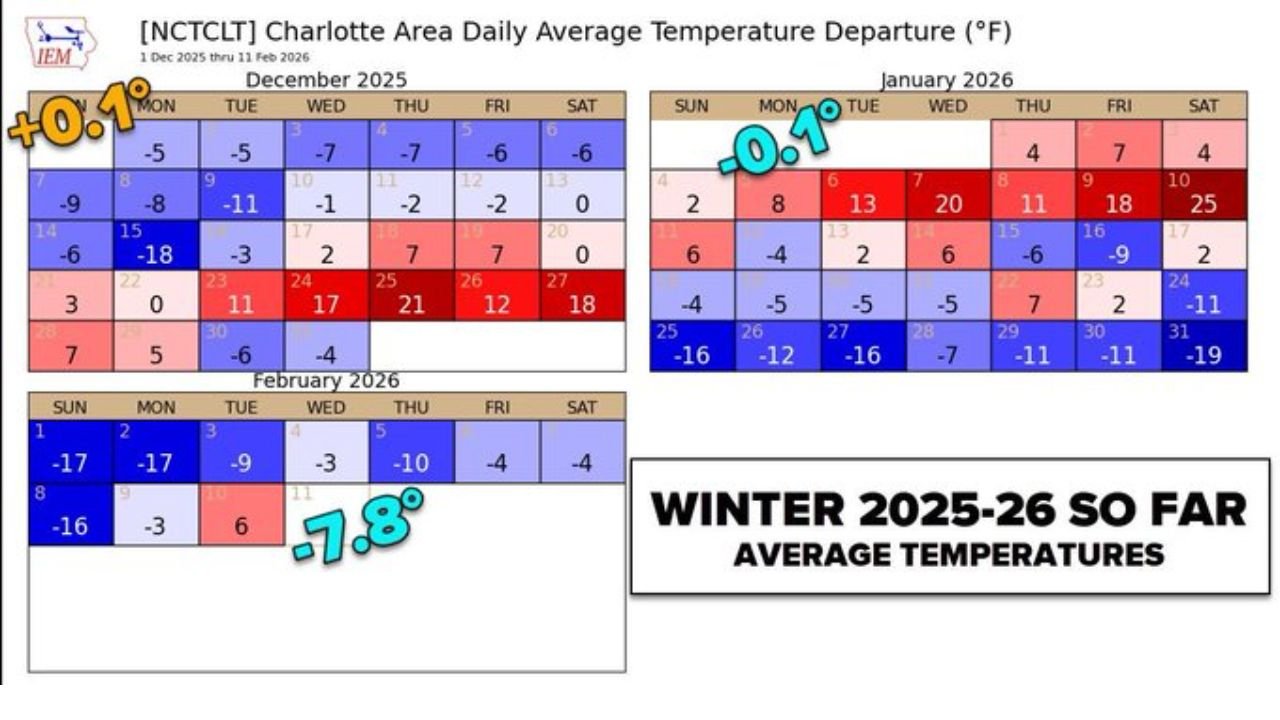
Temperature departure charts for Charlotte reveal dramatic swings:
- December 2025: Averaged close to normal overall, with fluctuations.
- January 2026: Featured multiple days running well below normal, including deep cold periods with double-digit negative departures.
- Early February 2026: Continuing colder-than-average readings, with some days near –7.8°F below normal.
Those sustained cold waves significantly boosted the AWSSI score.
Meteorologists note that severity is not just about a single cold day — it’s about persistence. And this winter delivered repeated cold intrusions that lingered long enough to leave a mark.
Snow, Ice, and Societal Impacts
Beyond numbers, this winter has had real-world consequences across Charlotte and surrounding areas:
- School schedule disruptions
- Travel slowdowns during snow and ice events
- Elevated energy demand during prolonged cold stretches
- Increased strain on infrastructure
The past two weeks alone featured notable cold, snow, and icy conditions that stood out compared to recent milder winters.
When viewed against winters of the late 2010s and early 2020s — many of which fell in the “Mild” to “Moderate” categories — this season represents a significant shift.
Not Extreme — But Certainly Not Mild
While the season has not reached the “Extreme” threshold on the AWSSI scale, it has clearly surpassed the Mild range and climbed into the higher bands.
What stands out most:
- Strong cold persistence in January
- Snow accumulation events
- Repeated temperature swings
- A clear upward trend on the severity graph
The current trajectory suggests this winter will likely finish in the upper-average to near-severe tier, depending on how the final weeks play out.
The Bigger Picture: Winter’s Wild Ride
Winter 2025–26 has been defined by volatility — shifting from mild to sharply cold and back again. That variability is reflected in the daily temperature departure charts, showing sharp blue (below normal) and red (above normal) swings throughout the season.
Compared to recent winters, this year has felt more “classic winter” in terms of:
- Cold persistence
- Snow presence
- Duration of below-freezing periods
Yet, one notable theme has been dryness outside of snow events — rainfall totals have been limited, reinforcing broader dryness concerns across parts of the Carolinas.
Final Stretch Ahead
With just a few weeks left in meteorological winter, additional storms or cold snaps could still influence the final AWSSI ranking. However, even if the remainder of February trends milder, the core severity has already been established.
Charlotte’s Winter 2025–26 will likely be remembered as:
- Colder than many recent seasons
- Marked by meaningful snow and ice
- A winter that briefly reminded the region what sustained cold feels like
For weather watchers, it has been anything but boring.
Stay connected with Chicagomusicguide.com for continuing national weather updates, seasonal outlooks, and climate trend analysis as winter winds down and spring approaches.