
Colorado Cities Including Denver, Boulder, Fort Collins, and Colorado Springs Smash March Heat Records as Western U.S. Endures Widespread Temperature Surge
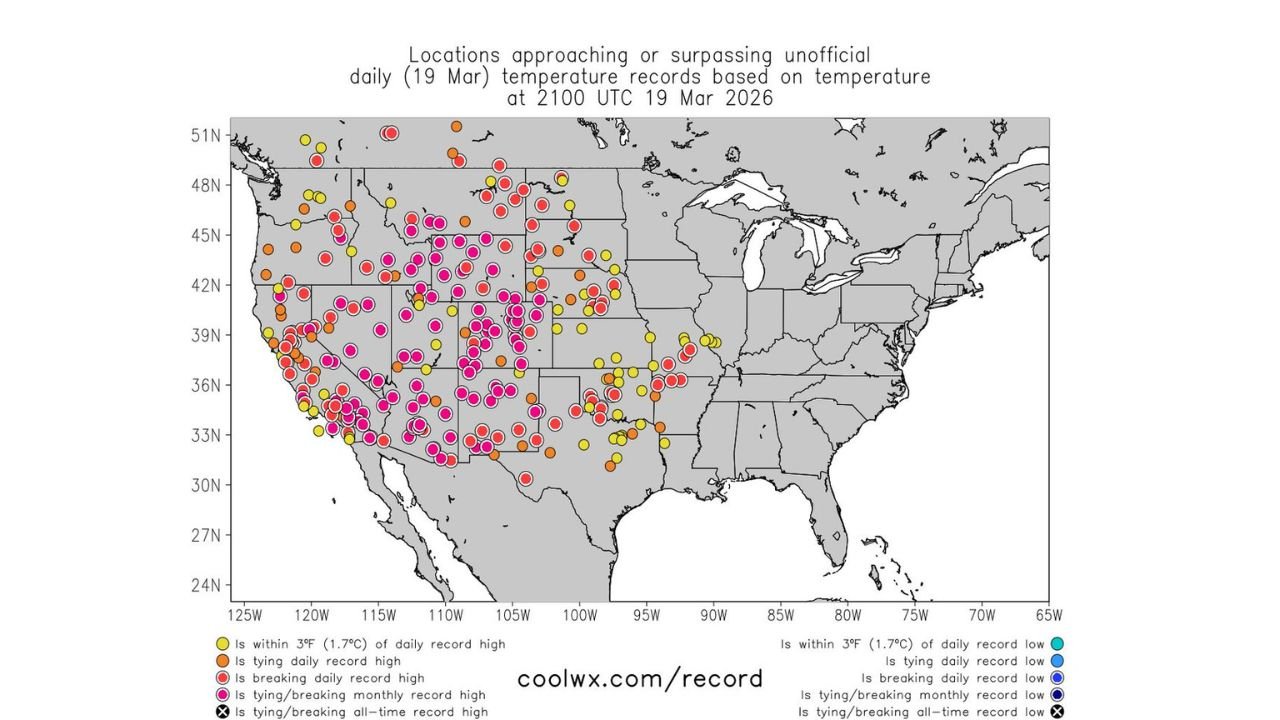
DENVER, COLORADO — Nearly every major city across Colorado is tying or breaking its existing March record high temperatures, as an extraordinary early-season heat surge spreads across the state and much of the Western United States. Cities including Denver, Boulder, Broomfield, Denver International Airport (DIA), Fort Collins, Pueblo, Greeley, Akron, Colorado Springs, Aspen, Leadville, Gunnison, Montrose, and Durango are reporting temperatures at or above long-standing monthly records.
Meteorological data as of March 19, 2026, shows widespread record-challenging heat across Colorado and neighboring Western states. Forecasters warn that the newly established records may not last long, with even hotter readings expected on Friday and Saturday.
Colorado at the Center of Record-Breaking Heat
Temperature analysis maps indicate dozens of locations across Colorado either tying or breaking daily and monthly March records. The density of record markers across the state highlights the breadth of the heat event.
Urban corridors along the Front Range, including Denver, Boulder, Fort Collins, and Colorado Springs, are among the most impacted. However, the heat is not limited to lower elevations. Mountain communities such as Aspen, Leadville, Gunnison, and Durango are also seeing unusually high March temperatures.
The widespread nature of this event suggests a strong and persistent upper-level ridge parked over the region, allowing warm air to dominate the state for multiple consecutive days.
Records Set Thursday Could Be Broken Again
Forecasters caution that Thursday’s “freshly minted” records may be short-lived. Updated projections show even warmer air pushing into Colorado on Friday, with peak heat likely on Saturday.
This means cities that tied or narrowly broke previous records could see those marks shattered again within 24 to 48 hours. Repeated record-breaking in such a short window is unusual for March and underscores the strength of the current heat dome across the West.
The pattern extends beyond Colorado, with record-challenging temperatures observed throughout Utah, Arizona, New Mexico, Nevada, and parts of California, reinforcing that this is a broader Western U.S. heat event rather than a localized spike.
Statewide Impacts from Plains to Mountains
Communities on the eastern plains, including Akron and Greeley, are seeing unseasonably warm and dry conditions. At the same time, central and western slope cities like Montrose and Durango are experiencing temperatures far above seasonal averages.
Even high-elevation locations such as Leadville, typically much cooler in March, are reporting readings that approach or exceed historical benchmarks.
Such widespread warmth increases concerns about early snowmelt, heightened fire weather risk, and dry surface conditions across portions of Colorado. Although this article focuses on record temperatures, the broader implications include potential strain on water resources and elevated wildfire potential as the season progresses.
A March Heatwave That Could Redefine Records
The sheer number of record indicators across the Western United States suggests this heat event ranks among the more notable early-season warm spells in recent memory.
Meteorologists emphasize that March heat can fluctuate quickly, but the current ridge pattern has proven unusually strong and persistent. The fact that records may be broken multiple days in a row — particularly in major population centers like Denver and Colorado Springs — signals a significant departure from typical late-winter conditions.
With additional warming expected through the weekend, the question is not whether more records will fall, but by how much.
As Colorado and the broader Western United States continue to experience this exceptional March heat surge, staying updated on evolving temperature records and regional climate trends remains essential. For continued coverage of major weather events and national climate impacts, visit ChicagoMusicGuide.com.