
Coronal Hole #31 Turns Toward Earth, Triggering Minor G1 Geomagnetic Storm Watch Beginning March 13
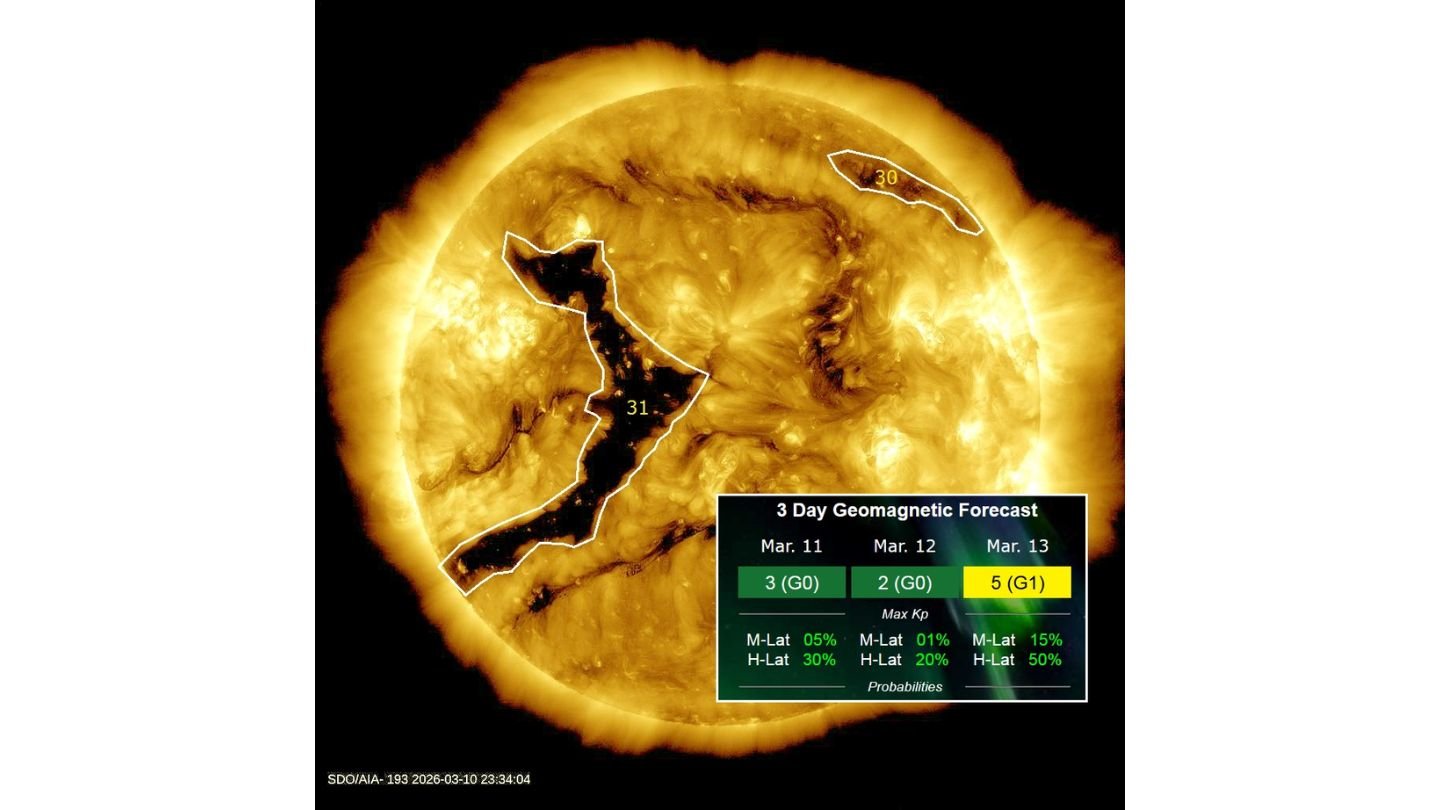
UNITED STATES — A well-established coronal hole identified as #31 has rotated into an Earth-facing position, and forecasters now expect a high-speed solar wind stream to reach our planet beginning Friday, March 13.
As a result, a minor (G1) geomagnetic storm watch has been issued.
Coronal Hole #31 Now Facing Earth
Solar imagery shows Coronal Hole #31 clearly defined on the Sun’s surface — a darker region where magnetic field lines open into space, allowing faster-moving solar wind to escape.
As this region rotates into direct alignment with Earth, that enhanced solar wind stream is forecast to interact with our planet’s magnetosphere later this week.
A second coronal hole, labeled #30, is also visible farther north on the solar disk, but current attention is centered on the larger and more influential #31 region.
3-Day Geomagnetic Forecast Breakdown
The latest 3-day geomagnetic outlook indicates:
- March 11: Quiet conditions (G0)
- March 12: Quiet conditions (G0)
- March 13: Minor storm conditions possible (G1), with a forecast maximum Kp of 5
Probabilities increase on March 13, with:
- 15% chance at mid-latitudes
- 50% chance at high latitudes
This indicates the strongest impacts are expected closer to polar regions, though mid-latitude areas could experience minor disturbances.
What a G1 Storm Means
A G1 geomagnetic storm is classified as minor on the NOAA space weather scale. While not considered severe, it can still produce:
- Weak power grid fluctuations at high latitudes
- Minor satellite orientation impacts
- Increased aurora visibility at higher latitudes
Aurora activity could become more active across northern-tier states if conditions align, though intensity is not expected to reach strong or severe levels.
Why Coronal Holes Matter
Unlike solar flares or coronal mass ejections, coronal holes produce steady streams of high-speed solar wind. When these streams interact with Earth’s magnetic field, they can enhance geomagnetic activity for several days.
Because Coronal Hole #31 appears broad and well-defined, forecasters anticipate a noticeable uptick in geomagnetic conditions once the solar wind stream arrives.
Timing and Outlook
Impacts are expected to begin late Thursday into Friday as the solar wind stream reaches Earth.
While this event is not projected to be strong, it represents another reminder that solar activity remains elevated during the current solar cycle.
ChicagoMusicGuide.com will continue monitoring space weather developments and any potential aurora viewing opportunities as March 13 approaches.