
Explosive Late-February Severe Weather Threat Brewing for Texas, Oklahoma and Kansas as Supercell Signals Spike Across the Plains
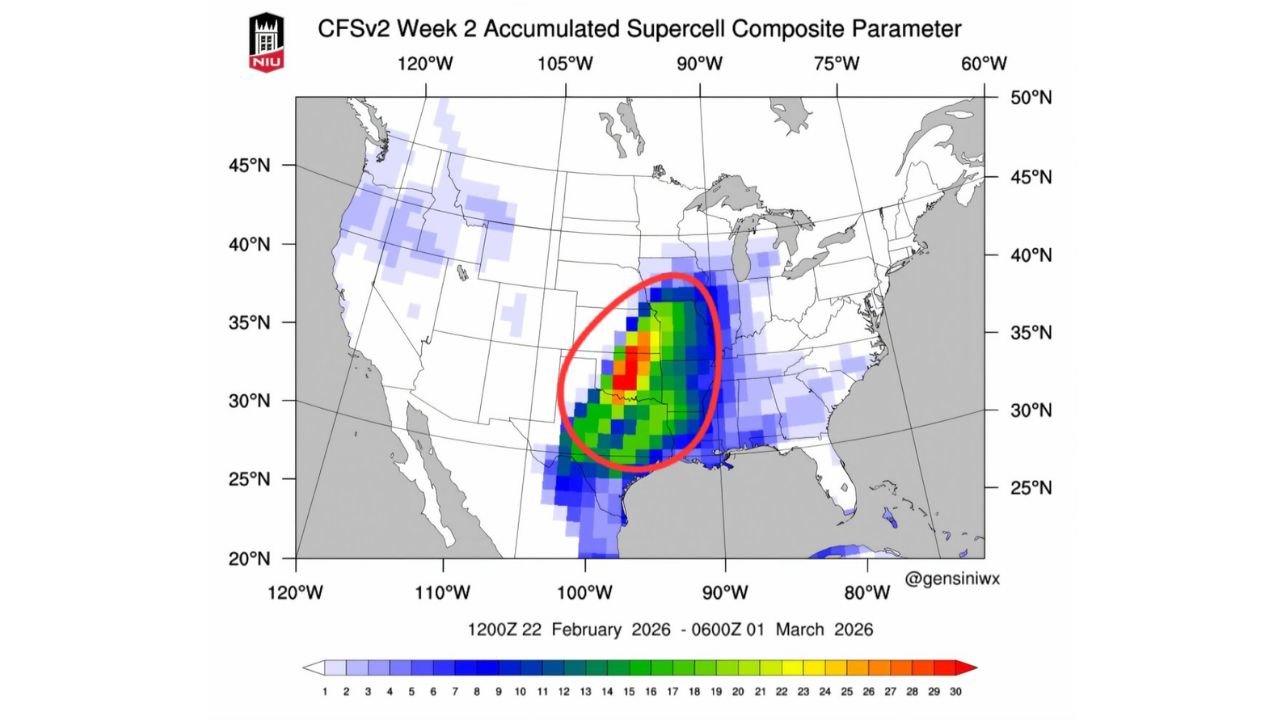
DALLAS, TEXAS — A new long-range weather outlook is signaling a growing severe weather threat across the central United States, with Texas, Oklahoma, and Kansas highlighted as a potential corridor for increased supercell development between February 22 and March 1, 2026. Forecast guidance shows a notable uptick in the Supercell Composite Parameter (SCP) across parts of the southern and central Plains.
Strongest Supercell Signals Focused Over Texas, Oklahoma, and Kansas
The highest values on the latest outlook are concentrated across:
- North-central Texas
- Central and eastern Oklahoma
- Southern and central Kansas
Color gradients on the model show elevated supercell composite values reaching into the upper 20s on the scale, with the most intense core centered roughly along the Red River region and extending northward toward Wichita, Kansas.
These parameters suggest atmospheric ingredients that could support organized severe thunderstorms, including potential supercells capable of large hail, damaging winds, and isolated tornadoes if shorter-range forecasts align.
The red-circled region in the guidance outlines a swath from around the Dallas–Fort Worth area northward into Oklahoma City and toward south-central Kansas, marking the primary zone of concern during this late-February period.
Gulf Moisture and Plains Instability Driving the Pattern
The broader map shows lower but still notable signals stretching eastward toward the Lower Mississippi Valley and parts of the Deep South, though the highest concentration remains across the Plains.
This setup suggests:
- Possible return of Gulf moisture into Texas and Oklahoma
- Increasing instability across the southern Plains
- Favorable wind shear profiles that support rotating storms
Late February is historically a transitional period when winter systems begin interacting with strengthening spring dynamics across the southern Plains. When combined with moisture from the Gulf of Mexico, the result can be early-season severe weather outbreaks.
While this is long-range guidance, multiple model signals are reportedly pointing toward similar trends, adding confidence that the pattern may support at least periodic severe weather episodes in the highlighted corridor.
What This Could Mean for Dallas, Oklahoma City, and Wichita
For communities in Texas, Oklahoma, and Kansas, the February 22 through March 1 timeframe may require heightened weather awareness. Cities including:
- Dallas
- Fort Worth
- Oklahoma City
- Tulsa
- Wichita
could see periods where thunderstorms become organized and potentially severe.
Although exact timing and storm modes will depend on shorter-range forecasts, residents and event organizers should monitor updates as the window approaches.
Even areas just east of the core zone — including parts of Arkansas, Louisiana, and Missouri — show modest signals that could shift depending on how the pattern evolves.
As the late-winter pattern begins transitioning toward spring, this developing setup across Texas, Oklahoma, and Kansas could mark one of the first significant severe weather stretches of the season. For continued updates on storm systems, severe weather outlooks, and regional impacts, visit ChicagoMusicGuide.com.