
Giant Hail Season Is Approaching Fast — NWS Climatology Data Shows the Great Plains From Texas to Kansas Are the Nation’s Most Dangerous Hail Corridor Between March and July
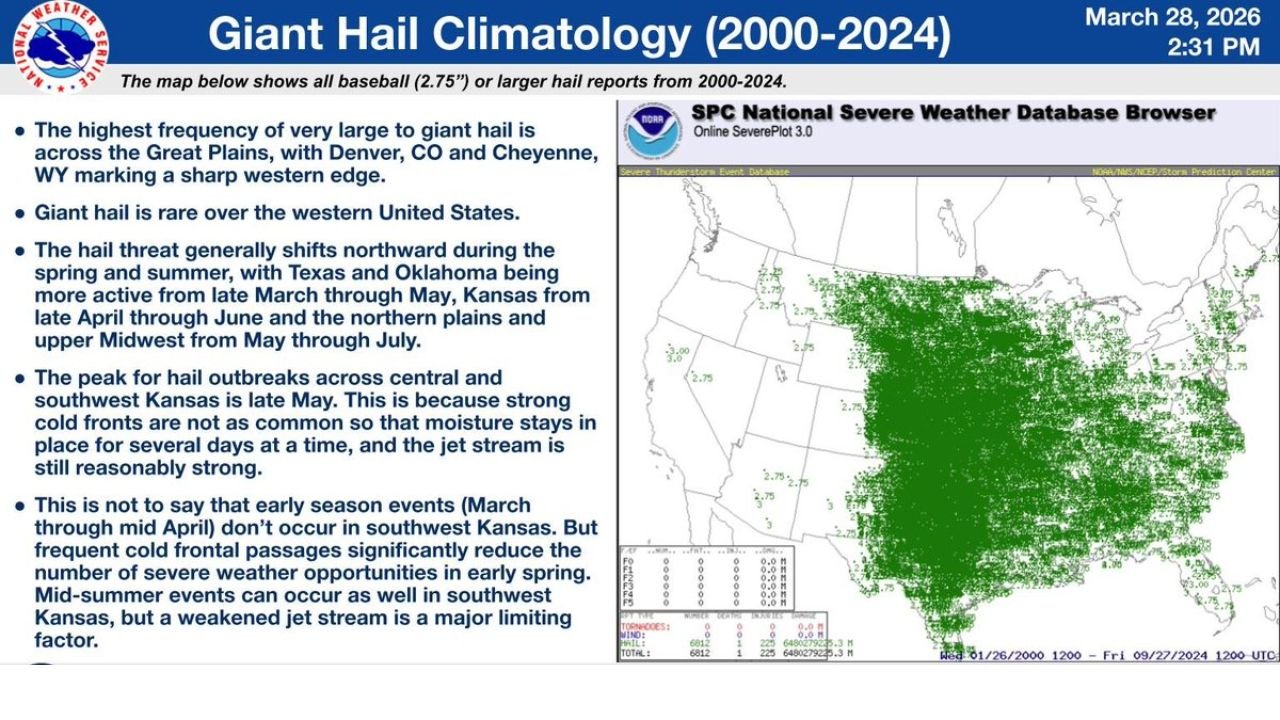
DODGE CITY, KS — Before the first giant hailstone falls this spring, the data already knows where it is most likely to land. The National Weather Service office in Dodge City, Kansas has released a comprehensive Giant Hail Climatology map covering 24 years of reports from 2000 through 2024 — and the picture it paints for residents across the Great Plains is one that demands attention as the severe weather season accelerates. Baseball-sized hail — stones measuring 2.75 inches in diameter or larger — is not a random event. It follows patterns, it follows seasons, and it follows geography. Here is exactly what 24 years of data tells us.
What Counts as Giant Hail — And Why It Matters
Before diving into the numbers, it is important to understand the threshold this map is tracking. Giant hail is defined as any hailstone measuring 2.75 inches or larger in diameter — that is baseball size or bigger. To put that in perspective, a baseball measures 2.86 to 2.94 inches across. At that size and falling at terminal velocity, hailstones cause catastrophic damage to vehicles, roofs, crops, skylights and anyone caught outdoors without shelter.
This is not pea-sized hail that dents your car. This is the kind of hail that punches through windshields, collapses greenhouses and sends people to emergency rooms. The NWS SPC National Severe Weather Database Browser logged 6,512 total reports of giant hail across the country between January 2000 and September 2024 — and the geographic distribution of those reports tells a very specific story.
Where Giant Hail Happens Most: The Great Plains Corridor
The SPC hail climatology map is dominated by a dense green cluster stretching from central Texas northward through Oklahoma, Kansas, Nebraska and into the northern Plains and upper Midwest. The contrast with the rest of the country is striking — the eastern United States shows scattered reports, the western United States is largely empty, and the Great Plains corridor is unmistakably the nation’s giant hail capital.
Key geographic findings from the 2000–2024 dataset:
- Highest frequency zone: The Great Plains — from north Texas through Oklahoma, Kansas, Nebraska and into South Dakota and Minnesota — is the undisputed epicenter of giant hail activity in the United States
- Western boundary: Denver, Colorado and Cheyenne, Wyoming mark a sharp western cutoff. West of this line, giant hail becomes rare almost immediately
- Western U.S.: Giant hail is rare across the entire western United States — the atmospheric setup that produces baseball-sized hail simply does not come together often west of the Rockies
- Eastern U.S.: Scattered reports exist but frequency drops significantly compared to the Plains corridor
The Seasonal Shift: When and Where Giant Hail Peaks
The NWS data reveals a clear and predictable northward migration of the giant hail threat as spring transitions into summer. This is one of the most important patterns in the entire dataset for residents planning ahead.
Giant hail peak windows by region:
- Texas and Oklahoma: Most active from late March through May — the earliest giant hail season in the country. Residents in Dallas, Oklahoma City and Tulsa need to be on alert starting now.
- Kansas: Peak activity runs from late April through June — with central and southwest Kansas reaching peak hail outbreak frequency in late May, the single most active period for giant hail anywhere in the dataset
- Northern Plains and Upper Midwest — Nebraska, South Dakota, Minnesota, Iowa: Most active from May through July — the latest seasonal window in the country
Why late May is the peak for central and southwest Kansas specifically: Strong cold fronts become less frequent by late May, which allows moisture to pool and stay in place for several days at a time. Combined with a jet stream that is still reasonably strong at that point in the season, the result is an atmosphere that can sustain the kind of supercell thunderstorms capable of producing the largest hailstones.
Early Season Risk: March Through Mid-April Is Not Safe Either
One of the most important warnings in the NWS data is this — early season events in March through mid-April do occur in southwest Kansas and the surrounding region. They are less frequent than the late May peak, but they are not rare enough to ignore. The primary limiting factor in early spring is the frequency of cold frontal passages, which repeatedly disrupt storm setups before they can fully organize. But when those frontal passages pause and moisture has time to build — giant hail can fall in March. It has happened before and it will happen again.
Giant Hail Climatology Summary Table
| Region | Peak Season | Frequency | Risk Level |
|---|---|---|---|
| Central & SW Kansas — Dodge City area | Late May | Highest in dataset | 🔴 Extreme |
| Texas — Dallas, Amarillo corridor | Late March – May | Very High | 🔴 Very High |
| Oklahoma — OKC, Tulsa | Late March – May | Very High | 🔴 Very High |
| Nebraska, South Dakota | May – July | High | 🟠 High |
| Upper Midwest — Minnesota, Iowa | May – July | Moderate-High | 🟠 Moderate-High |
| Eastern U.S. | Scattered year-round | Low-Moderate | 🟡 Moderate |
| Western U.S. — West of Denver/Cheyenne | Rare | Very Low | 🟢 Low |
| Forecast Confidence | NWS/SPC 24-year dataset | 6,512 confirmed reports | ✅ High |
State-by-State Giant Hail Risk
🔴 Kansas — Especially Dodge City, Wichita, Liberal corridor — The single highest-frequency giant hail zone in the entire 24-year dataset. Late May is the peak but the season runs from late April through June. If you live here, hail-rated insurance on your vehicle and roof is not optional.
🔴 Texas — Dallas-Fort Worth, Amarillo, Lubbock — Giant hail season opens earlier here than anywhere else in the country. Late March through May is the active window. The season is already beginning right now.
🔴 Oklahoma — Oklahoma City, Tulsa, Lawton — Mirrors Texas in timing and frequency. One of the most active giant hail states in the country. Late March through May demands full attention.
🟠 Nebraska, South Dakota — May through July is the primary window. Northern extension of the Plains hail corridor. Frequency lower than Kansas and Oklahoma but still well above national average.
🟠 Minnesota, Iowa, Wisconsin — Upper Midwest sees its peak from May through July as the hail season migrates northward with the jet stream.
🟡 Colorado — East of Denver — Some giant hail activity east of the Front Range but the western boundary drops off sharply at Denver and Cheyenne. Eastern Colorado counties carry more risk than the mountains or western slope.
🟢 Western U.S. — California, Nevada, Utah, Arizona, Pacific Northwest — Giant hail is rare across this entire region. The atmospheric setup that produces baseball-sized hail almost never comes together west of the Rockies.
Bottom Line: The Season Is Already Starting in Texas and Oklahoma
The 24-year NWS climatology record is clear — giant hail season in the southern Plains is not a May event. It is a late March event. For Texas and Oklahoma residents, the peak window has already opened. For Kansas, it is weeks away. For the northern Plains and upper Midwest, the clock is ticking toward a May through July window that historically produces some of the most damaging hail outbreaks in the country.
Now is the time to check your homeowner’s policy, review your vehicle coverage and make sure you know where to shelter when the next supercell fires over the Plains.
Data Sources: NWS Dodge City, KS — Giant Hail Climatology Map, March 28, 2026 | SPC National Severe Weather Database Browser — Online SeverePlot 3.0 | NOAA/NWS/NCEP Storm Prediction Center | Period of Record: January 26, 2000 – September 27, 2024 | Total Reports: 6,512
Giant Hail Season Is Here — Don’t Get Caught Unprepared
More giant hail outbreaks are always on the horizon across the Plains. Stay informed at ChicagoMusicGuide.com — your source for breaking severe weather coverage, hail climatology data and storm alerts across Kansas, Texas, Oklahoma and the entire United States.