
Historic Arctic Cold Front Pushes Temperatures to Freezing at Sea Level in Cuba, Setting Rare Tropical Record in Matanzas Province
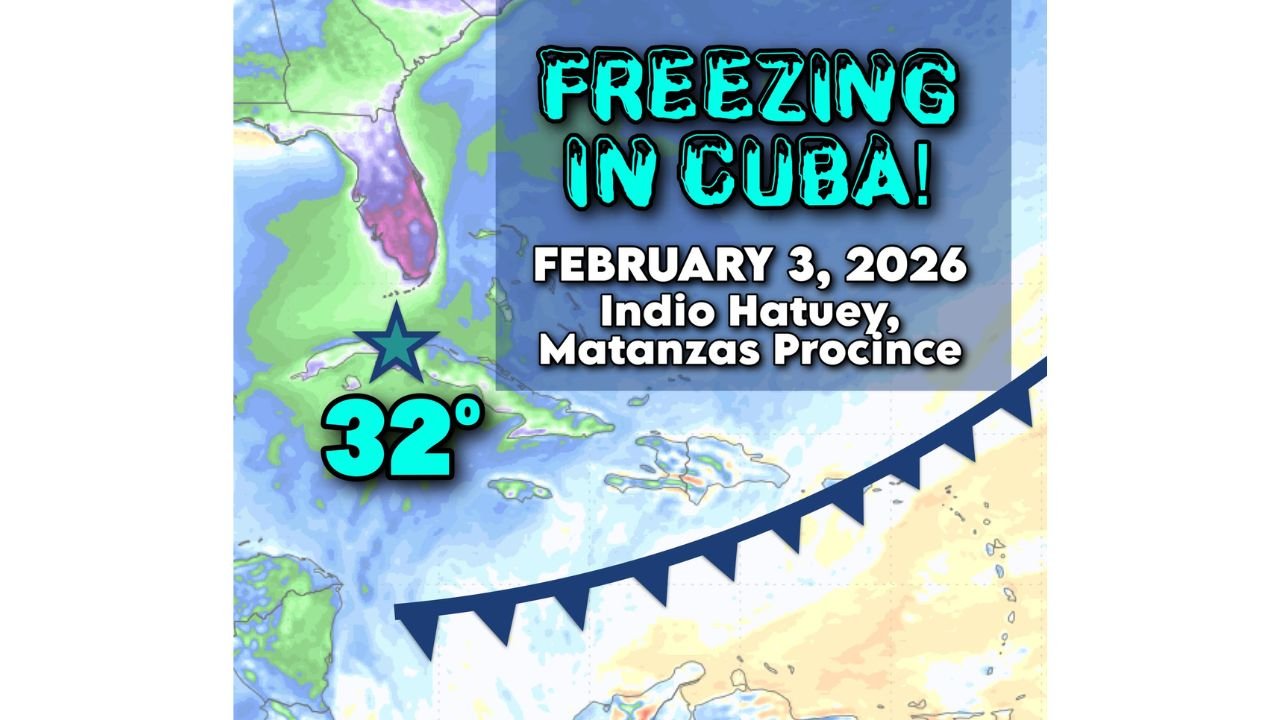
CUBA — The same powerful cold front that brought flurries as far south as the Tampa Bay region pushed deep into the Caribbean on Tuesday, triggering a historic cold weather milestone in Cuba. For the first time on record, a freezing temperature was officially observed at a Cuban weather station located near sea level, underscoring the unusual strength of this Arctic outbreak.
According to meteorological data, the freezing mark was logged on February 3, 2026, at the Indio Hatuey weather station in Matanzas Province, where the temperature dropped to 32 degrees Fahrenheit. The station sits at the Indio Hatuey Pasture and Forage Research Institute, less than 100 feet above sea level, making the event exceptionally rare for a tropical location.
Why This Freeze Stands Out in the Tropics
While freezing temperatures are not unheard of in Cuba’s mountainous regions during winter, this event is fundamentally different due to its location. Near-sea-level freezing temperatures at 22 degrees north latitude, surrounded by the warming influence of the Caribbean Sea, are extremely uncommon.
Meteorologists note that tropical coastlines are typically protected from freezes by warm ocean waters. In this case, however, an unusually strong Arctic air mass surged far enough south to overcome that buffer, allowing temperatures to fall to levels rarely seen outside higher elevations.
Previous Record and Historical Context
Before this event, the coldest temperature previously recorded in Cuba was 33 degrees, observed on February 18, 1996, in Bainoa, Mayabeque Province. Tuesday’s freeze therefore represents a new national benchmark for low temperatures at monitored locations.
It is also worth noting that Cuba expanded its network of official weather stations during the 1990s, meaning some locations do not have extremely long periods of record. Even with that context in mind, meteorologists say this event remains highly noteworthy due to both the latitude and elevation of the station involved.
Cold Front’s Broader Caribbean Reach
The cold front responsible for the Cuban freeze also impacted Jamaica and Puerto Rico, reinforcing how unusually far south the Arctic air penetrated. This same system earlier produced record cold mornings across Florida, linking the Caribbean event directly to a broader hemispheric cold pattern.
What This Means Going Forward
While temperatures in Cuba are expected to rebound as the Arctic air mass weakens, the event will likely be studied closely by climatologists as one of the most extreme cold intrusions into the tropics in recent decades.
Such events remain rare, but they highlight how powerful winter patterns in North America can occasionally override typical tropical safeguards, even reaching locations normally immune to freezing temperatures.
Stay tuned to ChicagoMusicGuide.com for continued coverage of extreme and unusual weather events impacting the United States and beyond.