
Illinois, Indiana, Ohio Under Enhanced Severe Weather Risk as Chicago Region Faces Large Hail, Damaging Winds, and Possible Tornadoes Thursday
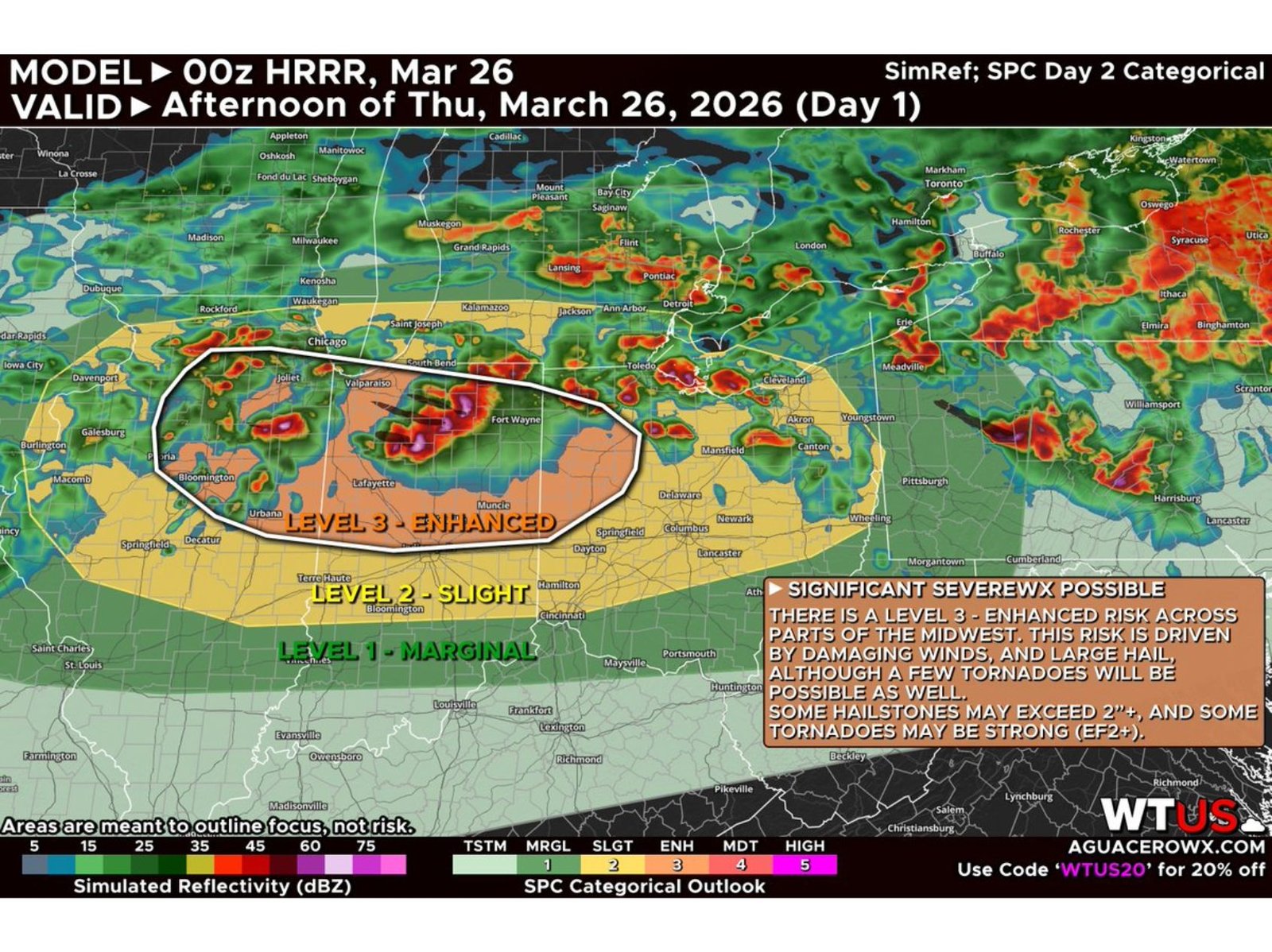
ILLINOIS — A significant severe weather event is expected to unfold Thursday across parts of Illinois, Indiana, and Ohio, with the Chicago region positioned near the northern edge of an enhanced (Level 3) risk area. The primary threats include damaging winds and large hail, though a tornado threat may also develop under the right conditions.
Storms are expected to develop during the afternoon and intensify into the evening, with impacts potentially spreading across multiple Midwest states.
Storm Development May Be Delayed but Could Intensify Quickly
Forecast data indicates that capping in the atmosphere may limit storm development through much of the daytime across the warm sector, delaying widespread activity. However, a strong disturbance aloft, particularly around the 700mb level, is expected to help initiate storms later in the day.
This means that while storms may not form early, they could develop rapidly during the afternoon, especially along and north of the cold front stretching across Illinois and Indiana. Once storms break through the cap, conditions may support quick intensification, increasing the risk of severe weather.
Areas near Chicago, Joliet, Rockford, and into northern Indiana will be closely watched as storm initiation begins.
Large Hail and Damaging Winds Lead Main Threats
Many of the storms are expected to track along the cool side of the cold front, where the environment favors large hail production. Some hailstones could exceed 2 inches in diameter, posing a significant risk to vehicles, rooftops, and outdoor property.
As storms evolve, especially toward the evening hours, they may begin to cluster or organize into lines, shifting the primary threat toward damaging winds. This transition could expand the impact zone, affecting cities such as Fort Wayne, Indianapolis, Columbus, and surrounding communities.
The combination of large hail early and strong winds later makes this a multi-phase severe weather event across the Midwest.
Tornado Threat Conditional but Potentially Significant
While the tornado threat is not expected to be widespread, it remains a conditional but important concern. If a few storms are able to move into the warm, unstable air ahead of the front or develop independently before the main line forms, they could become surface-based and capable of producing tornadoes.
In such scenarios, there is potential for strong tornadoes, particularly in localized areas where conditions align most effectively. However, if storms remain elevated or struggle to break through the cap, the tornado risk will remain limited.
This uncertainty means that all severe hazards remain possible, even if the primary focus is on hail and wind.
Evening Storms May Persist Before Gradual Weakening
As the system progresses into the evening and nighttime hours, storms may begin to cluster together, maintaining a threat for damaging winds and heavy rainfall. The severe threat is expected to gradually diminish a few hours after dark as instability decreases and the atmospheric cap begins to rebuild.
However, some strong storms could persist across parts of Illinois, Indiana, and Ohio, especially in areas where storm organization remains intact.
For the Chicago region, impacts will depend on storm timing and development, but residents should be prepared for changing conditions during the late afternoon and evening hours.
What This Means for the Midwest Region
This setup highlights a classic Midwest severe weather pattern, where multiple factors—including capping, frontal boundaries, and upper-level energy—combine to create a conditional but potentially impactful severe weather event.
Residents across Illinois, Indiana, and Ohio should remain alert for rapid storm development, shifting hazards, and evolving forecasts, particularly during the peak hours of the afternoon and evening.
As severe weather develops across the Midwest, staying informed will be critical for communities from Chicago, Illinois to Indiana and Ohio. For ongoing updates on storm threats, severe weather alerts, and regional forecasts, visit ChicagoMusicGuide.com.