
Illinois, Iowa, Wisconsin, Indiana, Ohio, and Missouri Shift Toward Wetter Outlook as NMME Flips May–July Forecast From Dry to Wet
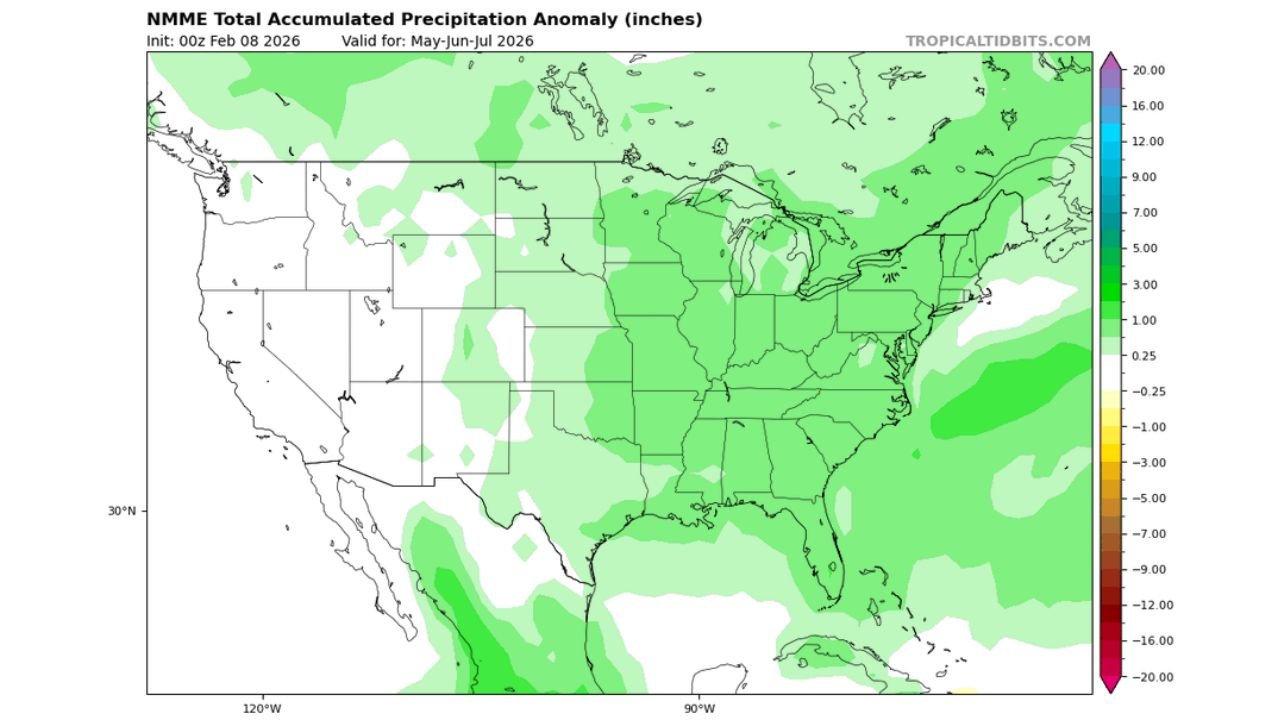
UNITED STATES — A major shift has emerged in the latest seasonal precipitation outlook, as the February run of the North American Multi-Model Ensemble (NMME) dramatically reverses its earlier dry forecast for May, June, and July across large portions of the Midwest and central United States. Regions that were previously projected to trend drier than normal — including Illinois, Iowa, Wisconsin, Indiana, Ohio, and Missouri — are now shown with a much stronger signal for above-average rainfall heading into early summer.
The change highlights both the evolving nature of long-range forecasting and the importance of monitoring model trends rather than relying on a single seasonal snapshot.
January Forecast Showed Broad Dry Risk Across The Midwest
The January NMME run depicted a concerning pattern for the heart of the country. Much of the central Plains and Midwest, including Illinois, Iowa, Missouri, Indiana, and Ohio, were shaded in near-normal to below-normal precipitation, with pockets leaning drier — a troubling sign given existing soil moisture concerns.
In that earlier outlook, wetter anomalies were largely confined to parts of the Southeast and coastal regions, leaving the agricultural core of the country vulnerable to a dry start to the growing season.
At the time, forecasters cautioned that the signal looked overly dry, especially given background climate drivers.
February NMME Run Reverses Course With Widespread Wet Signal
The February update, however, tells a very different story. The new NMME guidance now paints most of the Midwest and Great Lakes region in green, signaling above-average precipitation for the May–June–July period.
States showing the clearest positive shift include Illinois, Iowa, Wisconsin, Indiana, Ohio, Missouri, and Michigan, with wetter-than-normal anomalies expanding eastward into parts of the Ohio Valley and Mid-Atlantic.
This is a near 180-degree flip from the January forecast and suggests a more active storm track setting up across the central and eastern U.S. as summer approaches.
What Changed In The Seasonal Outlook
Seasonal models are heavily influenced by large-scale climate patterns, including El Niño, ocean temperature trends, and atmospheric circulation changes. As newer data was incorporated into the February run, the models adjusted toward a more moisture-rich pattern, especially across the interior U.S.
While seasonal guidance is never a lock, forecasters often look for consistency across multiple runs. This abrupt shift does not guarantee a wet summer, but it does strongly suggest that the earlier dry risk was likely overstated.
As meteorologists often note, seasonal models are best used for trend detection, not precise outcomes — and the trend is now clearly wetter.
Why This Matters For Agriculture And Water Concerns
For farmers and water managers across Illinois, Iowa, Indiana, Missouri, Ohio, and Wisconsin, the updated outlook is a notable change. A wetter May–July period would help offset lingering long-term precipitation deficits, improve soil moisture, and reduce early-season drought stress for corn and soybean crops.
It also aligns more favorably with ongoing concerns raised earlier this winter about dryness persisting into the warm season.
That said, forecasters caution that too much rain can bring its own challenges, including delayed planting and flooding — reinforcing the need to track shorter-range forecasts as spring approaches.
A Reminder On Seasonal Forecasts
The sharp contrast between January and February underscores an important reality: seasonal forecasting is not deterministic. While far from perfect, these models still offer valuable insight when viewed collectively and updated regularly.
As one forecaster put it, there is “always something to glean from them” — especially when the signal changes this dramatically.
As confidence slowly builds heading into spring, weather watchers across Illinois, Iowa, Wisconsin, Indiana, Ohio, and Missouri will be watching closely to see if this wetter trend holds. For continued updates on long-range forecasts, Midwest weather trends, and how evolving climate patterns may impact events and daily life, visit ChicagoMusicGuide.com for the latest coverage.