
Late December Temperature Outlook Shows Colder Conditions for Minnesota, Wisconsin, Michigan, and New York While Texas and Southern States Trend Warmer Into January 2026
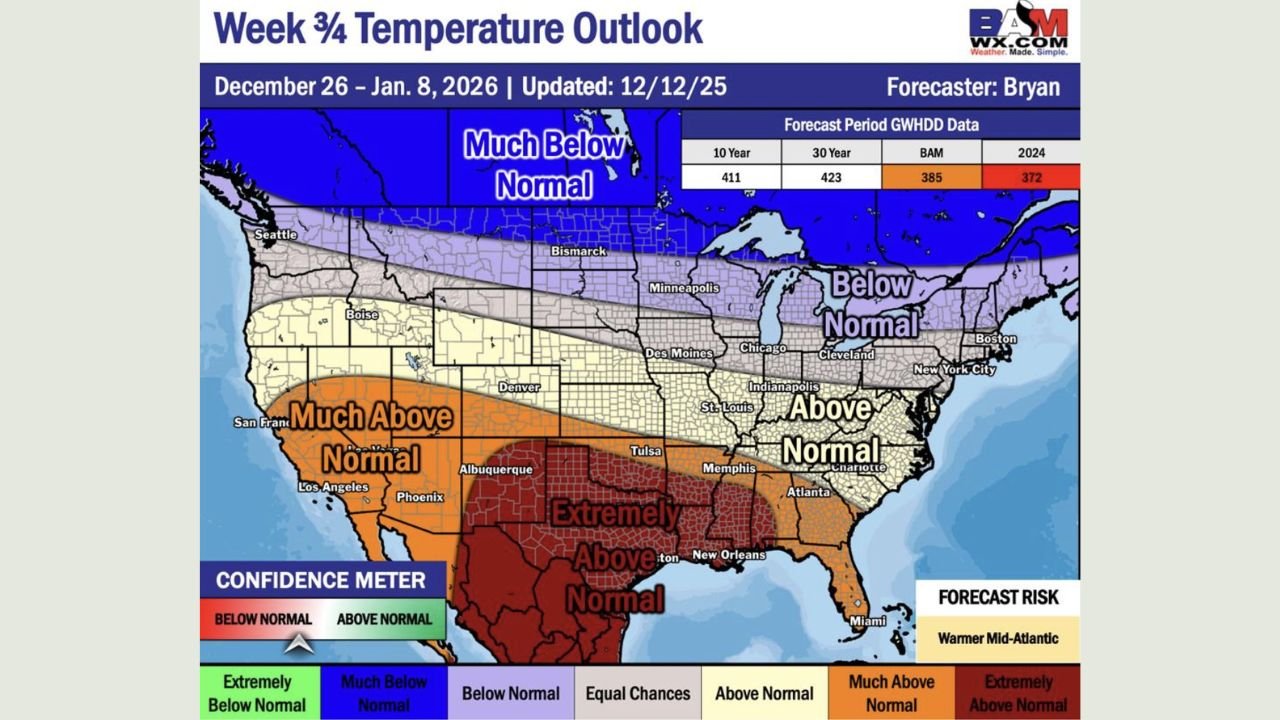
UNITED STATES — A newly released late December to early January temperature outlook highlights a clear state-by-state divide across the United States, with colder-than-normal conditions favored in northern states such as Minnesota, Wisconsin, Michigan, and New York, while above- to much-above-normal temperatures are increasingly likely across Texas and much of the southern United States as January 2026 begins. Forecasters note that the 16–30 day outlook period has been challenging to forecast, but confidence is improving that this state-level pattern will largely verify.
The latest guidance suggests that while some short-term temperature swings are still possible, the overall trend by state is becoming clearer heading into the final days of December.
Colder Outlook for Minnesota, Wisconsin, Michigan, and New York
Temperature outlook maps show below to much-below normal conditions favored across Minnesota, Wisconsin, Michigan, and New York through the end of December and into early January. These states are positioned beneath a colder jet stream pattern that supports repeated intrusions of colder air.
In Minnesota and Wisconsin, the cold signal is strongest, with extended periods likely running below seasonal averages. Michigan, particularly northern and interior sections of the state, is also expected to remain colder than normal, supporting ongoing winter weather potential. In New York, especially upstate areas, temperatures are forecast to trend below normal, increasing the likelihood of continued wintry conditions.
Forecasters caution that while day-to-day fluctuations will occur, these states are expected to spend more days colder than average than warmer during the outlook window.
Mixed Signals for Pennsylvania, Maryland, Virginia, and New Jersey
The Mid-Atlantic states, including Pennsylvania, Maryland, Virginia, and New Jersey, remain the most uncertain portion of the forecast. Outlook guidance shows these states near the boundary between colder northern air and warmer southern influences.
This setup increases the risk of frequent temperature swings, where brief warm-ups may be followed by sharp cool-downs. Because of this variability, forecasters say confidence is lower for a consistent temperature trend in these states compared to areas farther north or south.
Warmer Pattern Develops Across Texas and the Southern States
In contrast, Texas is expected to experience a much warmer-than-normal pattern heading into January 2026. Forecast guidance shows persistent warmth expanding across much of the state, particularly central and southern Texas.
Beyond Texas, Oklahoma, Arkansas, Louisiana, Mississippi, Alabama, Georgia, and Florida are also favored to see above to much-above normal temperatures during the same period. Some locations across the southern Plains and Deep South may experience one of their warmer starts to January in recent years.
This warmer trend reduces the likelihood of sustained cold outbreaks in these states during the early part of the new year.
What the Ensemble Temperature Data Indicates by State
Long-range ensemble temperature anomaly data reinforces this state-based split, showing negative temperature anomalies centered over Minnesota, Wisconsin, Michigan, and New York, while positive anomalies dominate Texas and the broader southern states.
These anomalies suggest several degrees below average in northern states and several degrees above average across the South. While ensemble data smooths out short-term extremes, it strongly supports the broader state-level pattern holding into early January.
Potential Impacts for Energy, Travel, and Winter Weather
For Minnesota, Wisconsin, Michigan, and New York, colder temperatures could mean higher heating demand, continued snow and ice potential, and periodic travel disruptions. In contrast, Texas and southern states may see reduced heating needs and fewer winter weather impacts during this period.
States along the transition zone, including Pennsylvania and Virginia, may see more localized impacts depending on how far south colder air masses push during individual weather systems.
What to Watch as January Approaches
Forecasters will continue monitoring how the temperature boundary evolves, especially across Pennsylvania, Maryland, Virginia, and New Jersey, where small shifts could change local outcomes. Even so, confidence is increasing that the state-by-state temperature pattern will remain largely intact through early January 2026.
As Minnesota, Wisconsin, Michigan, New York, Texas, and the southern states move toward the new year, this outlook provides a clearer picture of how winter may unfold differently depending on location. For continued updates on long-range forecasts, winter trends, and state-specific weather coverage, visit ChicagoMusicGuide.com.