
Major Severe Weather Outbreak Expected Sunday and Monday Across Chicago, St. Louis, Memphis and the Carolinas as Damaging Winds, QLCS Tornadoes and Blizzard Conditions Unfold
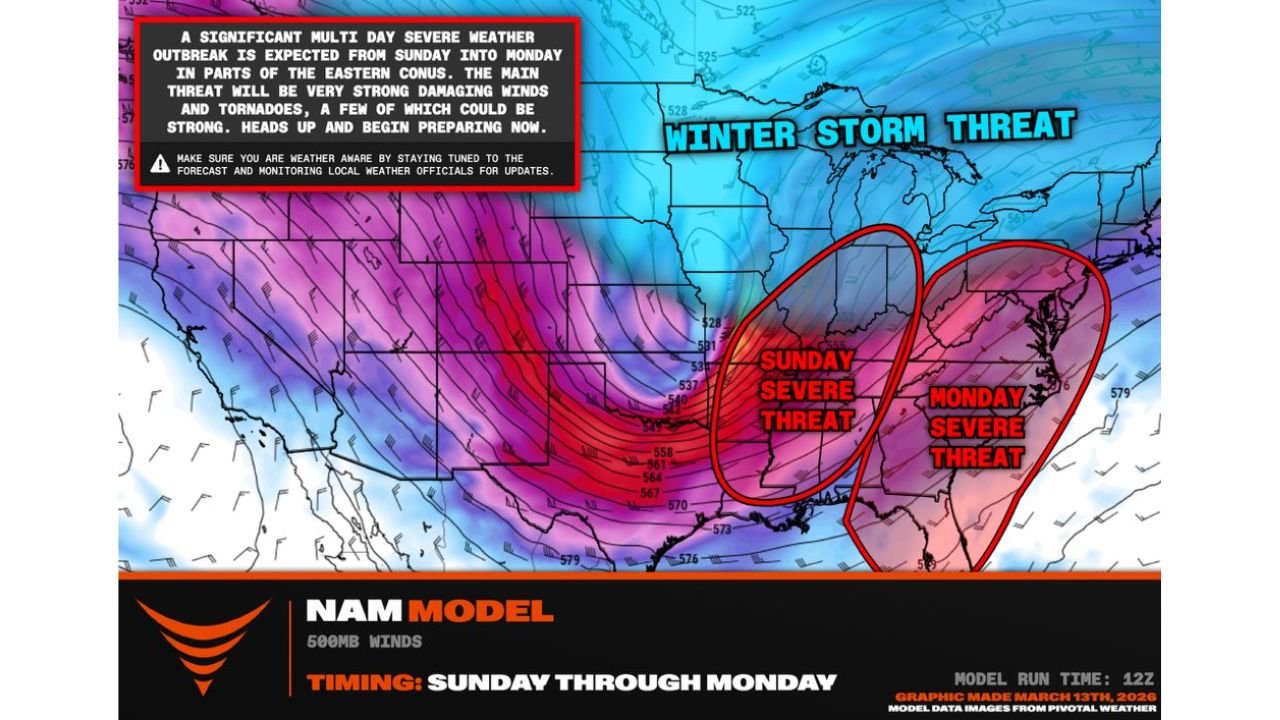
ST. LOUIS, MISSOURI — A significant multi-day severe weather outbreak is expected to unfold from Sunday into Monday across large portions of the eastern United States, with the Midwest and Mid-South first in line before the threat pushes toward the Carolinas and eastern Virginia.
Forecast data indicates a powerful, amplifying upper-level trough will sweep out of the Plains and into the Mississippi and Ohio Valleys on Sunday. This system will energize a strong low-level jet exceeding 50 knots ahead of a fast-moving squall line — setting the stage for a potentially widespread damaging wind event and embedded tornado outbreak.
Sunday Focused on Midwest and Mid-South
Sunday’s highest severe threat stretches from Little Rock and Shreveport through Memphis, St. Louis, Paducah, Louisville and into southern Illinois and near Chicago.
A narrow but intense squall line is expected to form and rapidly intensify during the afternoon and evening hours. This line will race northeast, producing:
- Widespread damaging straight-line winds
- Embedded QLCS tornadoes
- A few potentially strong tornadoes
- Scattered hail
Wind gusts in the most intense segments could exceed 70 mph, especially in bowing sections of the line.
The corridor of greatest concern includes Arkansas, western Tennessee, southern Missouri, southern Illinois and western Kentucky, where the combination of strong wind shear and forcing may allow for tornadoes embedded within the line — some possibly stronger than typical brief spin-ups.
Chicago and surrounding northern Illinois areas are on the northern fringe of the primary severe corridor but could still see strong storms late Sunday as the system lifts northeast.
Tornado Threat Within the Squall Line
This setup favors a QLCS (quasi-linear convective system), which often produces brief tornadoes along the leading edge of the line.
However, meteorologists note that this environment contains unusually strong wind fields aloft. In select segments of the squall line — particularly where localized instability overlaps with intense shear — stronger tornadoes cannot be ruled out.
Communities from Little Rock to Memphis to St. Louis should prepare for rapidly changing conditions and short warning lead times.
Blizzard Conditions in the Upper Midwest
While severe storms erupt farther south, the same powerful storm system will bring winter impacts to the north.
A developing winter storm is expected to impact portions of the Upper Midwest and northern Great Lakes region, where blizzard conditions are possible. Strong winds wrapping around the backside of the system could create blowing snow and hazardous travel in parts of Minnesota, Wisconsin and Michigan.
This stark contrast highlights the dynamic nature of the system — severe thunderstorms to the south, winter storm conditions to the north.
Monday Severe Threat Shifts East
By Monday, the cold front and severe weather threat will push eastward.
The Monday severe corridor includes:
- Central and northern Florida
- Georgia
- The Carolinas, including Charlotte and Raleigh
- Eastern Virginia
All hazards remain possible, including damaging winds and tornadoes. The tornado risk appears especially notable across parts of Florida Monday afternoon before the threat lifts northeast through the Carolinas into Virginia.
Timing and Impacts
The most active period Sunday will likely be late afternoon through the overnight hours as the squall line tracks from Arkansas and Missouri into Illinois and Kentucky.
On Monday, storms are expected to redevelop or reintensify across the Southeast during the afternoon and evening.
Residents across the Midwest and Southeast should:
- Review severe weather safety plans
- Ensure multiple ways to receive warnings
- Prepare for potential power outages
- Stay alert for rapidly evolving forecasts
This is shaping up to be one of the more impactful severe weather events of the early spring season, affecting multiple regions over a 48-hour period.
Stay with ChicagoMusicGuide.com for continued updates as this significant severe weather outbreak develops.