
Midwest and Great Lakes Set for Prolonged Mid-to-Late January Arctic Cold as Tropical Forcing Locks in Pattern Shift
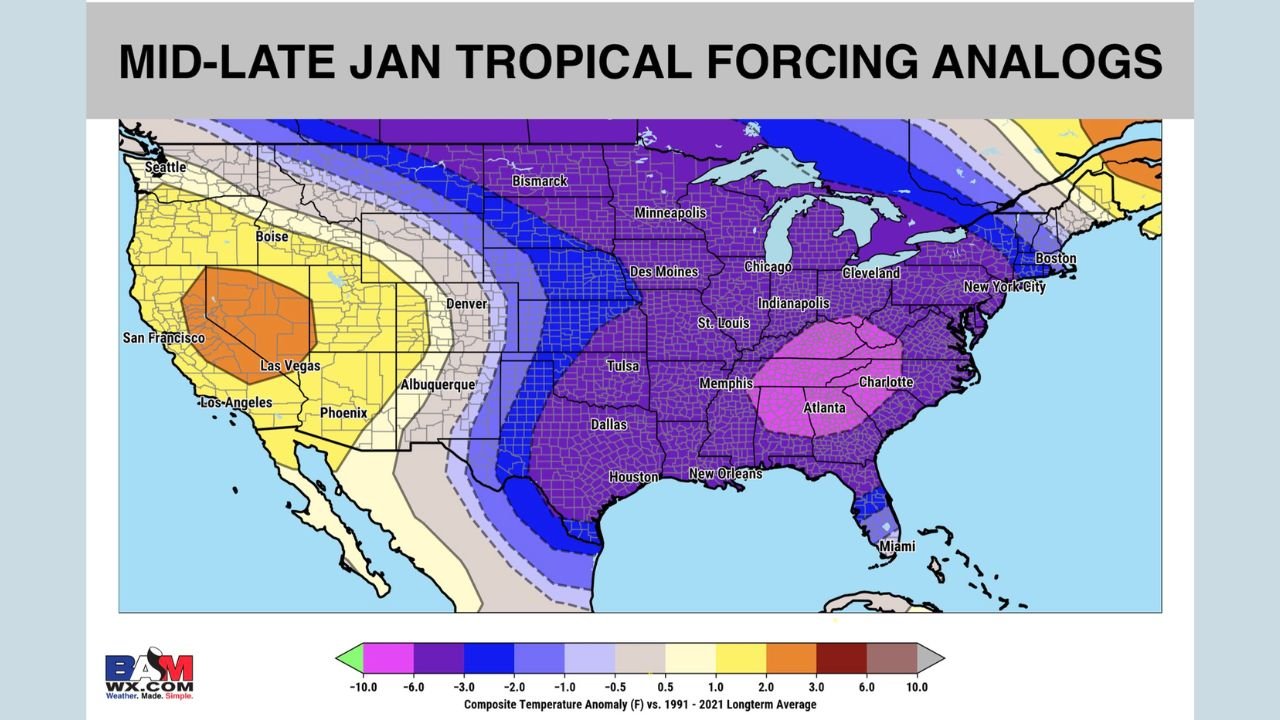
MIDWEST AND GREAT LAKES — Long-range tropical forcing analog data now strongly supports a prolonged Arctic cold pattern developing across the Midwest and Great Lakes, rather than a brief or isolated cold snap. The data shows a large, well-defined region of below-average temperature anomalies setting up across multiple states, signaling that cold air is likely to persist and reload through the mid-to-late January period.
Unlike fast-moving cold fronts that quickly exit, this pattern favors longer-lasting cold conditions driven by large-scale atmospheric alignment, with the Midwest and Great Lakes sitting squarely in the core impact zone.
Midwest Identified as the Cold Core
The strongest and most consistent cold anomalies on the data maps are centered across the Midwest, including Illinois, Iowa, Indiana, Missouri, and Wisconsin. These areas are shaded in the deepest below-normal colors, indicating sustained departures from seasonal averages, not just short-term dips.
This placement suggests repeated injections of Arctic air rather than a single outbreak. Daytime highs are more likely to remain suppressed, while nighttime lows trend colder over longer stretches. The signal points toward limited warm-ups between systems, a key marker of a locked-in winter pattern.
Great Lakes Region Locked Into Persistent Cold
The Great Lakes region, including Michigan and Ohio, also falls firmly within the primary cold zone. When Arctic air funnels southward under this type of jet stream configuration, the Great Lakes frequently experience extended cold spells, often intensified by regional wind patterns.
Because the cold is expected to persist, even modest wind speeds can significantly worsen perceived conditions. This makes the Great Lakes especially vulnerable to long-duration cold stress, rather than brief, manageable events.
Cold Extends Into the Central and Southern U.S.
Beyond the Midwest and Great Lakes, the data also shows below-normal temperature anomalies extending southward into parts of the central Plains and lower Mississippi Valley, including Kansas, Oklahoma, Arkansas, Tennessee, and Mississippi.
While these areas are not the cold core, the shading still supports repeated cold intrusions, especially following frontal passages. These regions are more likely to see sharp temperature drops and colder-than-average periods, even if conditions fluctuate more than farther north.
West Coast Ridge Helps Drive the Cold East
At the same time, the data highlights near-normal to above-normal temperatures across the West Coast and Southwest, including California, Nevada, and Arizona. This warmth is not incidental—it is a critical component of the broader pattern.
A western ridge helps displace the jet stream, forcing it south and east. This configuration acts as a conveyor belt, steering Arctic air directly into the central and eastern United States. The contrast between a warmer West and a colder Midwest is a classic setup for long-lasting winter cold regimes.
Tropical Forcing Signals Support a Negative EPO Pattern
The driving force behind this setup is tropical forcing in the West Pacific, where enhanced convection supports the development of a strong Alaskan ridge, commonly referred to as a negative EPO (-EPO) pattern.
When this ridge establishes itself, it blocks Pacific moderation and opens the door for Arctic air to pour southward into North America. Historically, similar tropical forcing analogs have been associated with extended cold periods, not short disruptions.
The alignment of these signals increases confidence that the upcoming cold pattern will persist through mid-to-late January, particularly across the Midwest and Great Lakes.
What the Data Suggests Going Forward
Taken together, the data clearly identifies the Midwest and Great Lakes as the most impacted regions, with additional cold spreading into the central and southern U.S. The emphasis is on duration, not just intensity—meaning cold conditions may linger even when individual days vary.
Residents, planners, and travelers across these regions should prepare for repeated cold waves, elevated heating demand, and prolonged winter conditions as January progresses.
As this pattern continues to evolve, ChicagoMusicGuide.com will keep tracking how sustained cold across the Midwest and Great Lakes may affect travel, scheduling, and regional activity during the heart of winter.