
Mississippi and Alabama Lead U.S. Tornado Watch Averages as Gulf Coast States See Highest Severe Weather Frequency
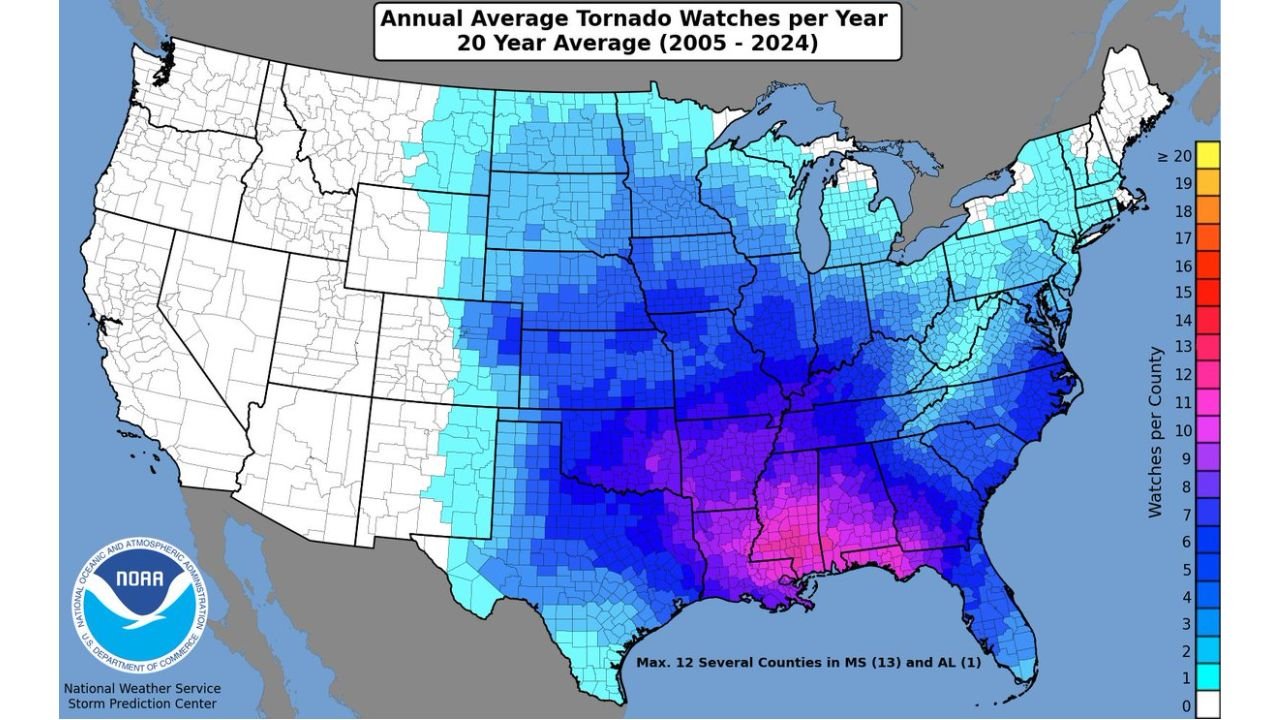
UNITED STATES — A long-term analysis of tornado watch activity across the country reveals that Mississippi and Alabama consistently rank among the highest in annual tornado watch frequency, according to data covering the 20-year period from 2005 through 2024. The map published by the National Weather Service Storm Prediction Center highlights a clear concentration of tornado watch activity across the Deep South and Gulf Coast states, where severe weather conditions occur more frequently than most other parts of the United States.
Over the past 19 years, forecasters report that the region averages between one and four tornado watches per year, though some counties across the Gulf Coast and Lower Mississippi Valley experience even higher numbers during particularly active seasons.
Deep South Shows the Highest Concentration of Tornado Watch Activity
The long-term NOAA analysis shows the highest tornado watch frequency centered across Mississippi and Alabama, extending into parts of Louisiana, Arkansas, and Tennessee. Counties in these states appear in darker shades on the map, indicating the highest annual average of tornado watches anywhere in the United States.
The data reveals that several counties in Mississippi record some of the highest watch averages, while neighboring counties in Alabama also rank near the top nationally. In fact, the analysis notes that Mississippi contains the greatest number of counties with extremely high tornado watch averages, while Alabama also includes several counties within that top tier of activity.
This region forms part of what meteorologists commonly refer to as “Dixie Alley,” an area stretching across the Lower Mississippi Valley and Gulf Coast where atmospheric conditions often favor severe thunderstorms capable of producing tornadoes.
Central Plains and Midwest Also Experience Frequent Watches
Beyond the Deep South, the map shows elevated tornado watch frequency extending northward into the Central Plains and Midwest, particularly across Kansas, Oklahoma, Missouri, and Iowa.
These states are located within Tornado Alley, a region well known for its frequent severe thunderstorms and tornado activity during the spring and early summer months.
While these areas experience numerous tornado watches each year, the long-term averages show that the Deep South still leads the nation in overall watch frequency, largely due to the region’s ability to produce severe weather in multiple seasons, including winter and early spring.
Meteorologists note that the combination of Gulf moisture, atmospheric instability, and strong wind patterns helps create favorable conditions for severe storms across both the Plains and southeastern United States.
Lower Tornado Watch Frequency in Western United States
In contrast, the western half of the country shows significantly lower tornado watch averages. Large portions of the Rocky Mountains, Desert Southwest, and Pacific Coast states record little to no tornado watch activity during the same 20-year period.
This difference is largely due to topography and atmospheric conditions, which are generally less favorable for the types of large, organized thunderstorms capable of producing tornadoes.
While isolated tornadoes can occur in the West, the long-term data clearly shows that severe storm environments are far more common across the central and eastern United States.
Why the Gulf Coast Region Remains a Severe Weather Hotspot
Meteorologists say the Gulf Coast and Lower Mississippi Valley remain particularly vulnerable to severe weather because of their unique geographic location.
Warm, moisture-rich air flowing north from the Gulf of Mexico often collides with colder air masses arriving from the central United States, creating the unstable atmospheric conditions needed for strong thunderstorms.
These systems frequently develop into supercell thunderstorms capable of producing tornadoes, which is why tornado watches are issued more frequently across the region.
For residents in Mississippi, Alabama, Louisiana, and surrounding states, severe weather preparedness remains critical during the peak tornado seasons of spring and early fall, when atmospheric conditions are most favorable for severe storms.
As severe weather patterns continue to evolve across the country, ChicagoMusicGuide.com will keep tracking storm risks, tornado outlooks, and severe weather trends impacting communities throughout the United States.