
North Carolina, Tennessee and Virginia Mountains See Snowfall Surge Up to 7+ Inches as Late-Season Band Sweeps Southern Appalachians
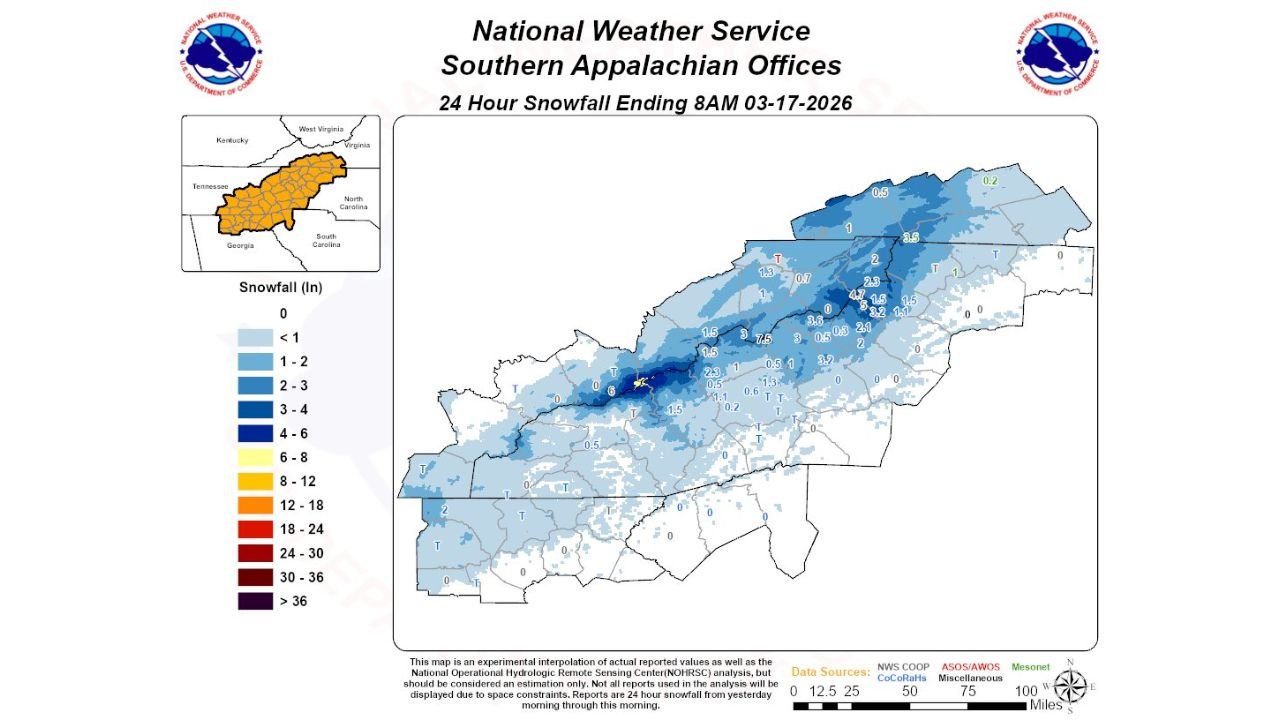
NORTH CAROLINA — A late-season winter system brought a notable burst of snowfall across the Southern Appalachian region, with new data from early March 17, 2026, revealing accumulations stretching across North Carolina, Tennessee, and Virginia, particularly in higher elevations.
Snowfall reports collected through 9 AM show a well-defined band of heavier snow cutting across the mountains, with several areas recording multiple inches of accumulation despite the mid-March timing.
Heaviest Snowfall Focused Across Western North Carolina and Eastern Tennessee
The most significant snowfall totals were concentrated along the mountain spine of western North Carolina and eastern Tennessee, where a narrow but intense band produced the highest accumulations.
Several locations in this corridor reported snowfall totals in the range of 4 to over 7 inches, with isolated higher pockets possible in elevated terrain. Areas near the Great Smoky Mountains and surrounding high elevations saw the most impactful snow.
Cities and regions around Asheville, Boone, and parts of eastern Tennessee were among those experiencing steady snowfall, with totals increasing quickly during the peak of the event.
Snow Extends Northeast Into Virginia With Moderate Totals
Farther northeast, snowfall extended into southwest and central Virginia, where totals were generally lighter but still impactful.
Most areas in Virginia reported 1 to 4 inches of snow, with localized higher amounts in elevated regions. Locations across the Blue Ridge Mountains and surrounding areas saw steady accumulations that added to the late-season winter feel.
The snowfall gradually tapered off moving eastward, with lower elevations seeing minimal or no accumulation.
Lighter Snowfall and Minimal Impact in Lower Elevations
Outside of the mountainous terrain, snowfall totals dropped off significantly. Much of the surrounding region—including parts of central and eastern North Carolina, as well as portions of Georgia and South Carolina—saw little to no accumulation.
These areas remained on the warmer side of the system, limiting snowfall potential and keeping impacts relatively minor compared to the mountains.
Why This Late-Season Snow Event Developed
This event was driven by a cold air mass interacting with moisture moving across the Southern Appalachians, allowing snow to develop primarily in higher elevations where temperatures remained low enough.
The terrain played a crucial role, as the mountains enhanced snowfall rates and helped create the narrow band of heavier accumulation seen across North Carolina and Tennessee.
Late-season snow events like this are not uncommon in the Appalachians, where elevation can sustain winter-like conditions even as spring approaches.
Travel and Local Impacts Across the Region
The snowfall led to slick road conditions in mountain communities, particularly during the early morning hours. Elevated roadways, bridges, and mountain passes were most affected.
While widespread disruptions were limited, localized travel issues were reported in areas with heavier snowfall, especially where totals exceeded several inches.
As temperatures rise later in the day, some melting is expected, though shaded and higher elevation areas may continue to see lingering snow cover.
A Reminder That Winter Isn’t Over Yet in the Appalachians
This March 17 snowfall event highlights how winter weather can still impact parts of North Carolina, Tennessee, and Virginia, even as spring draws closer.
With elevation-driven snowfall and lingering cold air, the Southern Appalachians remain vulnerable to late-season winter systems, particularly during transitional periods like March.
For continued updates on weather patterns and regional impacts across the United States, stay connected with ChicagoMusicGuide.com.