
Pennsylvania, Ohio, and New York Face Lake-Enhanced Snowstorm With 12–18 Inches Possible Near Erie and Crawford Counties
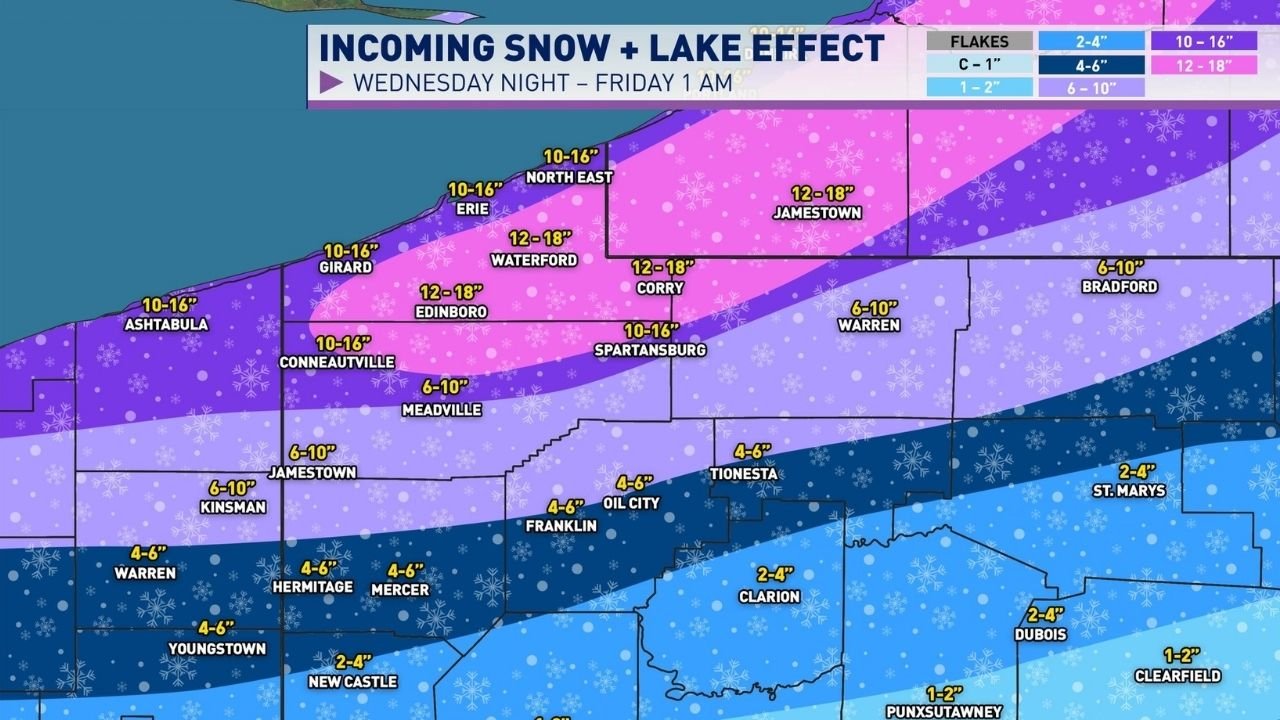
PENNSYLVANIA – A significant snow event is lining up for northwestern Pennsylvania as a strengthening low-pressure system pushes in tonight, then taps Great Lakes moisture on Thursday—setting the stage for heavy snowfall bands and sharply reduced visibility from the Erie area into Crawford and Warren counties, with impacts likely spilling into nearby parts of northeast Ohio and southwest New York.
Heavy snow focus: Erie County and the I-90 snowbelt corridor
Forecast guidance shown in the graphics highlights a classic “lake-enhanced” setup, where synoptic snow from the storm is boosted by Lake Erie moisture, allowing narrow but intense bands to drop snow much faster than surrounding areas. The highest totals are concentrated along and just inland from the Lake Erie shoreline, including communities such as Girard, Erie, and North East, where 10–16 inches is depicted, and nearby inland locations like Waterford, Edinboro, and Corry, where 12–18 inches is shown as a potential range.
Where the biggest totals are showing up on the map
Based on the snowfall zones displayed in the posted graphic, here’s how the higher-end banding breaks down:
- 12–18 inches possible: Waterford, Edinboro, Corry, and areas near the strongest banding in northwest PA
- 10–16 inches possible: Girard, Erie, North East, and nearby lakebelt communities
- 6–10 inches possible: Meadville, parts of Warren County, and areas toward Bradford
- 4–6 inches possible: Franklin, Oil City, Mercer, Hermitage, and pockets extending toward the Ohio line
- 2–4 inches possible: Clarion, Dubois, St. Marys
- 1–2 inches possible: Clearfield, Punxsutawney and farther south/east of the primary band
Because lake-effect bands can shift, a town on the edge of the “jackpot” zone can end up much lower—or much higher—depending on where the band stalls for several hours.
Timing: Wednesday night into Thursday, lingering bands possible
The event window shown in the graphic runs from Wednesday night through early Friday (around 1 a.m.), with the most dangerous period expected overnight into Thursday when snowfall rates can spike and visibility can collapse quickly inside the heavier bands. Conditions are expected to gradually improve Thursday afternoon into Thursday evening, but the guidance also warns that additional lake bands may re-develop and re-cover roads even after the worst of the storm pulls away.
Why travel could get dicey fast
This isn’t just about totals—it’s about snowfall rate, wind gusts, and temperature drops. When a stronger burst sets up, roads can go from wet to snow-covered in minutes, and drivers can lose sight of brake lights ahead with little warning.
Key travel hazards highlighted by this setup include:
- Sudden whiteouts in heavier bands
- Rapidly changing road conditions on highways and rural routes
- Lower visibility on turns and hills, especially in open areas
- Blowing snow and drifting where winds increase
If you must drive, the most important safety move is slowing down before you hit the worst visibility—waiting until you’re already in a whiteout is usually too late.
Practical safety checklist before the snow hits
If you’re in the lakebelt or planning to travel through northwest PA, the smartest move is to prepare like you could be delayed or stuck longer than expected:
- Fully charge your phone and keep a car charger handy
- Top off gas and carry blankets, gloves, and a flashlight
- Keep extra windshield washer fluid and a snow brush
- Give yourself extra stopping distance—especially at night
- Avoid sudden braking or acceleration on slick surfaces
- Make sure your vehicle is winter-ready (tires, wipers, battery)
What to watch next: model shifts and “band placement” confidence
Even the best guidance struggles with the exact placement of lake-effect bands until closer to the event. If the strongest band locks over one corridor for several hours, totals can outrun the broader map. If it wobbles, the snow gets spread out and localized totals come down.
That’s why the next higher-resolution updates matter most: they tighten the storm track, refine wind direction over Lake Erie, and give a clearer picture of where the dominant band could stall.
What do you think will happen—does the Erie snowbelt cash in again, or do the bands shift? Share what you’re seeing in your area and keep the conversation going at ChicagoMusicGuide.com.