
San Francisco Just Recorded Its Warmest March in History at 62.3 Degrees and the Numbers Show It Would Have Ranked as the 2nd Warmest April and 3rd Warmest May Ever Recorded Downtown
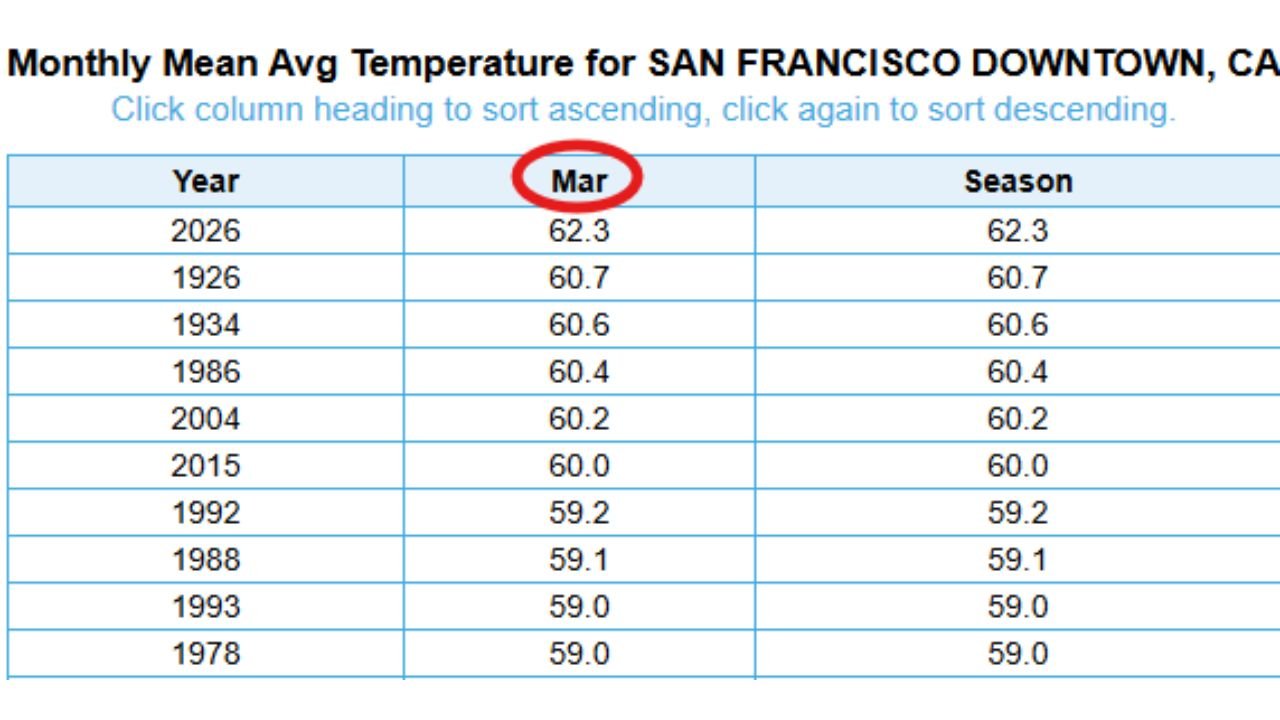
SAN FRANCISCO, CA — March 2026 is not just ending — it is going out as the most remarkable March in San Francisco’s entire recorded weather history. With only days left in the month, San Francisco Downtown has already locked in a monthly mean average temperature of 62.3°F — a number that does not just set a new all-time March record. It obliterates the previous mark by nearly half a degree over the second-warmest March on record. And when you compare that 62.3°F figure against the records for April and May — the months that are actually supposed to feel like this — the true scale of what just happened becomes impossible to overstate.
The Record That Just Fell: San Francisco’s Warmest March Ever
The Monthly Mean Average Temperature data for San Francisco Downtown going back over a century makes the 2026 number stand out immediately. The top of the all-time March rankings now reads:
- 2026: 62.3°F — New all-time record
- 1926: 60.7°F — Previous record, now second place
- 1934: 60.6°F
- 1986: 60.4°F
- 2004: 60.2°F
- 2015: 60.0°F
- 1992: 59.2°F
- 1988: 59.1°F
- 1993: 59.0°F
- 1978: 59.0°F
The gap between 2026 and 1926 — the previous record holder at 60.7°F — is 1.6°F. In the context of monthly mean temperature records, where the difference between first and tenth place is often less than 3 degrees across an entire century of data, a 1.6°F margin over the next closest year is not a close call. It is a dominant, unambiguous statement about just how far outside the historical envelope March 2026 pushed San Francisco’s temperatures.
The Context That Makes This Even More Striking
Here is where the March 2026 record becomes truly extraordinary — and it requires looking at the April and May temperature records to fully appreciate.
The warmest April ever recorded in San Francisco Downtown history came in 1992 with a monthly mean of 62.6°F. March 2026’s 62.3°F falls just 0.3°F short of the all-time warmest April on record. In other words, San Francisco just experienced a March that was nearly as warm as the single hottest April the city has ever seen.
The warmest May ever recorded in San Francisco Downtown came in 1992 with a monthly mean of 62.7°F. March 2026’s 62.3°F falls just 0.4°F short of the all-time warmest May on record — a month that is supposed to be significantly warmer than March given the seasonal progression of temperatures through spring.
To put this in plain terms: March 2026 in San Francisco was warmer than almost every April and May in recorded history. The city essentially skipped spring entirely and went directly to conditions that historically belong to late spring or early summer — and then sustained those conditions across an entire calendar month.
Three Months of Records Side by Side
| Month | All-Time Record | Year | 2026 March Value | How 2026 Compares |
|---|---|---|---|---|
| March | 62.3°F | 2026 | 62.3°F | 🔴 All-Time Record |
| April | 62.6°F | 1992 | 62.3°F | 🔴 Would Rank 2nd Warmest April Ever |
| May | 62.7°F | 1992 | 62.3°F | 🔴 Would Rank 3rd Warmest May Ever |
| Previous March Record | 60.7°F | 1926 | +1.6°F above | 🔴 Record Shattered |
| Years of Data | 100+ years | — | All stations | ✅ Official Record |
What This Means for the Bay Area and California
San Francisco’s March 2026 temperature record does not exist in isolation. It is part of the same historic heat wave pattern that shattered more than 1,100 daily temperature records across the United States between March 1 and March 26, 2026 — a nationwide heat event that was particularly intense across the western United States.
For the Bay Area specifically, a monthly mean of 62.3°F in March represents a fundamental departure from what residents consider normal late-winter and early-spring conditions. San Francisco’s climate is famously mild and stable — the city is not known for dramatic temperature extremes in either direction. That is precisely what makes this March record so significant. The city that rarely gets too hot or too cold just experienced a March so warm it rivals its hottest Aprils and Mays on record.
The cooling trend arriving this week will bring temperatures back toward more seasonable norms — but it cannot undo what March 2026 has already written into the climate record books. The numbers are permanent.
State-by-State and Regional Context
🔴 California — San Francisco, Bay Area — Ground zero for this specific record. The Downtown San Francisco station’s 62.3°F monthly mean is the headline number — but the broader Bay Area experienced similarly anomalous warmth throughout March that contributed to this result.
🔴 California — Statewide — San Francisco’s record is part of a statewide pattern of above-normal March temperatures that accompanied the historic heat wave documented across the western United States. Multiple California stations recorded all-time or top-five monthly temperature records during this period.
🟠 Pacific Southwest — Nevada, Arizona — Also impacted by the same heat pattern that produced San Francisco’s record. The western heat anomaly was regional in scope, not isolated to the Bay Area.
🟡 Pacific Northwest — Oregon, Washington — Less extreme than California but still above normal for March. The heat pattern that pushed San Francisco to record territory had a broader signature across the entire West Coast.
The Numbers Will Stand Long After the Heat Is Gone
Cooler temperatures are arriving in San Francisco this week — and the unusual warmth that defined March 2026 across the Bay Area is fading. But what this month wrote into the record books will not fade with it.
62.3°F. The warmest March in San Francisco history. A number that would have ranked second among all April records and third among all May records across more than a century of downtown temperature data. A number that arrived 1.6°F above the previous March record — a margin that tells the story of just how far outside the historical norm March 2026 pushed one of America’s most famously temperate cities.
California’s Record Books Just Got Rewritten and the Heat Wave That Caused It Is Still Being Felt Across the West
More climate and temperature records from March 2026 continue to emerge across the country. Stay informed at ChicagoMusicGuide.com — your source for historic temperature records, heat wave data and climate analysis across California, the Bay Area and the entire United States.