
Southern and Central Michigan Face Strong to Severe Storm Threat Late Monday Into Tuesday March 30 and 31 as Warm Airmass Pushes North Through Grand Rapids, Lansing and Detroit
GRAND RAPIDS, MI — A warm and unstable airmass is moving into Michigan this weekend — and by late Monday night into Tuesday morning, southern and central Michigan will be dealing with more than just ordinary spring rain. The latest atmospheric analysis is flagging a strong to severe storm threat for a significant portion of the Lower Peninsula, with the timing and geographic split already becoming clear enough to give residents across Grand Rapids, Lansing, Detroit and Kalamazoo a heads-up before the system arrives.
How This Storm System Is Dividing Michigan Into Three Zones
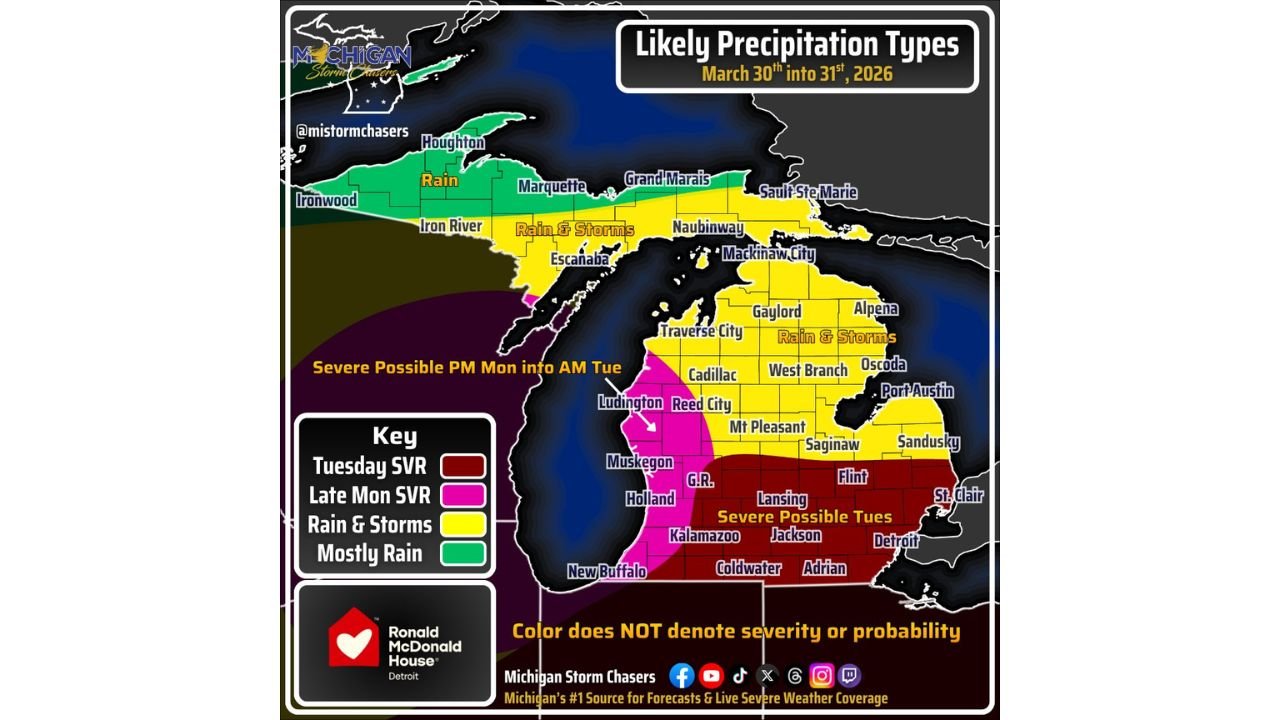
Not every part of Michigan is facing the same threat with this system — and that geographic split is one of the most important things to understand about this event. The precipitation type map for March 30th into 31st breaks the state into four distinct zones based on what each area is most likely to experience.
Upper Peninsula — Mostly Rain: The far western Upper Peninsula from Ironwood through Houghton is in the green zone — mostly rain, no severe weather threat. This is the lightest impact zone in the entire state for this event.
Central Upper Peninsula and Northern Lower Michigan — Rain and Storms: A broad yellow zone covering Marquette, Escanaba, Iron River, Traverse City, Gaylord, Alpena and Mackinaw City is forecast for rain and storms through Monday and Tuesday. Thunder is likely but the severe threshold is not expected to be reached across this zone as the system currently stands.
West-Central Lower Michigan — Late Monday Severe Possible: The magenta zone — covering Ludington, Muskegon, Holland, Grand Rapids and Reed City — is the first area entering the severe weather window. This zone faces its highest threat very late Monday night into early Tuesday morning. Residents in this corridor need to be weather aware heading into Monday evening.
Southern Lower Michigan — Tuesday Severe Possible: The deep maroon zone covering Kalamazoo, Lansing, Flint, Detroit, Jackson, Adrian, Coldwater, St. Clair and New Buffalo faces its severe weather window during the remainder of Tuesday. This is the most populated zone in the entire threat area and the one that will require the closest monitoring as Tuesday develops.
What Severe Means for Each Zone and When It Hits
The timing difference between the magenta and maroon zones is critical for residents to understand. This is not a single storm event that sweeps through the state all at once. It is a two-phase severe weather window that moves from west to east and from late night into the daytime hours.
Phase 1 — Late Monday into Early Tuesday (Magenta Zone): The western corridor from Muskegon through Grand Rapids faces its greatest threat after most people are already home or in bed. Nighttime severe weather is always the most dangerous because warning reception and reaction time are significantly reduced when people are asleep. If you live in Muskegon, Holland or Grand Rapids, have your weather alerts active on your phone before you go to sleep Monday night.
Phase 2 — Tuesday Daytime (Maroon Zone): The southern Lower Peninsula from Kalamazoo through Detroit faces its severe weather window during Tuesday’s daylight hours — a more favorable scenario for warning reception but still requiring full attention. The Detroit metro, Lansing corridor and Flint area all sit inside this threat zone.
Michigan Storm Threat Summary Table
| Zone | Areas Included | Threat Level | Timing |
|---|---|---|---|
| Mostly Rain | Ironwood, Houghton, W. UP | 🟢 No Severe | Monday |
| Rain and Storms | Marquette, Traverse City, Gaylord | 🟡 Non-Severe | Mon-Tue |
| Late Monday Severe | Muskegon, GR, Holland, Ludington | 🟠 Strong to Severe | Late Mon PM into Tue AM |
| Tuesday Severe | Detroit, Lansing, Kalamazoo, Flint | 🔴 Strong to Severe | Tuesday daytime |
| Forecast Confidence | Timing and coverage still evolving | ⚠️ Moderate | Updates Sunday March 29 |
City-by-City Breakdown for Lower Michigan
🔴 Detroit, St. Clair, Adrian, Coldwater — Deep inside the Tuesday severe weather zone. Daytime Tuesday is the window to watch. Damaging winds and large hail are the primary threats. Tornado potential depends on how much instability builds ahead of the system.
🔴 Lansing, Jackson, Flint — Sitting in the maroon zone for Tuesday severe weather. The I-96 and I-69 corridors will need close monitoring throughout Tuesday as storm cells develop and track northeast.
🔴 Kalamazoo, New Buffalo — Southern Michigan border communities face both the late Monday and Tuesday threat depending on exact storm timing. The southwest corner of the Lower Peninsula is on the leading edge of the entire system.
🟠 Grand Rapids, Muskegon, Holland — The late Monday overnight window is the critical threat period for this corridor. Storms capable of severe weather possible after 10 PM Monday through early Tuesday morning. Do not wait until Tuesday to prepare if you live here.
🟠 Reed City, Cadillac, Mt. Pleasant — Transition zone between the magenta and maroon areas. Some severe weather possible across this corridor depending on how the system evolves through the night.
🟡 Traverse City, Gaylord, Alpena, West Branch — Rain and storms expected but severe threshold not likely met. Stay weather aware but primary concern here is heavy rainfall and reduced visibility rather than severe thunderstorm hazards.
🟢 Upper Peninsula — Ironwood, Houghton, Marquette — Lightest impact zone. Rain expected but no organized severe weather threat at this time.
What You Need to Have Ready Before Monday Night
The most critical preparation step for anyone in the Grand Rapids, Muskegon and Holland corridor is simple — turn on wireless emergency alerts right now and do not turn them off before Tuesday morning. Overnight severe weather events are the most dangerous precisely because the warning system has to work harder to reach people who are asleep.
For Detroit, Lansing and Kalamazoo residents, the Tuesday daytime window gives more preparation time but less excuses for being caught unprepared. Know where your shelter is. Know the difference between a Severe Thunderstorm Warning and a Tornado Warning. Both demand immediate action but tornado warnings require getting to the lowest floor of a sturdy building immediately.
More details on exact timing, coverage and specific hazards will become available as Sunday progresses and model data continues to sharpen this event. Check back for updates before heading to bed Monday night.
Data Sources: Atmospheric Analysis, Precipitation Type Forecast — March 30-31, 2026 | NOAA/NWS Detroit and Grand Rapids Forecast Offices | Pattern assessment current as of March 28, 2026
Michigan Severe Weather Season Is Open and Monday Night Into Tuesday Is the First Real Test
More storm systems are lined up behind this one across the Great Lakes. Stay informed at ChicagoMusicGuide.com — your source for breaking severe weather coverage, storm timing updates and precipitation forecasts across Michigan and the entire United States.