
Southern Minnesota and Wisconsin Face a Possible Tornado Outbreak Tomorrow Afternoon as Supercells Erupt After 4 PM Along the Warm Front With Large Destructive Hail and Strong Tornadoes as the Main Threats
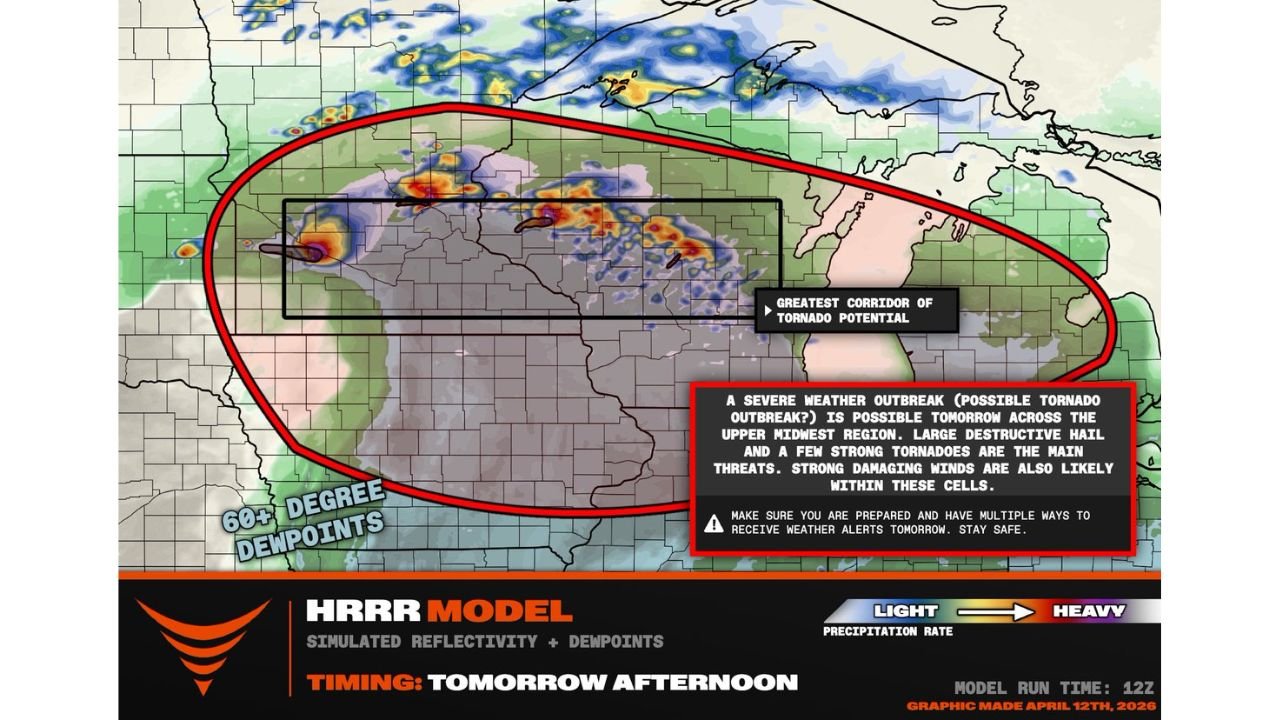
MINNEAPOLIS, MN — The Upper Midwest is staring down what could become a tornado outbreak tomorrow, and the atmospheric setup driving that concern is serious enough that experienced storm chasers are already positioning for the event. A powerful warm front pushing through southern Minnesota into Wisconsin is creating the greatest corridor of tornado potential in the region, with supercells expected to erupt by 4 PM tomorrow afternoon and quickly develop tornado-producing rotation as they move through an environment loaded with instability and dangerous wind shear.
The threat is not subtle. Current model data shows 60-plus degree dewpoints — an exceptional moisture reading for April in the Upper Midwest that signals an atmosphere charged with the kind of energy that fuels violent, long-track supercells — pooling across the primary target zone. When dewpoints reach that level this early in the spring season across Minnesota and Wisconsin, forecasters take notice immediately.
What the Data Is Showing for Tomorrow
The greatest corridor of tornado potential tomorrow is explicitly identified along the southern Minnesota into Wisconsin warm front axis. This boundary — where cooler air to the north meets the surging warm, moist air from the south — acts as both a trigger for storm development and an enhancer of low-level wind shear, the atmospheric ingredient most directly responsible for tornado formation.
Supercells are expected to erupt along this boundary by 4 PM and the model data suggests they will not need long to organize into tornado-capable rotating storms once they fire. The combination of 60-plus degree dewpoints, a favorable upper-level wind pattern, and the warm front boundary working together creates what meteorologists consider a high-ceiling environment — one where a well-organized supercell faces few atmospheric obstacles to producing a strong, long-track tornado.
The primary threats identified for tomorrow’s Upper Midwest event are large destructive hail, a few strong tornadoes, and strong damaging winds — all expected to be likely within the most organized cells that develop after 4 PM.
Threat and Timing Summary
| Threat | Level | Timing | Region |
|---|---|---|---|
| Tornadoes | Strong possible, outbreak possible | After 4 PM through evening | Southern Minnesota, Wisconsin |
| Large Destructive Hail | Primary threat | After 4 PM | Upper Midwest corridor |
| Damaging Winds | Likely within supercells | After 4 PM through evening | Southern Minnesota, Wisconsin |
| Dewpoint Moisture | 60+ degrees | Peak afternoon hours | Greatest tornado corridor |
| Storm Mode | Discrete supercells | Erupting by 4 PM | Warm front axis |
State-by-State Breakdown
Minnesota — Southern Corridor Southern Minnesota sits at the western entry point of tomorrow’s greatest tornado corridor. The warm front boundary pushing through this region is the primary storm trigger, and supercells developing here after 4 PM will immediately be in an environment capable of producing strong tornadoes and large destructive hail. Communities across southern Minnesota from the Minneapolis and Saint Cloud fringe southward through New Ulm, Willmar, and Rochester should treat tomorrow afternoon as a high-priority severe weather preparation day. Have multiple ways to receive weather alerts active before noon tomorrow.
Wisconsin — Along and South of the Warm Front Wisconsin shares the greatest tornado corridor designation with southern Minnesota and may represent the peak of the event as storms track eastward through the afternoon and evening hours. The Eau Claire, Wausau, Green Bay, and Oshkosh corridor falls within the primary target zone. Milwaukee sits on the southern fringe of the highest-risk area. The combination of the warm front boundary, extreme low-level moisture, and favorable upper-level support gives storms tracking into Wisconsin everything they need to maintain and intensify their rotation. A possible tornado outbreak — meaning multiple tornadoes from multiple supercells — cannot be ruled out across this corridor tomorrow evening.
Iowa and Illinois — Northern Fringe The outer edge of the severe weather environment reaches into northern Iowa and the northern Illinois corridor. While the greatest tornado corridor is concentrated across southern Minnesota and Wisconsin, organized severe thunderstorms capable of producing large hail and damaging winds are possible across northern Iowa communities including Mason City and Waterloo, and the Rockford and Chicago northern fringe of Illinois through tomorrow evening.
Why This Setup Is Being Taken So Seriously
Three factors are combining to elevate this event above a standard spring severe weather day across the Upper Midwest.
First, the 60-plus degree dewpoints across the target zone are exceptional for mid-April in Minnesota and Wisconsin. This level of atmospheric moisture is more typical of a peak summer severe weather setup across the Deep South, and its presence this far north this early in the season means the instability available to power storm updrafts is dramatically higher than average.
Second, the warm front positioning across southern Minnesota into Wisconsin creates the ideal low-level wind shear environment for tornadogenesis — the process by which a rotating supercell produces a tornado at the ground. Warm front tornadoes are frequently among the strongest and most long-track events of any given season because the wind shear enhancement right along the boundary is maximized.
Third, the discrete supercell mode expected after 4 PM means individual storms will be able to tap the full energy of the atmosphere without interference from neighboring storm outflow. A single, isolated supercell in an environment this loaded is the scenario that produces the most significant tornado events.
Forecast Confidence
Forecast Confidence: Moderate to High. The large-scale pattern supporting tomorrow’s Upper Midwest severe weather event is well-established and consistent across the latest model runs. The 4 PM supercell eruption timing along the warm front is well-supported. The primary uncertainty involves exactly how discretely storms can maintain themselves before merging into a larger line — individual supercell mode maximizes the tornado and large hail potential, while earlier linear organization shifts the primary threat toward widespread damaging winds.
Every resident across southern Minnesota and Wisconsin should have a confirmed shelter plan, multiple weather alert sources active, and a clear understanding of their nearest sturdy shelter before tomorrow afternoon.
More tornado outbreak and severe storm coverage is always on the horizon. Stay informed at ChicagoMusicGuide.com — your source for supercell and tornado tracking across Minnesota, Wisconsin, and the entire United States.