
St. Louis Missouri, Columbia Missouri and Quincy Illinois Smash All-Time March Heat Records as 2026 Delivers Historic Warm Surge
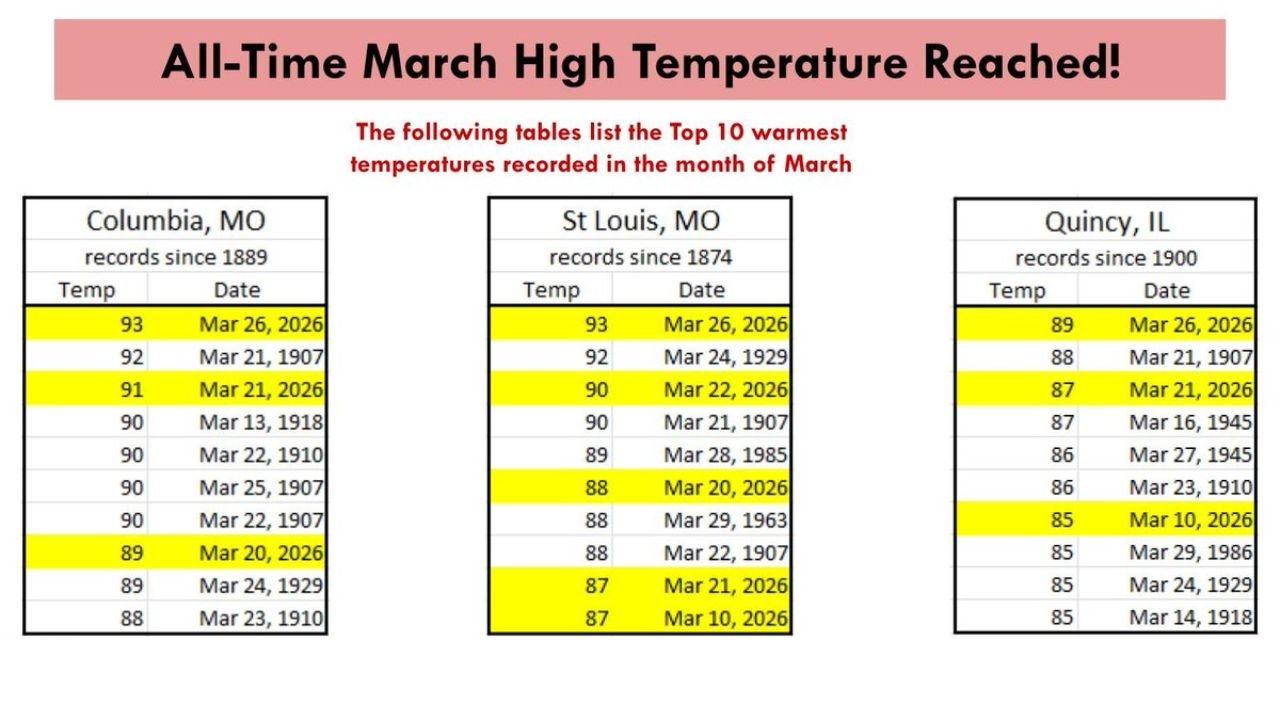
MISSOURI, ILLINOIS — A historic surge of unseasonable heat has rewritten the record books across parts of the Midwest, with St. Louis, Columbia, and Quincy all reporting all-time or near all-time March temperature records. The latest data shows that March 2026 is now among the warmest ever recorded, with multiple entries dominating the top 10 lists for each city.
The event highlights an unusual pattern of sustained warmth, with several days this month ranking among the hottest March readings in recorded history.
Record-Breaking Temperatures Across Missouri and Illinois
In St. Louis, Missouri, temperatures reached 93°F on March 26, 2026, tying for the all-time warmest March day in records dating back to 1874. What makes this even more remarkable is that five of the top 10 warmest March days in St. Louis history have now occurred in 2026 alone.
Similarly, Columbia, Missouri also hit 93°F on March 26, marking its highest March temperature on record. The city has seen three of its top 10 warmest March days occur this year, reinforcing how widespread and persistent the heat has been.
In Quincy, Illinois, the trend continues with a high of 89°F on March 26, 2026, placing it at the top of its historical March temperature records. Like Columbia, Quincy has also recorded multiple top 10 warmest March days this year, signaling a broader regional pattern rather than isolated spikes.
Why This March Heat Event Is So Unusual
March typically serves as a transition period between winter and spring, but this year’s pattern has been anything but typical. Instead of gradual warming, the region experienced summer-like conditions, with temperatures soaring well into the upper 80s and low 90s.
Meteorologists attribute this to a persistent warm air mass dominating the central United States, allowing temperatures to climb far beyond seasonal norms. The consistency of this pattern is what has made it historic—not just one record-breaking day, but multiple extreme temperature events within a single month.
This type of sustained warmth is rare for March and has led to a clustering of records that would normally be spread out over decades.
2026 Dominates Historical Temperature Rankings
What stands out most in the data is how heavily 2026 appears across the top rankings. In all three cities—St. Louis, Columbia, and Quincy—multiple entries from this year now sit among the top 10 warmest March days ever recorded.
For example, St. Louis not only tied its all-time record but also added several additional days in the upper tier of historical highs. Columbia and Quincy show similar patterns, with repeated appearances of 2026 dates throughout their rankings.
This clustering suggests that March 2026 could be remembered as one of the most anomalous early-season heat events in Midwest history, particularly for its consistency and geographic spread.
What This Means Moving Forward
While record-breaking warmth has dominated much of March, such patterns often shift quickly during the spring season. Rapid transitions between warm and cold air masses remain common, meaning the region could still see sharp temperature swings in the coming weeks.
However, the magnitude of this heat event already places it in a historic category, regardless of what follows. Communities across Missouri and Illinois are experiencing firsthand how dramatically weather patterns can deviate from seasonal expectations.
As the season continues, meteorologists will closely monitor whether this warmth signals a broader trend or remains an isolated but extreme event.
For continued updates on Midwest weather patterns, record-breaking conditions, and regional impacts, stay connected with ChicagoMusicGuide.com for the latest insights and coverage.