
Texas, Mississippi, Alabama, Tennessee, Kentucky, Ohio, Pennsylvania, and Washington DC Under Severe Weather Threat as Damaging Winds, Large Hail, and Strong Tornadoes Target Gulf Coast to Mid-Atlantic Corridor
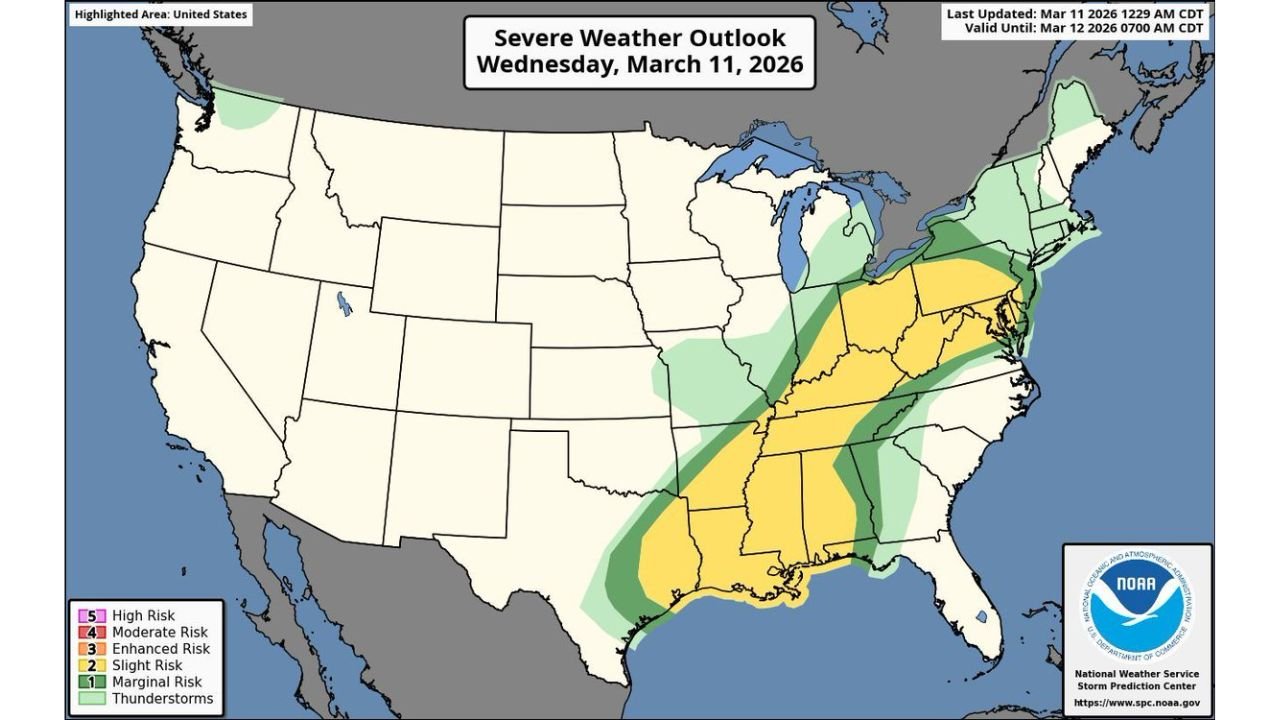
HOUSTON, TEXAS — A renewed round of severe weather is unfolding from the Gulf Coast to the Mid-Atlantic, with forecasters warning that damaging winds, large hail, and a few strong tornadoes are possible through this evening. The threat zone stretches from Texas and Mississippi northeastward through Alabama, Tennessee, Kentucky, Ohio, Pennsylvania, and into Washington DC, as storms organize along a powerful cold front pushing east.
The latest Severe Weather Outlook for Wednesday, March 11, 2026, highlights a broad corridor of risk, including a concentrated Slight Risk (Level 2 of 5) across much of the central Gulf states and portions of the Tennessee and Ohio Valleys.
Gulf Coast to Ohio Valley in Primary Risk Zone
The most significant threat spans parts of:
- Southeast Texas, including Houston
- Central and northern Mississippi, including Jackson
- Central Alabama, including Birmingham
- Middle Tennessee, including Nashville
- Central Kentucky, including Louisville
- Southern Ohio, including Cincinnati
- Western Pennsylvania, including Pittsburgh
This corridor aligns with a strengthening cold front that is driving northeastward. As warm, moisture-rich Gulf air surges ahead of the boundary, atmospheric instability is increasing, creating a favorable environment for strong thunderstorms.
Forecasters caution that storms may evolve into organized lines or embedded supercells capable of producing damaging straight-line winds and large hail.
Strong Tornado Potential Not Ruled Out
While widespread tornado activity is not guaranteed, meteorologists emphasize that a few strong tornadoes remain possible within the broader severe setup. Areas within the Slight Risk zone carry the highest concern for rotating storms, particularly where wind shear overlaps with instability.
Cities such as Jackson, Birmingham, and Nashville are positioned within an environment supportive of low-level rotation. As storms track northeast, the risk shifts toward Louisville, Cincinnati, Pittsburgh, and Washington DC later in the day and evening.
Residents in these cities should ensure they have multiple ways to receive weather warnings, including NOAA Weather Radio, smartphone alerts, and local broadcast updates.
Damaging Winds and Large Hail Likely
Beyond tornado potential, the more widespread hazard appears to be damaging wind gusts associated with fast-moving thunderstorm lines. Gusts exceeding severe limits could cause downed trees, power outages, and localized structural damage.
Additionally, large hail remains a concern, particularly in stronger discrete cells ahead of the main line. Hail can cause vehicle damage and pose risks to exposed property.
The Severe Weather Outlook map shows a long, continuous swath of risk extending from Texas through Mississippi and Alabama into the Mid-Atlantic, reflecting the dynamic nature of the system.
Washington DC and Mid-Atlantic in Evening Risk Window
As the cold front pushes northeast, the severe threat extends into the Mid-Atlantic, including Washington DC. While storm intensity may fluctuate as it progresses northward, forecasters indicate that strong storms could still produce gusty winds and isolated severe elements.
Urban corridors, including Washington DC, should monitor radar trends closely during the late afternoon and evening hours as the line approaches.
The expansive nature of this severe setup highlights the strength of the parent storm system sweeping across multiple regions in a single day.
As communities from Houston to Washington DC prepare for potentially dangerous weather conditions, preparedness and awareness remain critical.
For continued updates on severe weather alerts, storm outlooks, and developing weather threats across the United States, visit ChicagoMusicGuide.com.