
Total Lunar Eclipse Turns Moon Deep Red Across Texas, Illinois, New York and California Early March 3 — Rare “Selenelion” Visible at Sunrise in the East
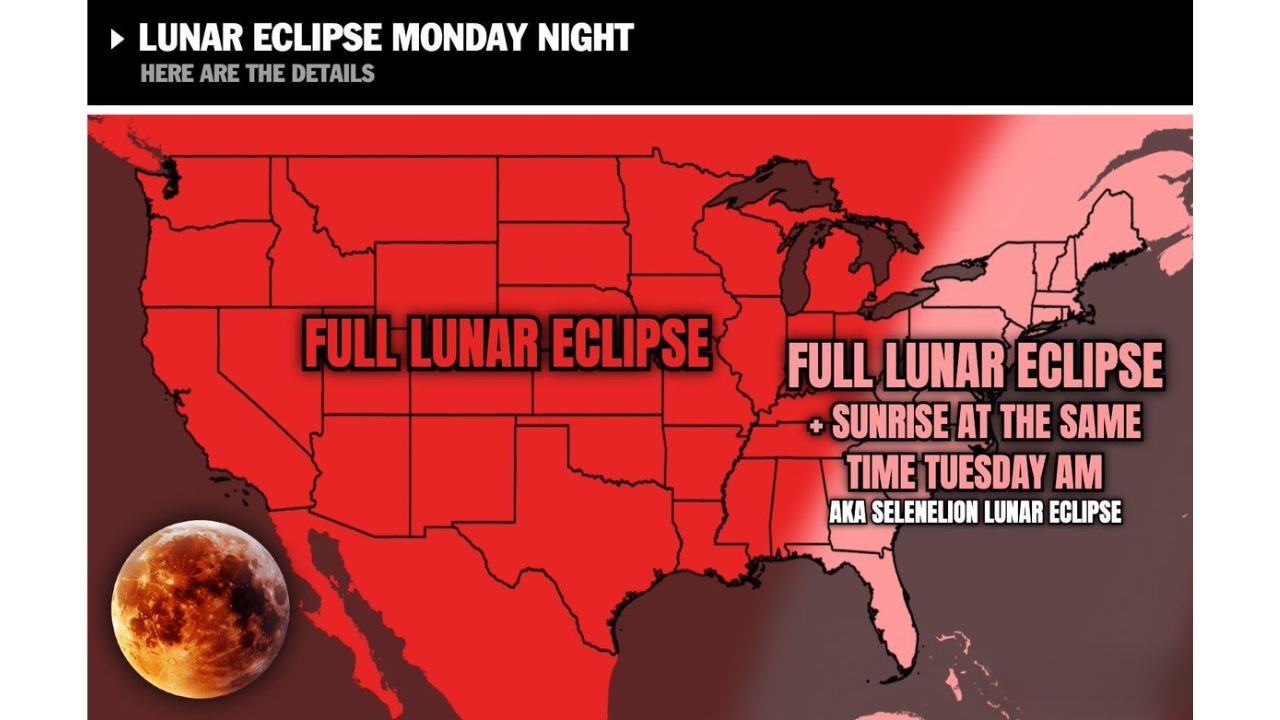
UNITED STATES — Skywatchers across Texas, Illinois, New York, California and the entire continental U.S. will witness a dramatic total lunar eclipse early March 3, as the Moon turns a deep red while passing fully into Earth’s shadow.
During totality, the Moon will take on the classic “Blood Moon” glow for nearly an hour, offering one of the most striking celestial events of the year — provided skies remain clear.
Where the Eclipse Will Be Fully Visible
The map indicates that nearly the entire western and central United States — including:
- California
- Arizona
- Texas
- Colorado
- Illinois
- Missouri
- Minnesota
- Nevada
- Washington
- Oregon
— will see the full total lunar eclipse during nighttime darkness.
In the Eastern United States, including:
- New York
- Pennsylvania
- Georgia
- Florida
- North Carolina
viewers will experience a rare and visually stunning phenomenon: a total lunar eclipse occurring at or near sunrise Tuesday morning, also known as a selenelion. This happens when the eclipsed Moon is setting in the west as the Sun rises in the east.
Viewing Times Across U.S. Time Zones (March 3)
Totality — when the Moon is fully engulfed in Earth’s shadow — occurs during the following windows:
- Eastern Time (ET): 6:04 AM – 7:02 AM
- Central Time (CT): 5:04 AM – 6:02 AM
- Mountain Time (MT): 4:04 AM – 5:02 AM
- Pacific Time (PT): 3:04 AM – 4:02 AM
- Atlantic Time (AT): 2:04 AM – 3:02 AM
- Hawaii Standard Time (HST): 1:04 AM – 2:02 AM
The Moon will gradually darken before totality and then slowly brighten afterward as it exits Earth’s shadow.
Why the Moon Turns Red
A total lunar eclipse occurs when:
- The Sun, Earth and Moon align
- Earth blocks direct sunlight from reaching the Moon
- Sunlight refracts through Earth’s atmosphere
That filtered sunlight scatters shorter blue wavelengths and allows red/orange hues to reach the Moon’s surface — producing the coppery glow.
What Makes This One Special
This eclipse stands out because:
- It offers nearly an hour of full totality
- It is visible across the entire continental U.S.
- Eastern states get the added spectacle of sunrise coinciding with totality
For cities like Chicago, Dallas, Los Angeles, Denver and Kansas City, the eclipse will occur in deep nighttime conditions. In contrast, places like New York, Washington D.C., Atlanta and Miami will see totality during dawn light — creating dramatic skyline photo opportunities.
Viewing Tips
- No special glasses are required (safe to view with naked eye)
- Find a location away from bright city lights
- Look west in Eastern states near sunrise
- Use binoculars or a telescope for enhanced detail
Bottom Line
A total lunar eclipse will paint the Moon deep red across California, Texas, Illinois, New York and the rest of the United States early March 3, with nearly an hour of totality and a rare sunrise “selenelion” for the East Coast.
If skies cooperate, this will be one of the most photogenic astronomical events of the year.
ChicagoMusicGuide.com will continue covering major sky and weather events impacting viewers nationwide.