Illinois and Indiana Severe Storms Fade Quickly After Sunset as Daytime Heating Collapse Ends Threat
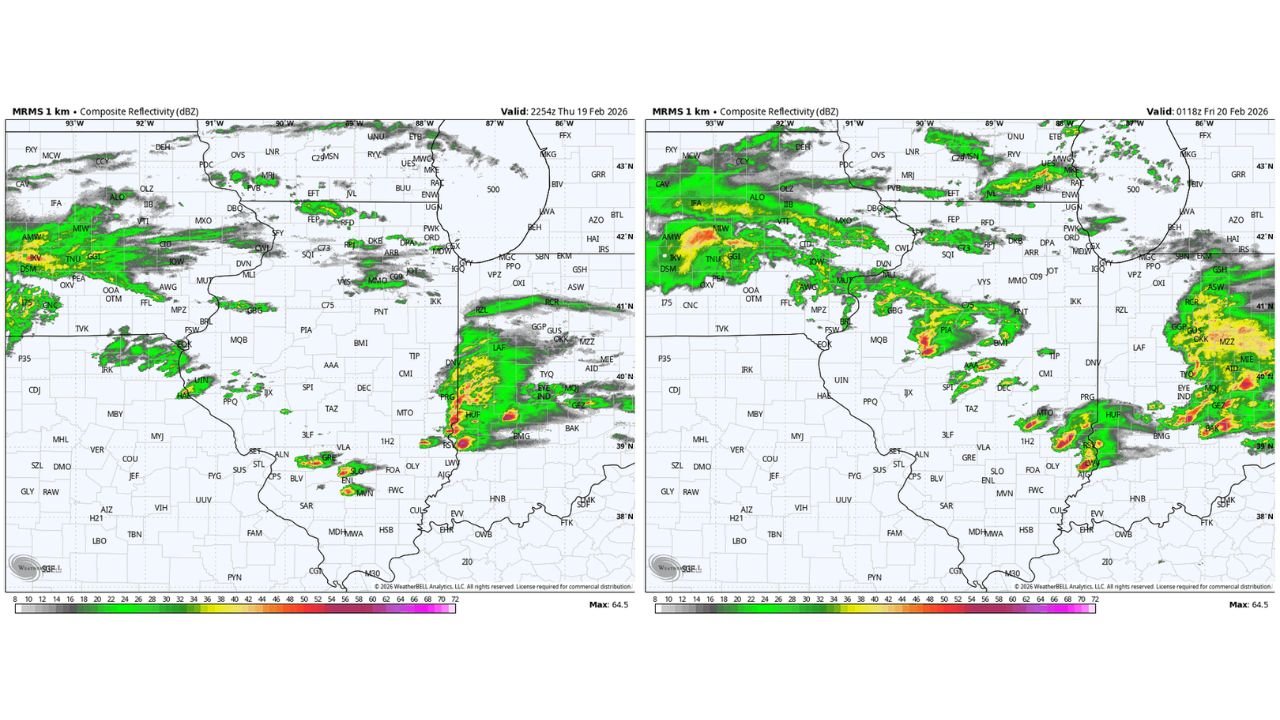
CHICAGO, ILLINOIS — A burst of severe thunderstorms that intensified across portions of Illinois and Indiana late Thursday afternoon quickly weakened after sunset, as the atmospheric ingredients fueling the storms rapidly diminished. Radar imagery shows storms peaking shortly before 5 p.m. CT before gradually losing strength by 7:18 p.m. CT.
The event was heavily dependent on daytime heating, and once the sun set, the severe weather threat diminished just as quickly as it developed.
Late Afternoon Intensification Across Central Illinois and Indiana
At approximately 4:54 p.m. CT, radar showed strengthening storm clusters across parts of east-central Illinois and western Indiana. Notable areas of stronger reflectivity appeared near and southeast of Peoria (PIA) and extending toward Champaign (CMI) and into portions of Indiana near Terre Haute and Bloomington.
Additional scattered storms were observed across:
- Western Illinois, including areas west of the Mississippi River
- Portions of northern Illinois, though less organized
- Eastern Iowa, with clusters approaching the Illinois border
Reflectivity values indicated embedded stronger cores within otherwise scattered convection, suggesting localized heavy rainfall and isolated strong wind gusts during peak heating hours.
Rapid Weakening by Early Evening
By 7:18 p.m. CT, radar imagery revealed a notable decrease in intensity across central Illinois. Storm clusters that had earlier shown stronger reflectivity became more fragmented and less organized.
While thunderstorms remained visible across parts of:
- Central Illinois
- Western Indiana
- Areas south toward the Illinois–Missouri border
The overall severe threat had substantially diminished. Storm tops lowered, and reflectivity values weakened as instability declined with sunset.
This rapid weakening trend aligns with an environment that was primarily driven by surface-based instability generated during afternoon sunshine.
Why Daytime Heating Was Critical
Meteorologists noted that the severe setup depended heavily on daytime solar heating. As clouds broke earlier in the day, surface temperatures increased, boosting instability across central Illinois and Indiana.
Key factors included:
- Afternoon sunshine increasing surface temperatures
- Modest moisture availability
- Localized convergence zones
However, once the sun lowered toward the horizon, instability values dropped quickly. Without continued heating, updraft strength weakened, leading to a rapid end to the more intense storm phase.
This type of pattern is common during early spring severe setups in the Midwest, where storms thrive during peak heating but struggle to maintain strength after dark.
Scattered Activity Elsewhere in the Midwest
Beyond Illinois and Indiana, radar also showed scattered showers and storms across:
- Eastern Iowa
- Southern portions of Wisconsin
- Western sections of Ohio
However, these areas also experienced diminishing intensity as the evening progressed.
No widespread organized line or long-lived severe complex developed, reinforcing that this was primarily a heating-driven event rather than a strongly forced overnight system.
What This Means for the Chicago Region
For the Chicago metropolitan area, storms remained mostly scattered and less intense compared to areas farther south and east. The most concentrated activity stayed closer to central Illinois and into Indiana.
With the sun set and instability fading, the severe weather risk effectively ended for the evening across northern Illinois.
Residents across Illinois and Indiana can expect calmer overnight conditions, with any remaining showers gradually weakening.
As Midwest communities move past this brief late-day severe episode, the event serves as a reminder of how quickly springtime storms can intensify — and how equally fast they can fade once daytime heating disappears. For continued regional weather updates and Midwest storm analysis, visit ChicagoMusicGuide.com.