Illinois Drivers Must Display Front and Rear Plates While Many Southern States Require Only One, National Map Shows
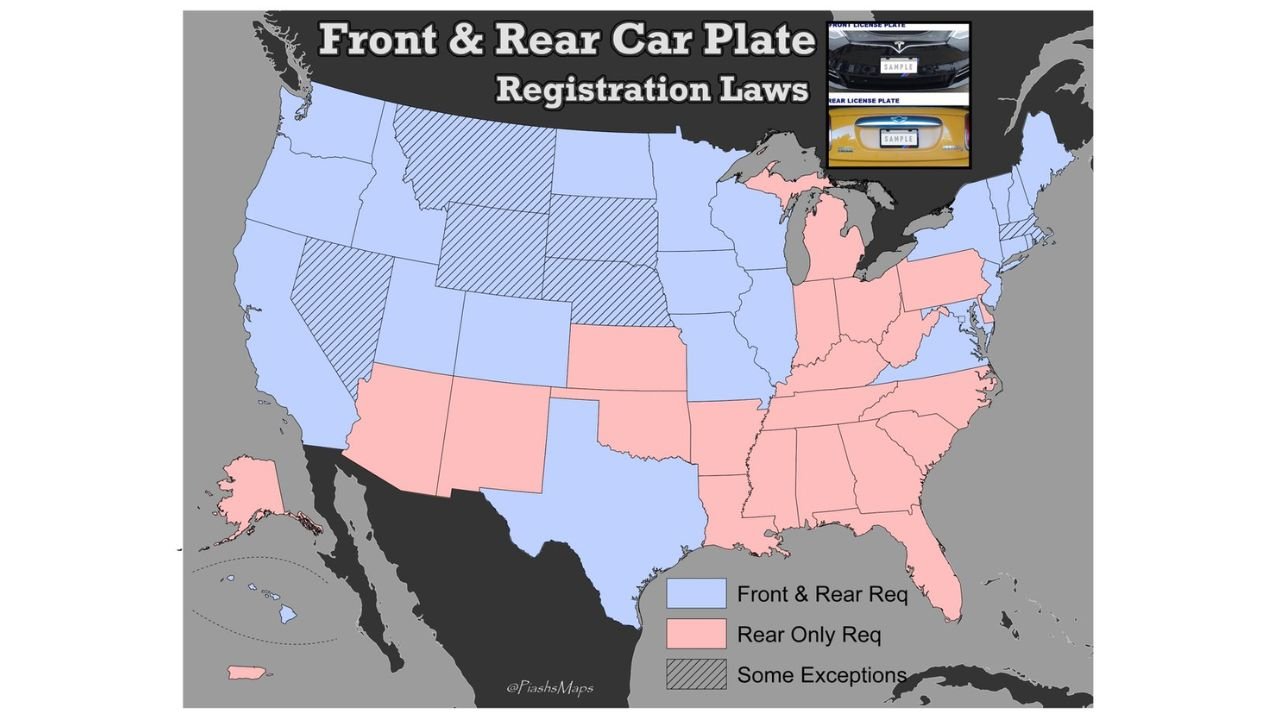
CHICAGO, ILLINOIS — Drivers in Illinois are legally required to display both a front and rear license plate, a rule that places the state among those with stricter vehicle registration display laws nationwide. A newly shared national map outlining Front & Rear Car Plate Registration Laws shows a clear regional divide, with many Southern states requiring only a rear plate while Midwestern and Western states often mandate two.
The visual breakdown categorizes states into three groups: Front & Rear Required, Rear Only Required, and Some Exceptions, revealing how varied license plate regulations are across the United States.
Illinois and Much of the Midwest Require Two Plates
According to the map, Illinois, along with neighboring states such as Wisconsin, Minnesota, and much of the western United States including California, Washington, and Oregon, require drivers to mount plates on both the front and rear of their vehicles.
This requirement is typically enforced for passenger vehicles and is designed to assist with law enforcement identification, traffic camera enforcement, and vehicle tracking in investigations. States like Colorado, Utah, and Nevada are also shown in the two-plate category, though some western states display “some exceptions,” meaning certain vehicle types may qualify for rear-only registration.
In the Midwest, Illinois remains consistent with its long-standing registration rules, and drivers who fail to display a front plate may face fines.
Southern States Largely Allow Rear-Only Plates
The map shows a strong cluster of rear-only plate states across the South and parts of the East Coast. States including Florida, Georgia, Alabama, Mississippi, Tennessee, and North Carolina are marked as requiring only a rear plate for most passenger vehicles.
Other rear-only states include South Carolina, Arkansas, Indiana, Ohio, and Michigan. In these areas, drivers are not required to mount a front plate unless operating specific commercial or specialty vehicles.
This regional difference often sparks debate among drivers who relocate between states. For example, a driver moving from Florida to Illinois must install a front bracket to comply with Illinois law, while someone relocating in the opposite direction may no longer need one.
Western and Mountain States Show Mixed Exceptions
The striped “Some Exceptions” category appears across parts of the Mountain West, including Montana, Wyoming, and sections of neighboring states. These states may require two plates for standard passenger vehicles but allow rear-only registration for certain vehicle weights, specialty registrations, or classic cars.
The variation underscores how registration rules are not uniform nationwide. Even within two-plate states, exceptions can apply depending on:
- Vehicle weight classification
- Specialty or antique plates
- Commercial registration status
- Manufacturer design limitations
Drivers are encouraged to review specific state DMV regulations when registering vehicles or transferring plates across state lines.
Why Two-Plate Laws Exist
States requiring both plates often cite enhanced traffic enforcement visibility and improved identification in automated license plate reader systems. Front plates can also assist law enforcement in identifying vehicles approaching an officer rather than only after they pass.
However, critics argue that front plates can:
- Increase vehicle modification costs
- Interfere with vehicle design aesthetics
- Require drilling into bumpers for installation
Despite ongoing legislative discussions in some states, Illinois continues to require two plates, maintaining its position among stricter display-law states.
What Illinois Drivers Should Know
For Illinois residents, the rule remains clear: passenger vehicles must display a front and rear license plate unless specifically exempted by state regulation. Driving without a front plate in Illinois can result in a citation, even if the vehicle is properly registered.
The national map provides a helpful overview for drivers traveling across state lines, especially those attending events, relocating, or purchasing vehicles from out-of-state dealerships.
As vehicle registration laws continue to evolve nationwide, drivers should remain aware of their state’s requirements to avoid fines and ensure compliance. For more updates on state regulations, public policy shifts, and transportation news affecting drivers in Illinois and beyond, visit ChicagoMusicGuide.com.