Rhode Island, Massachusetts and New York Buried Under Three Feet of Snow as Historic 2026 Northeast Blizzard Becomes Once-in-25-Year Event
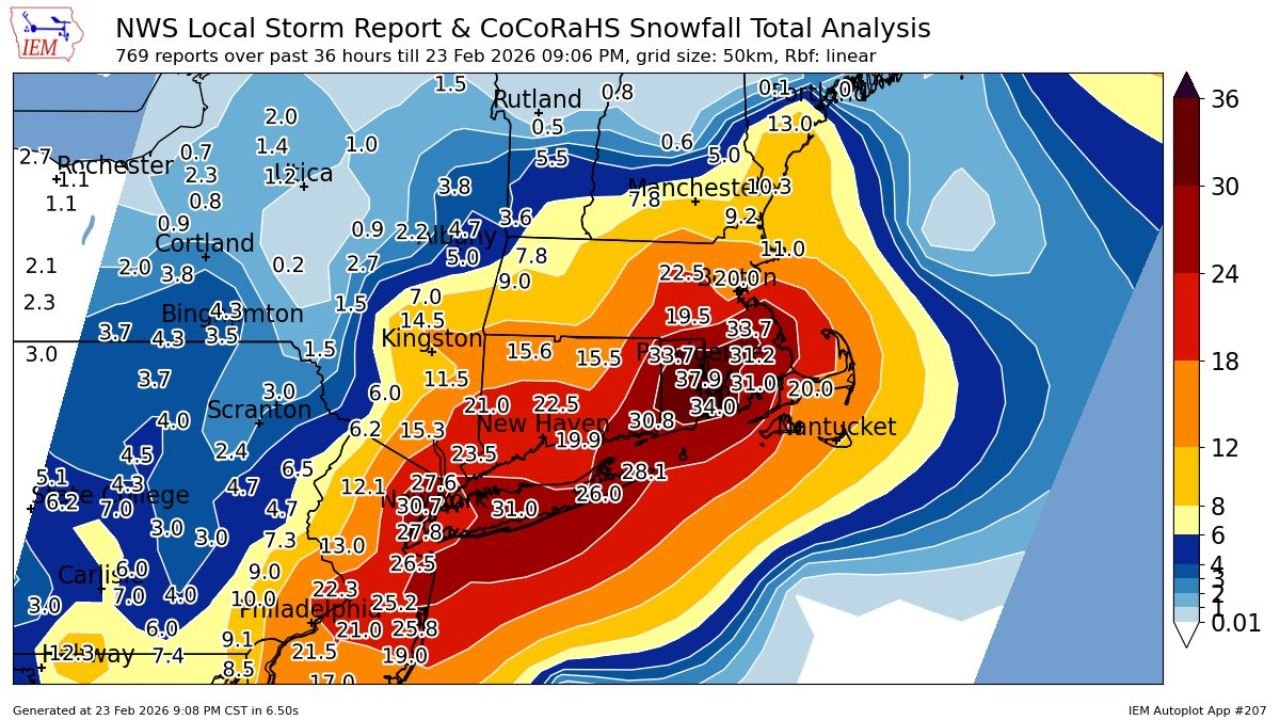
PROVIDENCE, RHODE ISLAND — A historic winter storm has buried parts of Rhode Island, Bristol County, Massachusetts, and much of southeast New England under more than three feet of snow, marking what forecasters are calling the region’s biggest snowstorm since January 20–23, 2005. Reports compiled through February 23, 2026, show staggering totals exceeding 30 inches, with some communities pushing toward 38 inches.
According to the latest NWS Local Storm Report & CoCoRaHS Snowfall Total Analysis, the storm delivered exceptional snowfall across coastal Massachusetts, Rhode Island, and much of Long Island, New York. Nearly 769 reports were logged within a 36-hour window, confirming the scale of the event.
Record-Breaking Totals Across Rhode Island and Massachusetts
The hardest-hit areas centered over Rhode Island, where snowfall totals reached an astonishing 37.9 inches in parts of the state. Nearby Bristol County, Massachusetts, also recorded over three feet of accumulation, firmly placing this storm in the record books.
Communities surrounding Providence, Newport, and coastal Massachusetts were engulfed in deep red bands on snowfall analysis maps, signifying totals between 30 and 36+ inches. In South Plymouth, Massachusetts, residents reported more than 30 inches, reinforcing the storm’s historic nature for southeast New England.
Meteorologists have described this system as a “once in 20 to 25 year event” for the region — a benchmark that highlights just how rare such widespread three-foot totals truly are.
New York’s Long Island Hammered With Two to Three Feet
While Rhode Island and Massachusetts led the totals, much of Long Island, New York, saw between 24 and 30+ inches of snow. Areas from Islip through Riverhead and toward the eastern tip experienced sustained heavy snowfall bands.
In several Long Island communities, measurements exceeded 31 inches, with snowfall analysis indicating pockets near 34 inches. The intense snow rates and prolonged duration led to hazardous travel conditions, stranded vehicles, and widespread school and event cancellations.
Western portions of Connecticut, including areas near New Haven, reported totals between 21 and 23 inches, while snowfall tapered sharply westward toward Scranton, Pennsylvania, and upstate New York, where totals dropped to under 10 inches in many locations.
A Storm Not Seen Since 2005 Across the Northeast
The magnitude of this blizzard is being compared to the historic January 20–23, 2005 snowstorm that paralyzed much of New England. For many longtime residents in Rhode Island, Massachusetts, and New York, this week’s storm stands as the most significant winter event in over two decades.
Snowfall gradients were dramatic. While coastal Massachusetts, Rhode Island, and Long Island, New York were buried under three feet, areas just 100 miles inland saw totals closer to 6 to 12 inches. The sharp cutoff highlights the powerful coastal dynamics that fueled the storm.
Heavy banding, ocean-enhanced moisture, and prolonged wraparound snowfall contributed to the extreme totals. In places like Kingston, New York, totals reached around 14 to 15 inches, while Manchester, New Hampshire, saw lower but still impactful accumulations around 7 to 10 inches.
Regional Impact and What Comes Next
The aftermath across Rhode Island, Massachusetts, and New York includes extensive snow removal operations, delayed transportation services, and potential coastal flooding concerns as cleanup begins. With snowfall depths exceeding three feet in some towns, plowing operations are expected to take several days.
Local officials are urging residents to clear snow from rooftops safely, avoid unnecessary travel, and monitor updates from the National Weather Service as temperatures fluctuate and refreezing risks increase.
For many in southeast New England, this blizzard will be remembered as a defining winter event — a storm that reshaped neighborhoods overnight and reminded residents just how powerful coastal systems can be.
As communities across Rhode Island, Massachusetts, and New York begin digging out from this historic snowfall, stay connected for continued updates on winter weather, travel advisories, and regional impacts. For ongoing coverage of major weather events and community news, visit ChicagoMusicGuide.com.