West’s Record-Breaking Heat and East Coast’s Deep Freeze Combine to Make Winter 2025–26 the Second Warmest Ever Recorded in the United States
UNITED STATES — Millions across the East Coast endured one of their coldest winters in decades, but extraordinary warmth across the Western United States pushed Winter 2025–26 into the record books as the second warmest winter ever recorded nationwide.
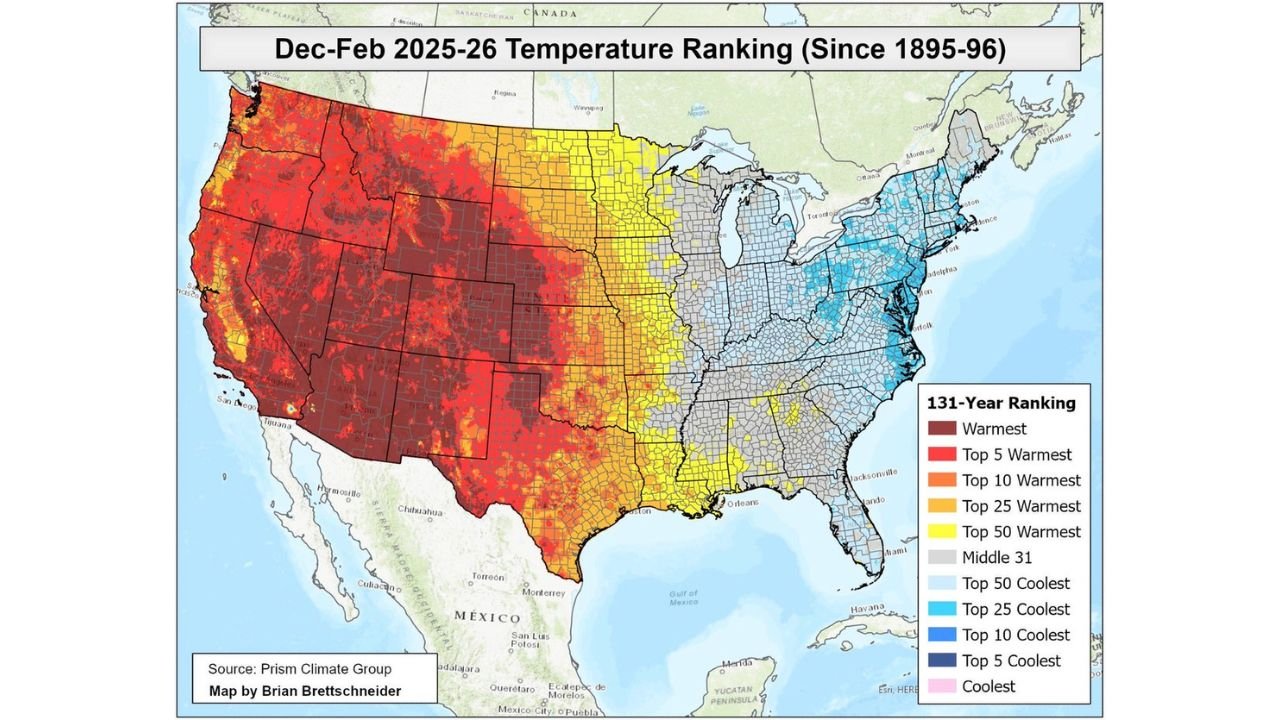
New temperature ranking maps for December through February 2025–26, based on data dating back to 1895–96, show a dramatic east-to-west temperature divide across the country.
Western U.S.: Near-Record and Record Warmth
The most striking feature on the national map is the expansive area of deep red shading across the West, indicating:
- Warmest winter on record in parts of the Southwest and Interior West
- Top 5 warmest winters across large portions of California, Nevada, Arizona, Utah, Colorado, New Mexico, Oregon, Washington and Idaho
- Broad regions ranking in the Top 10 to Top 25 warmest categories
States such as Arizona, New Mexico, Nevada and Utah show widespread “warmest” designations, highlighting the intensity and consistency of the warmth.
This extreme western heat heavily influenced the national average, overwhelming colder anomalies elsewhere.
Central U.S.: Mixed but Generally Mild
Across the Plains and Midwest, conditions were more mixed:
- Parts of Texas and Oklahoma ranked among the Top 10 to Top 25 warmest
- The northern Plains trended warmer than average
- Portions of the Midwest fell closer to the long-term middle ranking
The central U.S. did not experience the extreme warmth of the West, but overall leaned mild enough to contribute to the high national ranking.
East Coast: One of the Coldest Winters in Decades
In sharp contrast, the East Coast stands out in blue shading, indicating significantly cooler conditions.
Areas from:
- Virginia and the Carolinas
- Through Pennsylvania, New York and New England
- Down portions of the Mid-Atlantic
ranked within:
- Top 25 coldest winters
- Some pockets in the Top 10 coldest
For millions in the Northeast and Mid-Atlantic, it felt like a throwback winter — frequent cold spells, persistent chill and below-normal temperatures.
Yet even this prolonged eastern cold could not offset the magnitude of warmth across the western half of the country.
How the U.S. Ended Up Second Warmest Overall
Despite regional cold extremes, the West’s overwhelming warmth dominated the national temperature average.
When aggregating temperature data across all states:
- The magnitude of western warmth
- Its geographic coverage
- And its placement among the highest ranks in a 131-year record
were enough to push the entire country into its second warmest winter on record.
This illustrates how national climate rankings can look very different from local experience.
What It Means Going Forward
Such a pronounced temperature gradient often reflects:
- Persistent upper-level ridging in the West
- Frequent troughing over the East
- Jet stream patterns favoring sharp regional contrasts
As spring approaches, these long-wave patterns may gradually shift — but the winter of 2025–26 will be remembered for its extreme split personality.
For residents in California and the Southwest, it was historic warmth. For those in the Northeast, it felt like one of the coldest winters in recent memory.
ChicagoMusicGuide.com will continue tracking national weather trends and how large-scale climate patterns are shaping conditions across the United States.