Alabama, Mississippi, Georgia and Florida Storm Outbreak Delivers Hundreds of Wind Reports as Tornado Threat Falls Short of Expectations
UNITED STATES — A recent severe weather outbreak across Alabama, Mississippi, Georgia, and Florida delivered hundreds of damaging wind reports, even as the anticipated tornado threat underperformed expectations. Data from March 15–17, 2026 shows that while tornado activity was limited, the overall storm system still produced significant impacts across the Southeast.
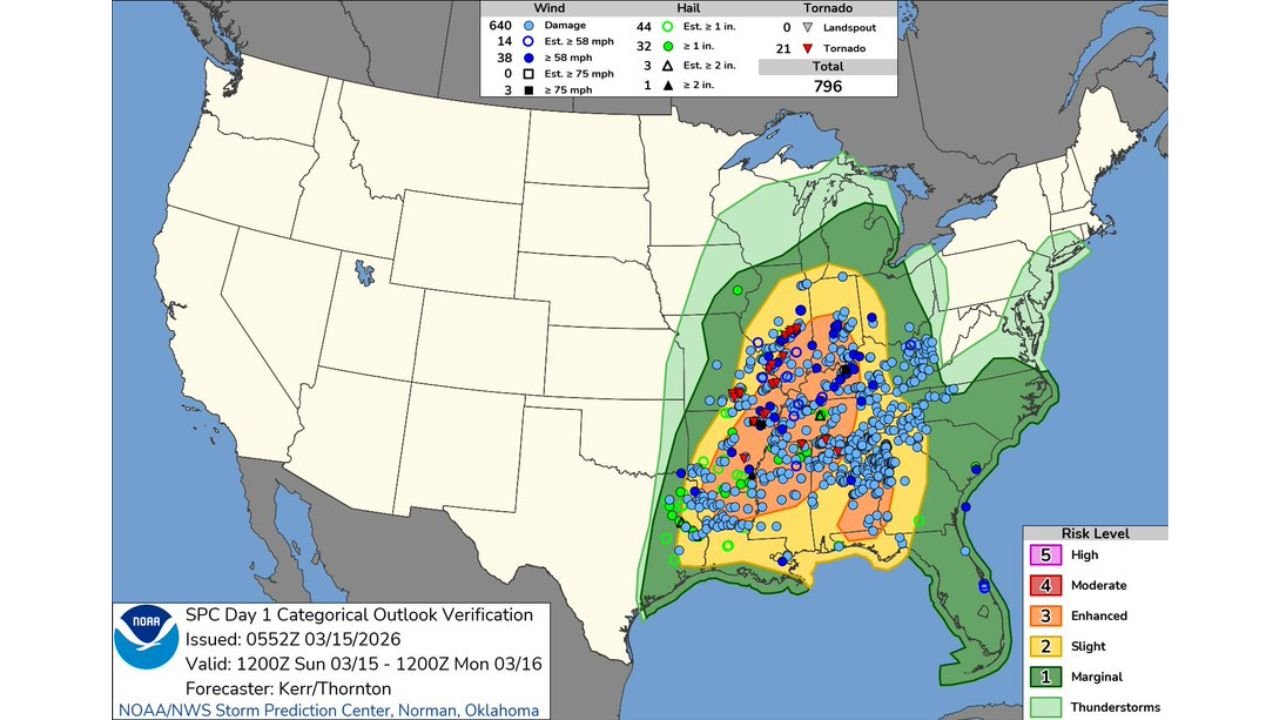
Forecast verification maps reveal a widespread zone of storm activity stretching from Mississippi and Alabama into Georgia and Florida, with a high concentration of wind damage reports and severe thunderstorm activity.
Widespread Wind Damage Across Alabama, Mississippi and Georgia
Storm data confirms that Alabama, Mississippi, and Georgia experienced the most widespread impacts, with hundreds of wind reports recorded across the region. The strongest activity was concentrated in areas under an enhanced to moderate risk zone, where storms produced damaging gusts and scattered severe weather.
The verification data shows a dense cluster of storm reports across central Alabama and Mississippi, extending into parts of Georgia, indicating that the system was highly active despite not reaching its full tornado potential.
While tornado reports were limited compared to forecasts, the volume of wind-related damage highlights the strength of the storm system. Many areas experienced downed trees, power outages, and localized structural damage.
Florida and East Coast See Continued Storm Activity Into March 17
As the system progressed eastward, Florida and parts of the East Coast, including Georgia and the Carolinas, saw continued storm development into March 16 and March 17, 2026. The risk shifted from the Deep South toward the Atlantic coast, bringing additional rounds of strong thunderstorms and heavy rainfall.
Verification maps show a corridor of storm reports extending along the Florida Peninsula and up the Eastern Seaboard, with a mix of wind and limited tornado activity. The distribution of reports suggests that while storms remained active, their intensity varied as they moved east.
Cities across northern Florida and coastal Georgia were among the areas that experienced the most consistent storm impacts during this phase.
Why the Tornado Threat Fell Short of Forecast Expectations
Meteorologists note that while the overall severe weather setup was strong, several limiting factors reduced the tornado threat. One key issue was the presence of morning rain and cloud cover, which likely disrupted atmospheric instability.
This reduced the ability of storms to organize into stronger rotating systems capable of producing tornadoes. As a result, the event did not fully meet the expectations associated with a Level 4 (moderate) risk outlook.
However, experts emphasize that even when tornado potential is lower than expected, severe weather events can still produce significant impacts through wind and hail, as seen in this case.
Short Break Ahead Before Next Severe Weather Pattern Builds
Following this active period, meteorologists indicate that the Southeast United States, including Alabama, Mississippi, Georgia, and Florida, may experience a temporary break in severe weather activity over the next 8 to 10 days.
This quieter period is expected to provide some relief before conditions potentially become more active again toward late March and early April, when another pattern shift could bring renewed severe weather risks.
Forecasters stress that while this recent event may not have met all expectations, it still demonstrated the unpredictable nature of severe weather forecasting and the importance of preparing for multiple types of storm impacts.
As the Southeast continues to recover from this widespread storm event across Alabama, Mississippi, Georgia, and Florida, attention now turns to the next potential severe weather pattern on the horizon. Even when forecasts don’t fully align with outcomes, the impacts can still be significant. For continued updates on severe weather events and forecast developments across the United States, visit ChicagoMusicGuide.com.