United States Sees Stunning +21°F National Temperature Anomaly on March 20 as Records Fall from California and Texas to New York and Florida
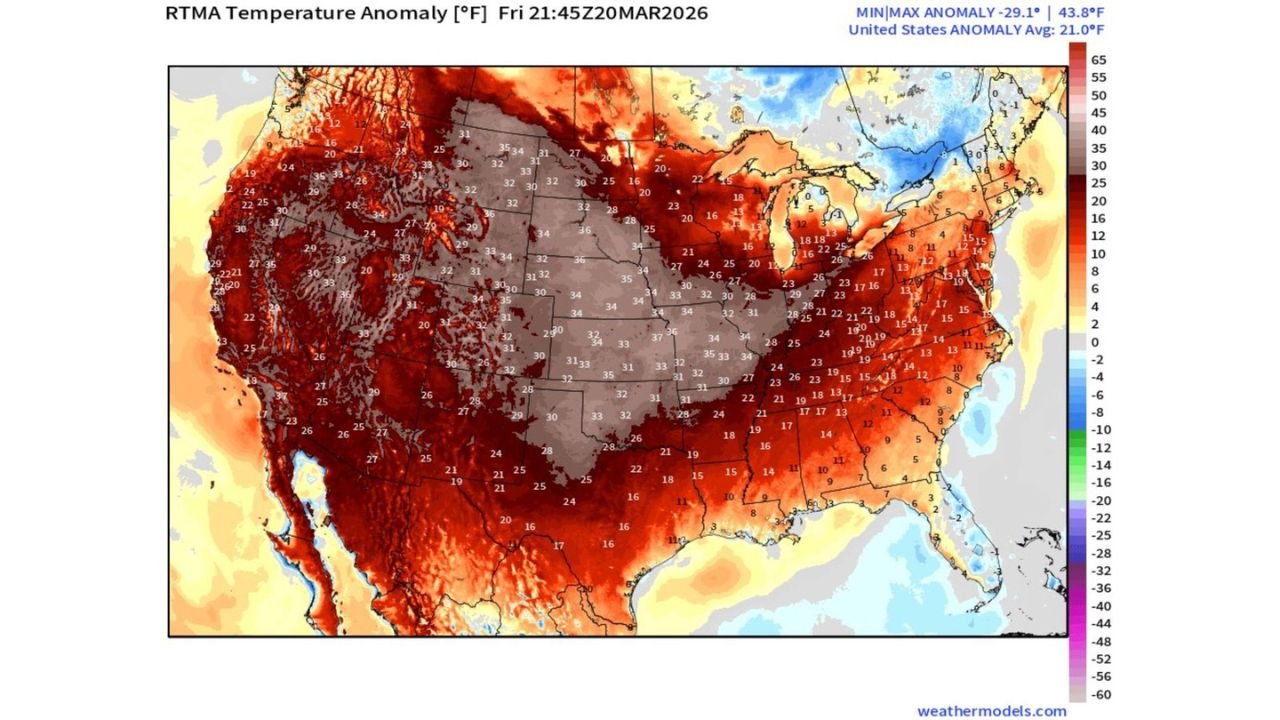
WASHINGTON, D.C. — The United States experienced a staggering +21°F national temperature anomaly on March 20, 2026, compared to the 1991–2020 climate baseline, an extraordinary departure from normal conditions for early spring. Real-time temperature anomaly data shows widespread warmth saturating nearly every region of the country, with record highs either tied or broken from California and Arizona to Texas, the Midwest, and the East Coast.
Forecasters describe the scale of this warmth as unusual even by modern standards. The anomaly average of +21°F above normal nationwide represents the kind of value typically seen in extreme model projections — not widespread, real-time observations.
Coast-to-Coast Warmth Reshapes the Map
Temperature anomaly maps reveal deep red shading across the majority of the continental United States, signaling departures ranging from +15°F to +35°F above normal in many areas.
The most intense anomalies stretch across:
- California, Nevada, Utah, Arizona, and Colorado
- Texas, Oklahoma, Kansas, and the central Plains
- Minnesota, Wisconsin, Michigan, and the Upper Midwest
- Portions of the Mid-Atlantic and Northeast
Only small pockets of near-normal or slightly below-normal air appear across parts of New England and isolated sections near the Canadian border.
In many regions, the country resembled conditions more typical of late May than March, accelerating seasonal transitions and shattering long-standing daily records.
Western and Central U.S. Lead the Extremes
The western half of the country stands out with particularly intense positive anomalies. Parts of California, Nevada, Utah, and Arizona show temperature departures exceeding +25°F to +30°F above average.
Across the Rockies and High Plains, readings soared well beyond seasonal norms. Meanwhile, Texas and the Southern Plains also registered substantial warmth, reinforcing the national average surge.
The consistency of elevated temperatures across such a broad geographic footprint contributed heavily to the national anomaly reaching +21°F — an exceptionally high average when calculated across the entire country.
Midwest and East Also Join the Surge
The warmth did not stop in the West. The Midwest, including Illinois, Indiana, Ohio, Michigan, and Wisconsin, experienced widespread positive departures exceeding +15°F to +25°F above normal.
Even the Mid-Atlantic and portions of the Southeast, including Virginia, the Carolinas, and Georgia, saw temperatures running significantly above typical late-March values.
This uniformity of warmth — stretching from coast to coast — underscores the rarity of such a strong national-scale anomaly.
How Unusual Is +21°F Nationwide?
A +21°F national anomaly based on the 1991–2020 baseline is remarkable for any time of year, but especially for March. National anomalies typically fluctuate in the range of a few degrees above or below average.
For the country as a whole to average more than twenty degrees above normal requires:
- A dominant upper-level ridge pattern
- Suppressed cold air intrusions from Canada
- Strong solar heating combined with dry air masses
- Persistent warm air advection across multiple regions
The anomaly data also shows extremes on both ends of the spectrum, with maximum positive anomalies exceeding +40°F in localized areas, although those are not widespread.
Records Likely to Continue Falling
With warmth entrenched across much of the United States, daily record highs have already fallen in numerous cities, and additional records may be challenged as the pattern persists.
March 20 may ultimately stand out as one of the more anomalously warm late-winter days in recent memory, particularly due to the national average magnitude.
Meteorologists will closely monitor how long the ridge pattern holds and whether cooler air eventually returns to rebalance seasonal conditions.
As the United States navigates this extraordinary March warmth, continued monitoring of temperature trends and record reports remains essential. For ongoing updates on national weather patterns, record-breaking heat, and climate trends, visit ChicagoMusicGuide.com.