Fairbanks, Alaska Just Recorded Its Coldest Winter Season in Over 120 Years of History as the 2025-26 Season Crushes All Previous Records Back to 1904
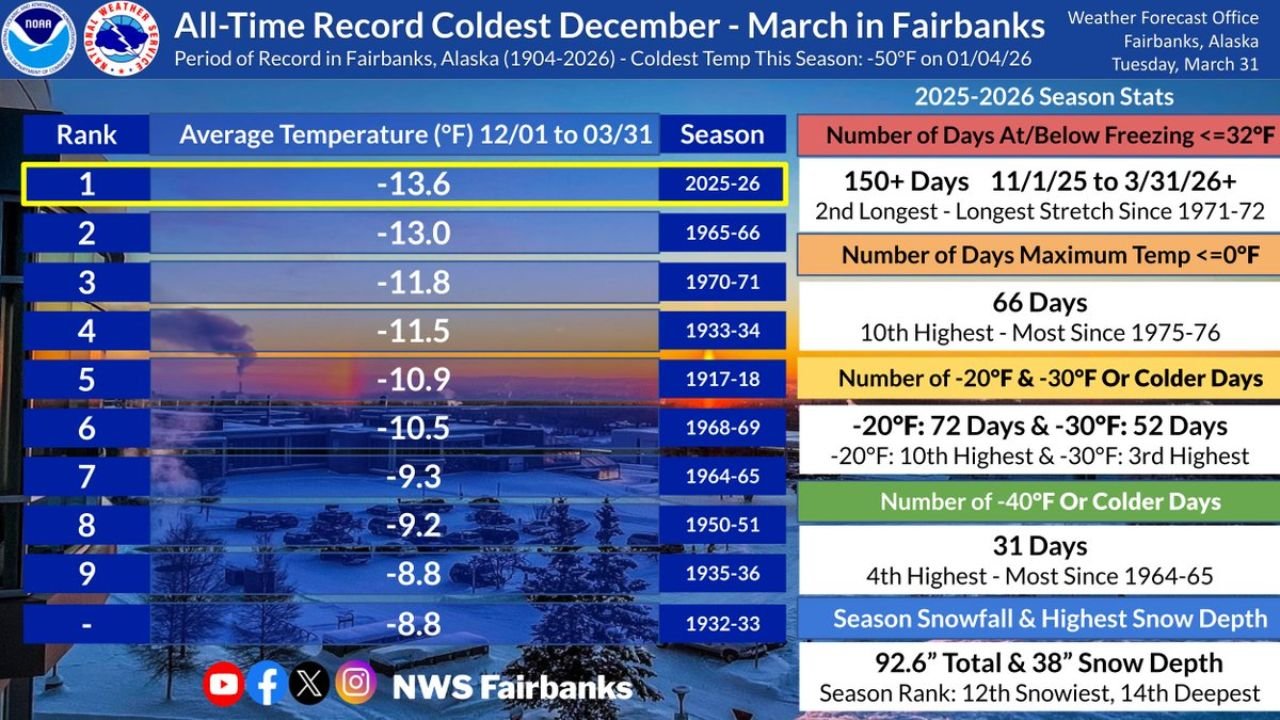
FAIRBANKS, AK — History was made in Fairbanks, Alaska — and it was made in the most brutal way possible. The numbers are now official, and the 2025-26 winter season has been confirmed as the all-time coldest December through March on record for one of America’s most extreme cold-weather cities, surpassing every season in a data record that stretches back more than 120 years to 1904.
The season that just closed did not just break a record. It shattered it — and the data behind that conclusion tells a story of relentless, historic cold that gripped interior Alaska for months without relief.
A Record That Stood for 60 Years Is Gone
For six decades, the coldest December-through-March season ever recorded in Fairbanks belonged to the 1965-66 winter, which logged an average temperature of -13.0°F over that four-month stretch. That record had survived every Arctic outbreak, every polar vortex intrusion, and every brutal interior Alaska winter for 60 years.
The 2025-26 season erased it.
Current official data confirms the December 1 through March 31 average temperature for Fairbanks this season came in at -13.6°F — beating the previous record by 0.6 degrees and claiming the top spot on a list that includes some of the coldest winters ever experienced anywhere in the United States. The record was issued by the National Weather Service Fairbanks office on Tuesday, March 31.
What makes this even more striking is the context. The season immediately before this one — the 2024-25 winter — ranked as the 2nd warmest December-March period on record for Fairbanks. In the span of a single year, the city swung from near the warmest extreme in its entire recorded history to the coldest extreme ever documented. That kind of back-to-back reversal is virtually without precedent in the climate record.
The Numbers Behind the Record
The season average of -13.6°F is just the headline. The full data profile of the 2025-26 Fairbanks winter reveals a season of extraordinary, sustained cold across nearly every measurable category.
The coldest single temperature recorded this season was -50°F on January 4, 2026 — a reading that would be dangerous anywhere in the continental United States but is especially significant even by Alaska standards, representing the kind of deep freeze that can disable vehicles, burst pipes, and make outdoor exposure life-threatening within minutes.
Days at or below freezing — defined as temperatures at or below 32°F — stretched to 150 or more consecutive days, running from November 1, 2025 through at least March 31, 2026. That is the second longest continuous stretch of below-freezing conditions recorded in Fairbanks since 1971-72, meaning an entire five-month period where temperatures never once climbed above the freezing point.
The city also recorded 66 days where the high temperature never broke 0°F — the 10th highest total on record and the most since 1975-76. On 72 separate days, temperatures dropped to -20°F or colder. On 52 days, the mercury fell to -30°F or below — the 3rd highest total in the historical record. Perhaps most remarkably, Fairbanks recorded 31 days at -40°F or colder this season, the 4th highest total ever recorded and the most since 1964-65.
Full Season Data at a Glance
| Record Category | 2025-26 Value | Historical Rank |
|---|---|---|
| Dec-Mar Average Temperature | -13.6°F | #1 All-Time Coldest (1904-2026) |
| Previous Record (1965-66) | -13.0°F | #2 All-Time |
| Coldest Single Temperature | -50°F (Jan 4, 2026) | Season coldest |
| Days At/Below Freezing (32°F) | 150+ days | 2nd Longest Since 1971-72 |
| Days With High Temp At/Below 0°F | 66 days | 10th Highest; Most Since 1975-76 |
| Days At -20°F or Colder | 72 days | 10th Highest |
| Days At -30°F or Colder | 52 days | 3rd Highest |
| Days At -40°F or Colder | 31 days | 4th Highest; Most Since 1964-65 |
| Season Snowfall Total | 92.6 inches | 12th Snowiest on Record |
| Highest Snow Depth | 38 inches | 14th Deepest on Record |
What This Record Means
🔴 All-Time Record Broken — The 2025-26 season average of -13.6°F is the coldest December-March period ever recorded in Fairbanks, Alaska across 122 years of data. No winter in recorded history comes close.
🔴 Cold Extremes Dominated All Season — With 31 days at -40°F or colder and 52 days at -30°F or colder, this was not a season with a few cold snaps. It was a season of relentless, deep cold that persisted for months across interior Alaska.
🟠 The Year-Over-Year Swing Is Extraordinary — The shift from the 2nd warmest December-March on record in 2024-25 to the all-time coldest in 2025-26 represents one of the most dramatic single-year temperature reversals in Fairbanks history.
🟡 Snowfall Was Significant but Not Record-Breaking — The 92.6 inches of total snowfall and 38-inch snow depth ranked 12th snowiest and 14th deepest respectively, notable but outside the top 10 in both categories. The story of this season is cold, not snow.
🟢 Southern Alaska — This record is specific to the Fairbanks interior. Coastal and southern Alaska experienced different conditions this season, and the all-time cold record applies exclusively to the Fairbanks station data.
Forecast Confidence on the Record
Confidence Level: Confirmed. This is not a forecast — it is an officially verified climate record issued by the National Weather Service Fairbanks office. The season is closed and the data is final. The 2025-26 December-March average temperature of -13.6°F in Fairbanks, Alaska is now permanently entered into the all-time climate record as the coldest such period since observations began in 1904.
More record-breaking weather history is always on the horizon. Stay informed at ChicagoMusicGuide.com — your source for extreme weather records and climate events across Alaska and the entire United States.