
Euro Snow Model Signals Major Two-Week Snow Boost for Washington, Oregon, and California as Cascades and Sierra Load Up
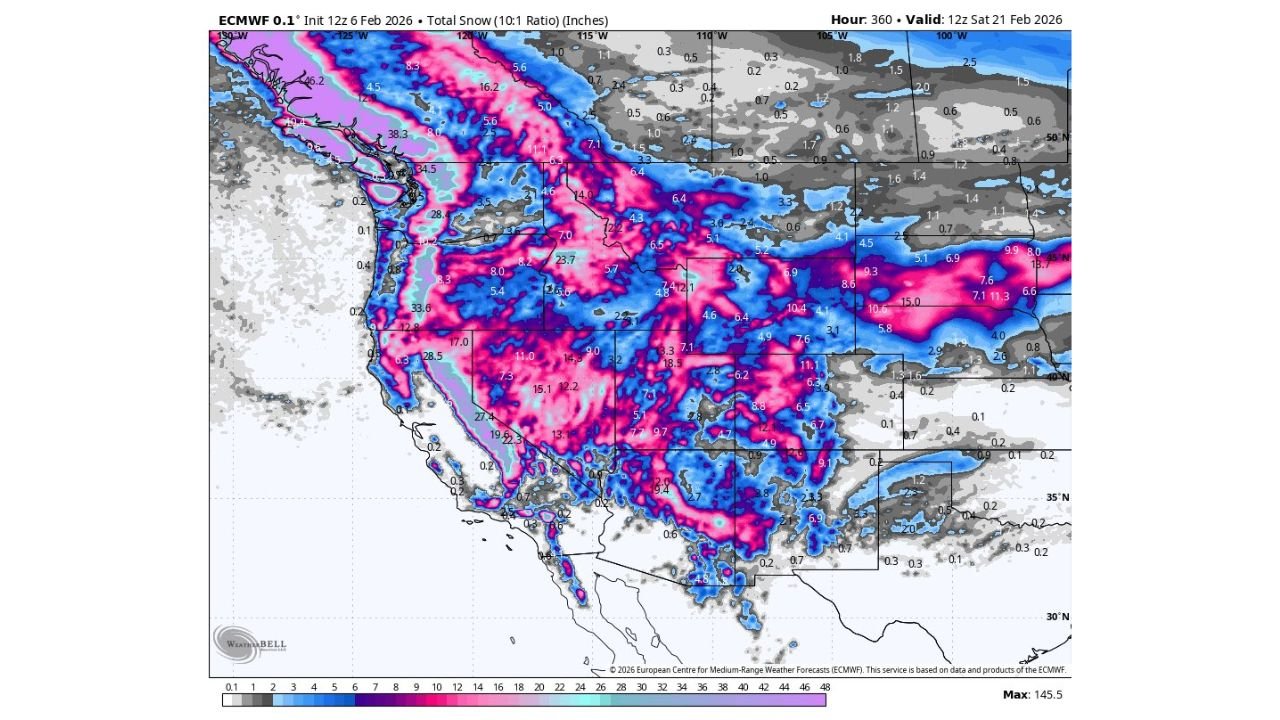
UNITED STATES — A new Euro model (ECMWF) snow projection is pointing to a meaningful two-week snow boost across the Western United States, with the strongest signal aimed at the Cascades and the Sierra Nevada. The map’s “total snow” output suggests a broad, active storm track that keeps feeding mountain snowfall through mid-to-late February, creating the kind of pattern that can rapidly improve conditions for higher-elevation travel, ski terrain, and water supply in snow-dependent basins.
This outlook is based on an ECMWF 0.1° total snow (10:1 ratio) view initialized 12z Feb. 6, 2026, and valid out to 12z Saturday, Feb. 21, 2026, showing cumulative snow potential across multiple Western ranges rather than a single storm snapshot.
What the Euro Model Map Is Signaling for the Western U.S. Through Feb. 21
The biggest takeaway from the map is simple: the West stays “in the game” with repeated chances for snowfall, and the mountain corridors light up more consistently than the lowlands. The color spread is broad and persistent across the Pacific Northwest, the Great Basin, the Central and Northern Rockies, and down into parts of the Southwest high terrain.
In other words, this isn’t one isolated hit. It’s a pattern that keeps producing snow across multiple states and multiple elevations—an important distinction because it can compound impacts over time, especially in areas that stack storms efficiently.
The map also shows that totals are highly terrain-driven. In the West, snow outcomes frequently depend on where storms intersect with the right elevation and slope orientation. That’s why the highest numbers cluster along major mountain chains, while nearby valleys can remain much lower.
Cascades and Sierra Nevada: The Two Biggest Snow Magnets in This Setup
The text attached to the map calls out the Cascades and the Sierra as the main winners, and the visual output matches that theme with repeated high-end shading over those ranges.
For the Cascades—spanning Washington and Oregon—the Euro map indicates an extended period where storm energy keeps reloading along the Pacific side. That’s the kind of signal that often translates into multiple rounds of accumulating snow at higher elevations, particularly when colder air frequently refreshes behind each system.
For the Sierra Nevada in California, the map similarly suggests a sustained snow pattern with strong totals concentrated along the spine of the range. When the Sierra is highlighted like this on a longer-range total snow view, it usually implies that storms are not only arriving—but arriving with enough cold support to keep higher terrain snow-dominant.
Even without pinning exact resort-by-resort numbers, the map’s strongest corridor supports the idea of “a bunch” of snow for both ranges—exactly the kind of two-week run that can quickly reshape mountain conditions.
Where Else the Euro Map Shows Snow Adding Up Across the West
Beyond the Cascades and Sierra, the map shows widespread accumulating potential across several key regions:
- Northern Rockies (including portions of Idaho, Montana, and Wyoming) show repeated snow shading consistent with a steady supply of mountain snowfall.
- Intermountain West (including parts of Nevada and Utah) shows meaningful coverage in higher terrain zones where systems can wring out moisture as they move inland.
- Colorado Rockies and surrounding high country are also included in the broader snow footprint, suggesting at least periodic shots of accumulating snow through the period.
- Arizona and New Mexico high terrain show pockets of snow potential as well—typically tied to elevation-focused accumulation rather than widespread lowland snow.
This kind of broad map signal usually favors the mountain travel corridors (passes and higher routes) seeing recurring impacts. When totals compound across two weeks, even moderate “storm-by-storm” events can add up quickly.
Why This Two-Week Snow Run Matters for Travel, Events, and Weekend Plans
A prolonged Western snow pattern doesn’t just affect ski areas—it affects everything that moves through mountain regions. If the Euro-style scenario verifies, these are the practical implications many people feel first:
Mountain travel disruptions become more likely when storms keep coming. Pass conditions can change rapidly, chain requirements become common, and closures are more frequent when crews are dealing with repeated snow instead of a single cleanup event.
Visibility and road traction concerns can pop up repeatedly, especially in the Cascades where wind-driven snowfall can reduce visibility on exposed routes, and in the Sierra where heavy snow periods can quickly overwhelm roads.
Event planning and touring logistics can also become more complicated in Western metro hubs connected to mountain corridors. Even if cities are not buried, travel into and out of regions that rely on mountain highways can become unpredictable. That matters for weekend trips, festival travel, and anyone driving to shows in mountain-adjacent areas.
For readers who follow live music and travel-heavy weekends, this is the kind of extended snow pattern that can quietly reshape plans—especially when storms arrive in waves instead of one clean window.
If you’re watching the Euro model snow map for signs of a Western comeback, this is a notable signal: the Cascades and Sierra Nevada are positioned to benefit the most, with widespread mountain snow potential across much of the Western United States through Feb. 21, 2026. For more Weather updates that help you plan trips, concerts, and weekend travel, visit ChicagoMusicGuide.com.