
Historic Polar Vortex Collapse Over Greenland Sends 500mb Temperatures to -58.5°C, Raising Threat of Near -80°F Surface Cold
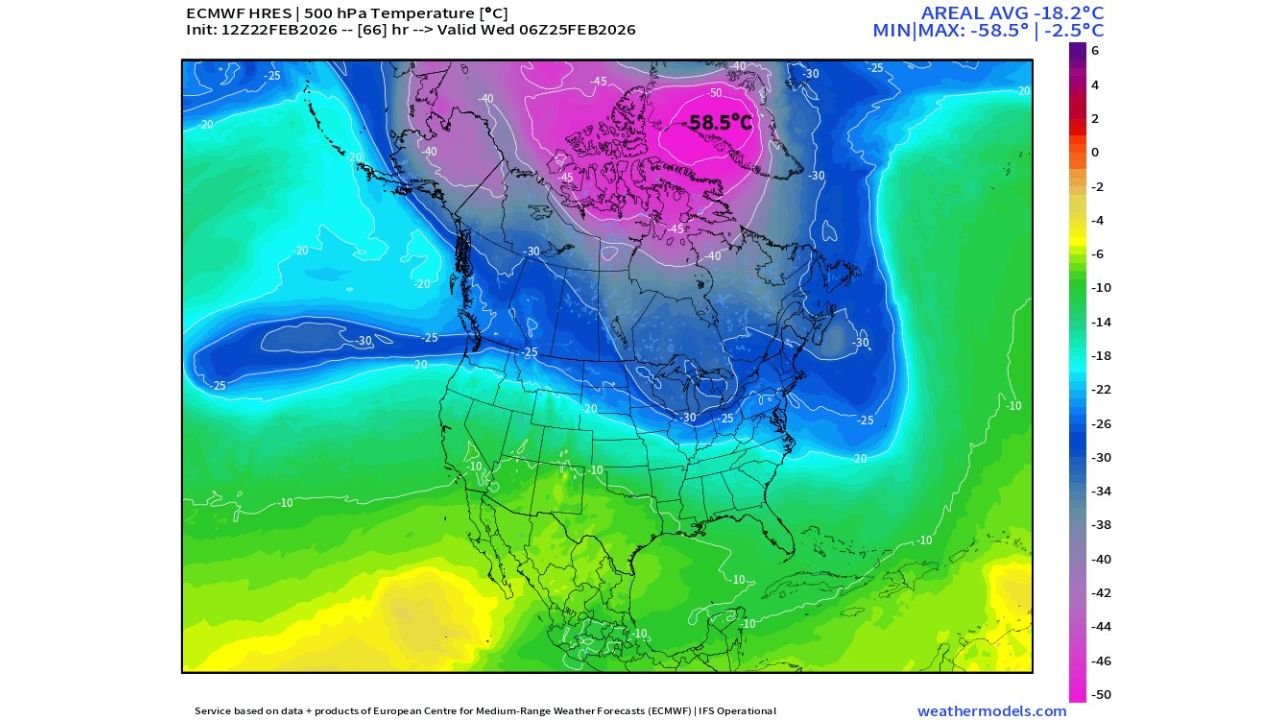
GREENLAND — A historically intense tropospheric polar vortex is forecast to engulf Greenland this week, with model guidance showing 500mb temperatures plunging to -58.5°C, a level cold enough to support dangerously extreme surface readings under ideal radiational cooling conditions.
The latest ECMWF high-resolution data valid early Wednesday shows a deeply consolidated Arctic air mass centered directly over Greenland, highlighted by widespread magenta shading indicative of extraordinary mid-level cold.
500mb Temperatures Near -58.5°C
At roughly 18,000 feet above sea level (500mb level), temperatures are forecast to reach:
- -58.5°C across central Greenland
- Widespread -45°C to -50°C across surrounding Arctic regions
For context, these values represent the cold core of the polar vortex at peak intensity.
When air this cold dominates the mid-levels of the atmosphere, it often correlates with:
- Extremely stable air
- Minimal moisture
- Clear skies
Clear Skies + Radiational Cooling = Extreme Surface Cold
Forecast commentary suggests:
- Near-zero moisture levels
- Clear skies overnight
- Strong longwave radiational heat loss
These factors can allow the snow-covered surface to cool dramatically after sunset.
With such a cold air mass overhead, surface temperatures across Greenland could potentially drop into the -80s Fahrenheit, especially in interior high plateau regions.
Comparison to Historical Records
The benchmark frequently cited for Greenland extreme cold is -93°F, recorded in December 1991 following the atmospheric impacts of Mount Pinatubo’s eruption.
While current projections do not necessarily guarantee record-breaking conditions, the magnitude of mid-level cold being modeled is comparable to historically rare Arctic setups.
What Makes This Event Notable
Several elements make this forecast stand out:
- Deep, vertically stacked polar vortex core
- Extremely low 500mb temperatures
- Strong cold pooling directly over Greenland
- Broad Arctic coverage extending into northern Canada
The areal average temperature across the highlighted zone is deeply below seasonal norms.
Broader North American Context
While Greenland sits at the epicenter of the cold core, the map also shows:
- Widespread sub -30°C air across northern Canada
- Cold anomalies extending into parts of the northern United States
- Milder air confined to the southern U.S. and Mexico
This pattern reinforces a strongly amplified Arctic regime.
Bottom Line
Greenland is set to be overtaken by a historically intense tropospheric polar vortex, with 500mb temperatures near -58.5°C and the potential for surface temperatures plunging toward -80°F under clear skies.
While records are not guaranteed, this setup ranks among the more extreme Arctic air masses modeled in recent seasons.
For continued national and global weather analysis, visit ChicagoMusicGuide.com.