
Illinois, Wisconsin, Michigan, New York, and Massachusetts See Above-Normal Snowfall as California, Colorado, and Western States Sink Into Major Snow Drought
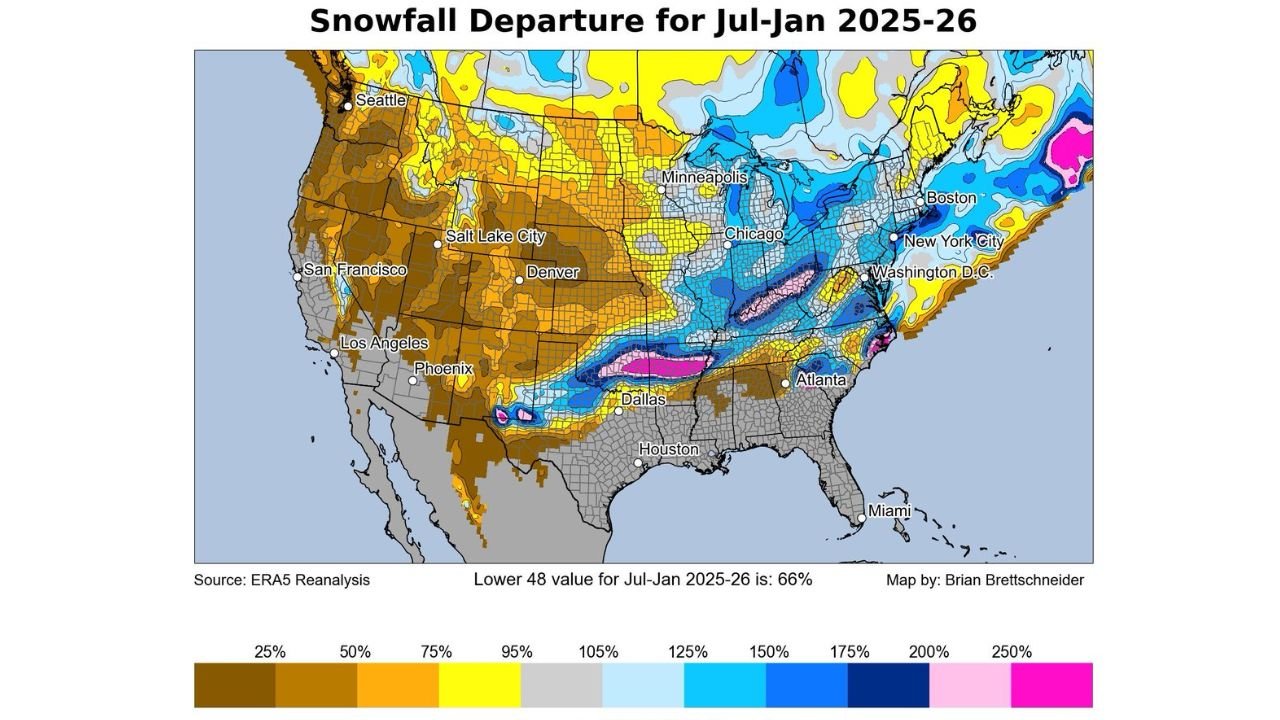
UNITED STATES — New snowfall departure data covering July 2025 through January 2026 reveals a sharply divided winter pattern across the Lower 48, with above-average snowfall concentrated in the Midwest, Great Lakes, and Northeast, while large portions of the western United States and Plains remain locked in a significant snow drought. The imbalance is already raising questions about spring melt, water supply, and warm-season weather impacts later this year.
Midwest and Great Lakes Running Well Above Normal Snowfall
One of the most clearly impacted regions on the map is the Midwest, particularly Illinois, Wisconsin, Michigan, Minnesota, and Indiana. Large areas across these states are running 125% to 175% of normal snowfall, with localized pockets exceeding that threshold.
Wisconsin stands out as being near or slightly above average overall, but surrounded by regions seeing higher totals, especially toward the Great Lakes snowbelt. Northern Illinois and Michigan also show sustained snow surplus, driven by repeated storm tracks and lake-enhanced snowfall.
This surplus is important because it increases soil moisture heading into spring, which can later influence severe weather potential, flooding risk, and summer humidity across the region.
Northeast Sees Consistent Snow Surplus From Pennsylvania to New England
The Northeast corridor is another major winner this winter. Pennsylvania, New York, Vermont, New Hampshire, Massachusetts, and Maine all show widespread above-normal snowfall, with some interior and higher-elevation zones reaching 150% to 200% of normal.
Snowfall across upstate New York and northern New England has been especially robust, while southern New England remains above average despite more variability. This pattern reflects a storm track frequently favoring the Ohio Valley into the Northeast, rather than cutting west into the Plains.
For cities like Boston, Chicago, and New York, this winter has leaned more active than recent years, reinforcing the east-heavy snow distribution.
Central Plains and Southern States Caught in a Sharp Transition Zone
A noticeable transition zone stretches from Kansas and Missouri into parts of Kentucky and Tennessee, where snowfall totals fluctuate dramatically over short distances. Some areas near this corridor have seen near-normal snowfall, while just to the north or south totals swing sharply higher or lower.
This boundary is critical because it often marks the storm track battleground, and it may play a role in where springtime severe weather sets up as warmer air begins pushing north.
Western United States Facing a Significant Snow Drought
The most concerning signal on the map appears across the western United States, including California, Nevada, Utah, Arizona, New Mexico, Colorado, and large parts of the Pacific Northwest. Much of this region is running well below 75% of normal snowfall, with some areas closer to 25–50% of average.
This snow drought is especially notable in:
- California’s interior and Sierra-adjacent regions
- The Great Basin
- The central and southern Rockies
- Large portions of the Plains extending westward
Reduced snowpack in these regions has serious implications for water supply, wildfire season intensity, and summer heat amplification later in the year.
Why This Winter Pattern Matters Beyond Snowfall
The uneven snowfall distribution doesn’t just end with winter. Heavy snow across the Midwest and Northeast can increase spring flooding risk, while the lack of snow in the West and Plains may accelerate early-season drought and extreme heat.
Meteorologists often watch winters like this closely because they can shape jet stream behavior, soil moisture patterns, and temperature extremes well into summer.
As winter continues to evolve, these snowfall departures offer a valuable snapshot of where the atmosphere has focused its energy — and where consequences may soon follow. Stay with ChicagoMusicGuide.com for continued weather coverage, regional breakdowns, and how these patterns could affect travel, events, and seasonal planning across the United States.