
January 2026 Snowfall Shocks the U.S. as Dozens of Cities Outpace Salt Lake City With Measurable Snow
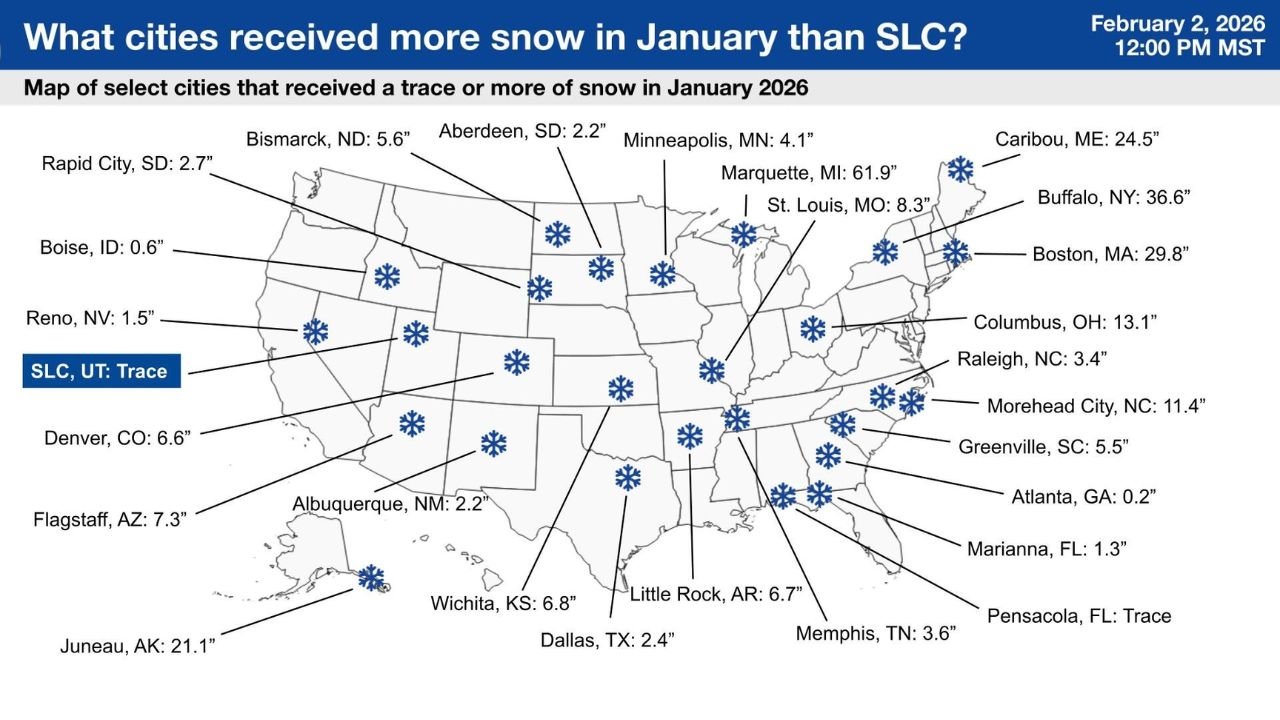
UNITED STATES — January 2026 delivered an unexpected winter storyline across the country as Salt Lake City, Utah, a city typically known for heavy mountain snowfall, recorded only a trace of snow for the entire month. Meanwhile, dozens of cities across the Midwest, East Coast, South, and even parts of the Deep South measured more snowfall than Salt Lake City, according to a map released by the National Weather Service in Salt Lake City on February 2, 2026.
Salt Lake City Left Behind in a National Snow Anomaly
While Salt Lake City, Utah is often among the nation’s winter snowfall leaders, January 2026 flipped expectations. The city officially logged just a trace of snow, placing it below nearly every major region of the country shown on the map.
Meteorologists noted that persistent high-pressure ridging over the Great Basin repeatedly deflected storm systems north and east, starving northern Utah of meaningful precipitation. This allowed cold air and moisture to focus elsewhere, setting the stage for a rare national imbalance in snowfall distribution.
The result was a month where traditional snowbelt cities behaved normally — or even above average — while Salt Lake City fell nearly silent.
Upper Midwest and Great Lakes Dominate January Totals
Snowfall was especially impressive across the Upper Midwest and Great Lakes, where cold air remained firmly entrenched for most of the month.
Notable January snowfall totals included Marquette, Michigan, which topped the national list at 61.9 inches, followed by Buffalo, New York with 36.6 inches, and Boston, Massachusetts at 29.8 inches. Caribou, Maine recorded 24.5 inches, reinforcing the strength of northern storm tracks.
Cities such as Minneapolis, Minnesota (4.1 inches) and Bismarck, North Dakota (5.6 inches) also exceeded Salt Lake City’s trace, even in what was considered a relatively average winter pattern for the region.
Snow Reaches the South and Unexpected Coastal Cities
Perhaps the most striking element of January 2026 was measurable snowfall reaching deep into the southern United States.
Cities that typically see little to no snow still managed to record more than Salt Lake City, including Atlanta, Georgia (0.2 inches), Greenville, South Carolina (5.5 inches), and Raleigh, North Carolina (3.4 inches). Even Morehead City, North Carolina, along the coast, logged 11.4 inches, an exceptional monthly total for the area.
In Florida, Marianna recorded 1.3 inches, while Pensacola reported a trace, placing the Panhandle in the same snowfall category as Salt Lake City — a comparison rarely seen in climatological records.
Central and Southern Plains See Solid Winter Activity
The Central Plains and Southern Plains also contributed to the surprising snow map. Wichita, Kansas received 6.8 inches, while Little Rock, Arkansas recorded 6.7 inches and Memphis, Tennessee logged 3.6 inches.
Further south, Dallas, Texas measured 2.4 inches, outperforming Salt Lake City by a wide margin. These totals reflect a pattern of southern-stream storm systems tapping Gulf moisture and producing snowfall well outside the traditional snow corridor.
Western U.S. Mixed Results Outside Utah
Across the western states, snowfall varied sharply. Flagstaff, Arizona stood out with 7.3 inches, while Denver, Colorado recorded 6.6 inches. Boise, Idaho received 0.6 inches, and Reno, Nevada picked up 1.5 inches — still more than Salt Lake City’s trace.
Even Juneau, Alaska, logged 21.1 inches, reinforcing the widespread nature of January’s active winter pattern beyond Utah.
What This January Pattern Reveals About Winter Variability
Meteorologists emphasize that January 2026 highlights how atmospheric positioning, rather than regional reputation, dictates snowfall outcomes. Jet stream alignment, storm track orientation, and blocking patterns combined to deliver snow across much of the country while bypassing northern Utah almost entirely.
While Salt Lake City’s seasonal snowfall could still recover later in winter, January’s numbers already stand out as one of the most unusual monthly comparisons in recent memory.
As winter patterns continue to evolve heading deeper into February, meteorologists are watching whether Utah’s snow drought breaks — or if this anomaly becomes a defining feature of the 2025–26 winter season. For continued coverage of national weather patterns, seasonal climate trends, and how winter conditions impact travel, events, and daily life, visit ChicagoMusicGuide.com for the latest updates.