
North Carolina and South Carolina Brace for Sneaky Northwest Flow Supercell Threat with Large Hail Risk from Foothills to Charlotte and Metrolina Saturday Evening
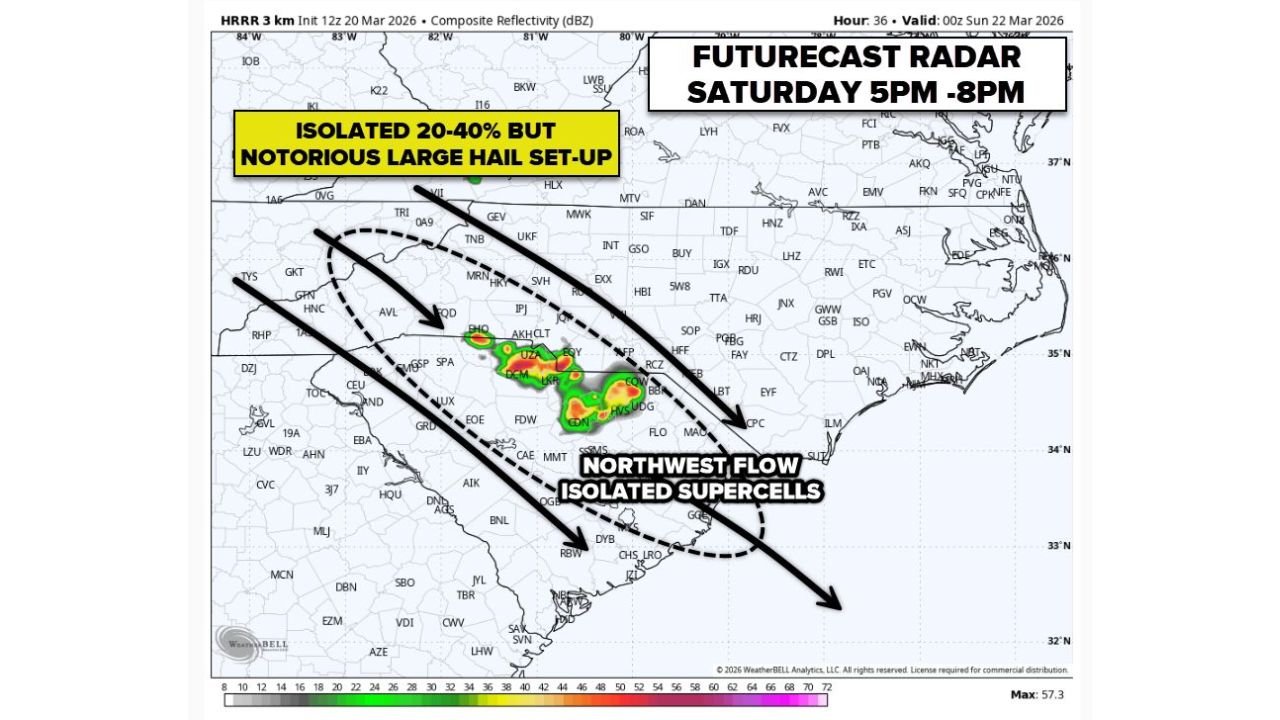
CHARLOTTE, NORTH CAROLINA — A sneaky and highly localized northwest flow severe setup is developing for Saturday evening, March 21, 2026, across parts of North Carolina and South Carolina. While forecast coverage remains limited — potentially just one or two storms — meteorologists warn that any storm that forms could evolve into a supercell capable of producing large hail, especially from the North Carolina foothills into the Charlotte and Metrolina region and extending into South Carolina.
Forecast guidance shows this event unfolding between 5 PM and 8 PM Saturday, with storms tracking from the northwest to southeast, a pattern that has historically been associated with notorious hail producers in this region.
Northwest Flow Pattern Favors Isolated Supercells
This setup is driven by a northwest flow aloft, meaning upper-level winds are steering storms from the mountains of western North Carolina southeastward toward the Piedmont and into South Carolina. These types of events often develop quickly and may not require widespread moisture to become severe.
Forecast models indicate a 20–40% isolated storm probability, but that percentage does not tell the full story. Northwest flow events are known for producing high-impact but low-coverage storms, where one or two cells dominate the evening radar picture.
Areas of concern include the North Carolina foothills, Charlotte, Gastonia, Rock Hill, and surrounding Metrolina communities, extending southward into parts of upstate South Carolina.
Large Hail the Primary Concern
The biggest risk with this event is large hail, driven by strong updrafts and favorable atmospheric conditions. Even with limited storm development, the environment supports rotating supercells, which can suspend hailstones longer within the storm core, allowing them to grow in size before falling.
Meteorologists emphasize that these storms will likely be isolated, but if one tracks over a populated area such as Charlotte or nearby suburbs, localized damage to vehicles, roofs, and outdoor property could occur.
Northwest-moving arrows in forecast simulations clearly show storms forming over western North Carolina and tracking southeast across the Charlotte metro region and into South Carolina, aligning with typical northwest flow severe setups.
Futurecast Radar Highlights 5 PM–8 PM Window
High-resolution model simulations suggest that any storms that develop will do so during the late afternoon to early evening window, primarily between 5 PM and 8 PM Saturday.
Simulated reflectivity shows small but intense storm cores developing near the foothills and then sliding southeast. While coverage is sparse, the storms that do form appear organized enough to warrant close monitoring.
Because only one or two storms may develop, many communities across North Carolina and South Carolina could remain completely dry. However, residents in the projected path should remain weather-aware, especially during the early evening hours.
Localized but Potentially Impactful Setup
This is not a widespread severe weather outbreak. Instead, it is a highly localized severe risk, focused on a narrow corridor from the North Carolina foothills through Charlotte and into South Carolina.
These types of northwest flow setups are often underestimated because they lack widespread thunderstorm coverage. However, history shows they can produce significant hail in isolated areas, particularly across the Metrolina region.
Residents are encouraged to monitor radar updates and be prepared for quick changes in weather conditions Saturday evening.
As weather patterns continue to evolve across North Carolina and South Carolina, staying informed remains critical. For ongoing severe weather updates, regional forecasts, and detailed storm analysis across the United States, visit ChicagoMusicGuide.com.