University of Chicago’s South Side Science Festival Draws Thousands for 130 Hands-On Demos, Helping Kids and Adults Meet Researchers in White Coats
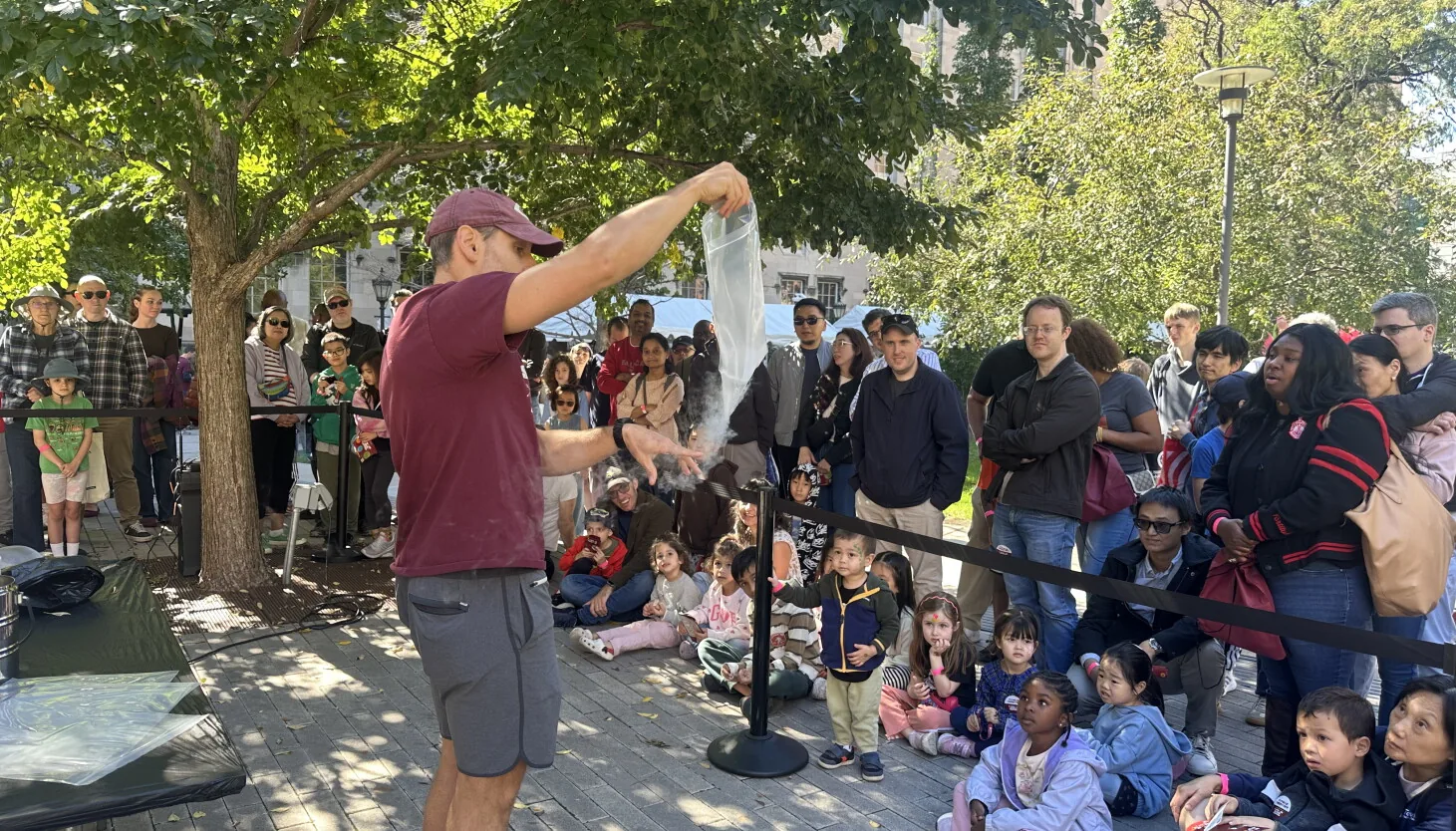
CHICAGO, IL — Thousands of children and adults spent Saturday stepping into the role of University of Chicago students and researchers at the fifth annual South Side Science Festival. The campus filled with white coats, hands-on stations and a steady stream of visitors eager to ask questions, play games and try experiments.
The festival featured more than 130 demonstrations and activities across disciplines including biology, aerospace and physics. Organizers said the event is meant to show that science belongs to everyone, while also building a stronger connection between South Side residents and the researchers working nearby.
A campus festival built to make science feel open, not distant
The South Side Science Festival was modeled on The Long Night of Sciences, a public science event in Germany where universities and labs open their doors to the public. University of Chicago organizers said they wanted to bring that spirit to Chicago while keeping the focus on the neighborhoods around the university.
Maanasa Raghavan, an associate professor in the Department of Human Genetics and one of the founding organizers, said the event was designed to make the work of scientists more approachable for local families. Her goal was not just to copy the format, but to tailor it to the South Side community and the questions people there are likely to bring.
Organizers say trust and access are central to the festival’s mission
Raghavan said the annual event matters even more at a moment when scientists face polarized opinions and federal funding cuts that can make the work feel discouraging. Seeing thousands of people turn out for the festival, she said, is a reminder that the public values what researchers do.
She said the event can help foster future scientists and give current researchers a reason to keep showing up. The festival is built around the idea that direct contact can make science feel less abstract and more human, especially for families who may not regularly interact with researchers.
The event also responds to post pandemic doubts about medicine
Organizer Luke Dyer said the festival was also created in part as a response to broader fear and distrust in medicine that grew after the early months of the COVID-19 outbreak. He said the goal is to invite people in, show them what scientists at the University of Chicago are actually doing and let them ask questions in person.
That kind of face-to-face interaction, organizers said, can do work that a lecture or brochure cannot. It gives visitors a chance to see how research happens and to hear answers from the people doing it, rather than encountering science only through headlines, social media or a doctor’s office visit.
Researchers said the festival gives them a different kind of motivation
For PhD student Michelle Bessiake, who has led demonstrations at the festival for the past three years, volunteering offers a sharp contrast to the grind of lab work. She said she can spend as many as 60 hours a week on experiments and research, but the festival helps ground that work in something more immediate.
Bessiake said it is rewarding to watch the moment when visitors begin to understand why scientists do what they do. One of her favorite parts is seeing kids play with slime and then start asking questions that connect the activity to real-world health decisions.
Families came for fun, but left with questions about how science helps
South suburban resident Nijel Mottley brought his 4-year-old son, Remy, to the festival because the child already loves mixing things and watching science videos on YouTube. Mottley said his son is naturally hands-on and was clearly enjoying the chance to explore science in person.
For Mottley, the festival offered more than entertainment. He said communities need more scientists to help solve problems, and events like this can encourage children to learn the many ways science can be applied in everyday life. The festival gave families a chance to see research as something practical, not remote.
More than a showcase, the festival acts like an invitation to return
By bringing together scientists, students and local families, the South Side Science Festival turned the University of Chicago campus into a place where curiosity could run in both directions. Children got to handle experiments and adults got to ask direct questions, while researchers had a chance to hear what visitors cared about most.
That exchange is at the center of the festival’s identity. Organizers said the event is meant to show that science is not reserved for experts behind closed doors, but is something that can be explored, questioned and shared with the surrounding community year after year.
Chicago's music scene, one story at a time — Chicago Music Guide.