Nearly 170 Million Birds Took Flight Across the United States in a Single Night as the Spring Migration Surge Smashes Expectations From Texas and the Gulf Coast to the Great Lakes and New England
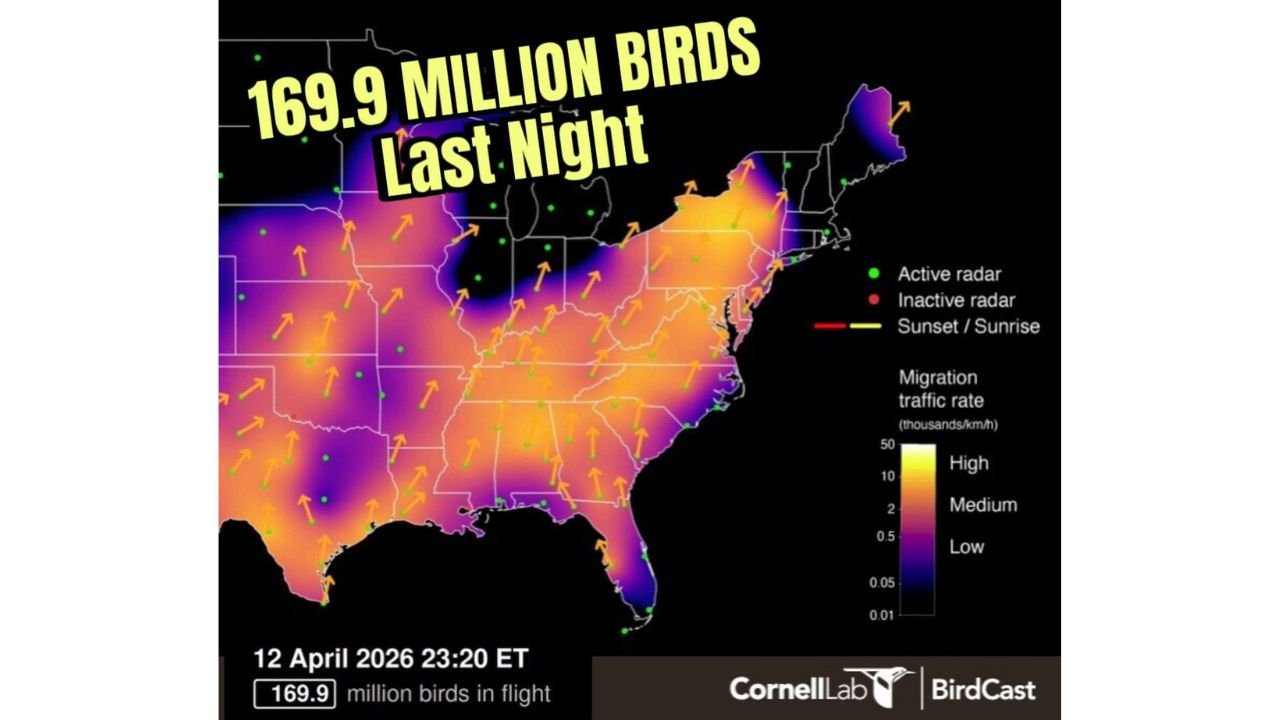
CHICAGO, IL — One of the most extraordinary single-night bird migration events of the spring season just unfolded across the skies of the United States — and the numbers are staggering. On the night of April 12, 2026, approximately 169.9 million birds took flight simultaneously across the country in their northward spring migration, far exceeding the pre-flight forecast of 116 million birds and registering as a landmark migration event tracked through Doppler radar signatures across the eastern two-thirds of the nation.
To put that number in context: nearly 170 million individual birds were airborne at the same time over American skies in a single overnight period — more than half the entire population of the United States, in the air, moving north, all at once.
Why Last Night Was So Exceptional
Spring bird migration across the United States is driven by atmospheric conditions — specifically the combination of warm temperatures, favorable southerly winds, and mild overnight lows that give migrating birds the tailwind and thermal comfort they need to cover large distances in a single overnight flight. Most songbirds and shorebirds migrate at night, navigating by stars and the Earth’s magnetic field while avoiding daytime predators.
The conditions on the night of April 12 were nearly ideal for a mass migration event. Temperatures approaching 90 degrees Fahrenheit were recorded across portions of the central and southern United States during the day, with overnight lows staying in the 60s across a broad corridor. That combination of daytime warmth and mild overnight temperatures is precisely what triggers large-scale migration departures — birds read those cues as a green light to launch northward in enormous numbers.
The pre-night forecast called for 116 million birds in flight. The actual count came in at 169.9 million — an overshoot of nearly 54 million birds, or roughly 46% above the expected total. That margin of outperformance is significant and reflects just how favorable the atmospheric setup was for bird movement last night across the country.
Where the Migration Was Concentrated
The migration traffic map for April 12, 2026 at 11:20 PM ET shows the highest migration traffic rates — depicted in the brightest yellow tones — concentrated across a broad corridor covering the Gulf Coast states, the lower Mississippi Valley, the mid-South, the Ohio Valley, the Great Lakes region, and extending northeast toward New England and the mid-Atlantic.
The deepest orange and brightest yellow migration traffic values covered Texas, Louisiana, Mississippi, Alabama, Tennessee, Arkansas, Missouri, Illinois, Indiana, Ohio, Kentucky, and the entire Northeast corridor from Pennsylvania and New York through New England. Migration arrows across the map point consistently northward and northeastward — the classic spring migration direction — with the highest traffic rates per kilometer per hour concentrated across the Gulf Coast to Great Lakes axis.
The migration was also active but at medium levels across the Great Plains corridor including Kansas, Nebraska, Oklahoma, and the Dakotas, with the western states showing lower but still measurable migration activity.
Migration Data Summary
| Metric | Value |
|---|---|
| Total Birds in Flight | 169.9 million |
| Pre-Night Forecast | 116 million |
| Overshoot Above Forecast | Approximately 54 million birds |
| Observation Time | April 12, 2026 at 11:20 PM ET |
| Detection Method | Doppler radar network signatures |
| Peak Migration Traffic | Gulf Coast through Great Lakes and Northeast |
| Primary Migration Direction | Northward and northeastward |
| Driving Weather Factor | Temps near 90°F with overnight lows in the 60s |
What This Means Going Forward
With temperatures expected to continue approaching 90 degrees Fahrenheit this week across portions of the central and southern United States, and overnight lows holding in the 60s across the migration corridor, current analysis indicates the favorable migration conditions are not a one-night phenomenon. The atmospheric setup that triggered last night’s record-level flight event is likely to persist through much of this week, meaning migration totals may go even higher on subsequent nights if winds remain favorable and the warm pattern holds.
For residents across the affected states — from Houston and New Orleans in the south through Chicago, Detroit, Cleveland, and Pittsburgh in the Great Lakes, and northeast through New York, Boston, and New England — this week represents one of the peak migration windows of the entire spring season. Hundreds of species are moving through simultaneously, making this an extraordinary period for anyone interested in the natural world happening overhead every night.
One Simple Action That Helps
The peak migration flight time occurs approximately three hours after sunset each night — the window when the largest concentrations of birds are airborne and navigating across the country. Artificial outdoor lighting from homes, office buildings, and urban areas is a documented source of disorientation for migrating birds, pulling them off course and increasing collision risk with structures.
Turning off or dimming unnecessary outdoor lights during the overnight hours this week — particularly between 10 PM and 2 AM — is a simple and direct way for residents across every affected state to support one of the most spectacular natural events happening over American skies right now.
Forecast Confidence
Confidence: Confirmed observation. The 169.9 million bird figure is a measured result from the Doppler radar network, not a forecast projection. The radar signatures of migrating birds are a well-established and scientifically validated detection method, and the April 12 count is an official recorded observation. The outlook for continued high migration activity through this week is based on the persistence of the warm, southerly atmospheric pattern currently in place across the eastern United States.
More weather-driven natural event coverage is always on the horizon. Stay informed at ChicagoMusicGuide.com — your source for atmospheric and migration event tracking across the Gulf Coast, the Great Lakes, and the entire United States.