
Alabama Set for First 80° Surge of 2026 as Montgomery Climbs Into Low 80s, But Winter Threat Lurks North by Late February
UNITED STATES — A dramatic warm-up is unfolding across Alabama and much of the Deep South, with forecast data showing the warmest stretch of 2026 so far arriving this week. Communities across South Alabama — including Montgomery — are projected to surge into the low 80s by midweek, a remarkable turnaround for mid-February.
However, while springlike warmth dominates the short-term forecast, longer-range outlooks suggest winter is not finished across the broader Southeast and Mid-Atlantic as we head toward early March.
Montgomery’s Meteogram Shows Climb Into the 80s
Forecast guidance for Montgomery Regional (Dannelly Field) Airport paints a clear picture of this warming trend.
Daily high temperatures are expected to rise steadily:
- Sunday (Feb 15): 71°F
- Monday: 70°F
- Tuesday: 73°F
- Wednesday: 78°F
- Thursday: 81°F
- Friday: 82°F
By Thursday and Friday, Montgomery is projected to hit 81–82°F, which would make it the warmest stretch of the year so far.
Overnight lows also trend milder through midweek, rising into the upper 50s and low 60s before easing back late in the week.
This kind of February warmth isn’t unheard of in Alabama, but reaching the low 80s this early stands out — especially following a more typical winter pattern earlier this season.
8–14 Day Outlook Favors Above-Normal Temperatures Across the South
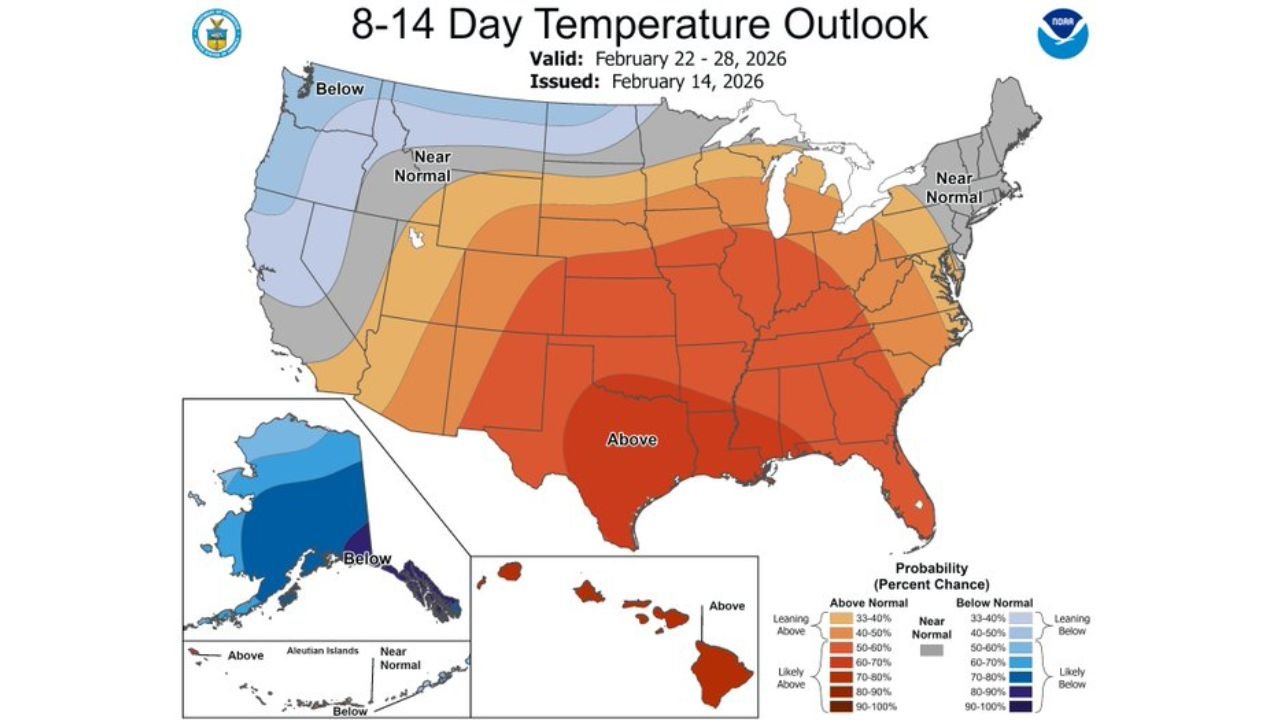
The broader February 22–28 temperature outlook reinforces the warming theme.
Much of the Deep South — including Alabama, Georgia, Mississippi, Louisiana, and parts of Texas — is shaded in “Above Normal” probability, with the strongest signal centered across the Gulf states.
Even much of the central United States trends warmer than average during this period, while cooler anomalies appear limited mainly to parts of the Pacific Northwest and northern Rockies.
The takeaway:
There is no immediate sign of Arctic air plunging into the Deep South through the rest of February.
A Slight Cooldown After February 23–27
While this week brings peak warmth, guidance suggests temperatures will ease slightly during the February 23–27 window.
Montgomery highs fall back into the mid-60s by next weekend:
- Saturday: 71°F
- Sunday: 66°F
- Monday: 63°F
- Tuesday: 65°F
That cooldown, however, still keeps readings near or above seasonal averages — not a true cold snap.
Forecasters emphasize that sharp cold snaps remain common in March and even early April, so winter cannot be declared over just yet.
Snow Threat Focused Well North of Alabama
While Alabama basks in warmth, the probability of meaningful snowfall through March 1 is concentrated much farther north.
Probability maps for 1 inch or greater snowfall show:
- Highest chances across the Mid-Atlantic and Northeast
- Moderate probabilities stretching across the central Appalachians
- Very limited snow potential across the Deep South
For Alabama and much of Georgia and Florida, snowfall chances remain extremely low during this period.
The dividing line between winter and early spring will likely sit well north of the Gulf Coast states.
What This Means for the Deep South
For residents of Montgomery and South Alabama:
- Expect early springlike afternoons this week
- Light jackets may be all that’s needed in the mornings
- Outdoor events and travel should benefit from mild conditions
- Energy demand for heating will likely drop
But meteorologists caution against complacency. The Southeast often experiences late-season cold outbreaks, and March can still deliver surprises.
In other words: enjoy the 80-degree warmth — but don’t pack away winter coats just yet.
At Chicagomusicguide.com, we continue tracking major weather shifts across the country that could impact travel, events, and touring schedules. Stay with us for continued updates as winter transitions toward spring across the United States.