Springlike Thunderstorms Could Rumble Across Washington, Baltimore, and the Mid-Atlantic Thursday Evening as Forecast Models Signal Loud But Non-Severe Storms
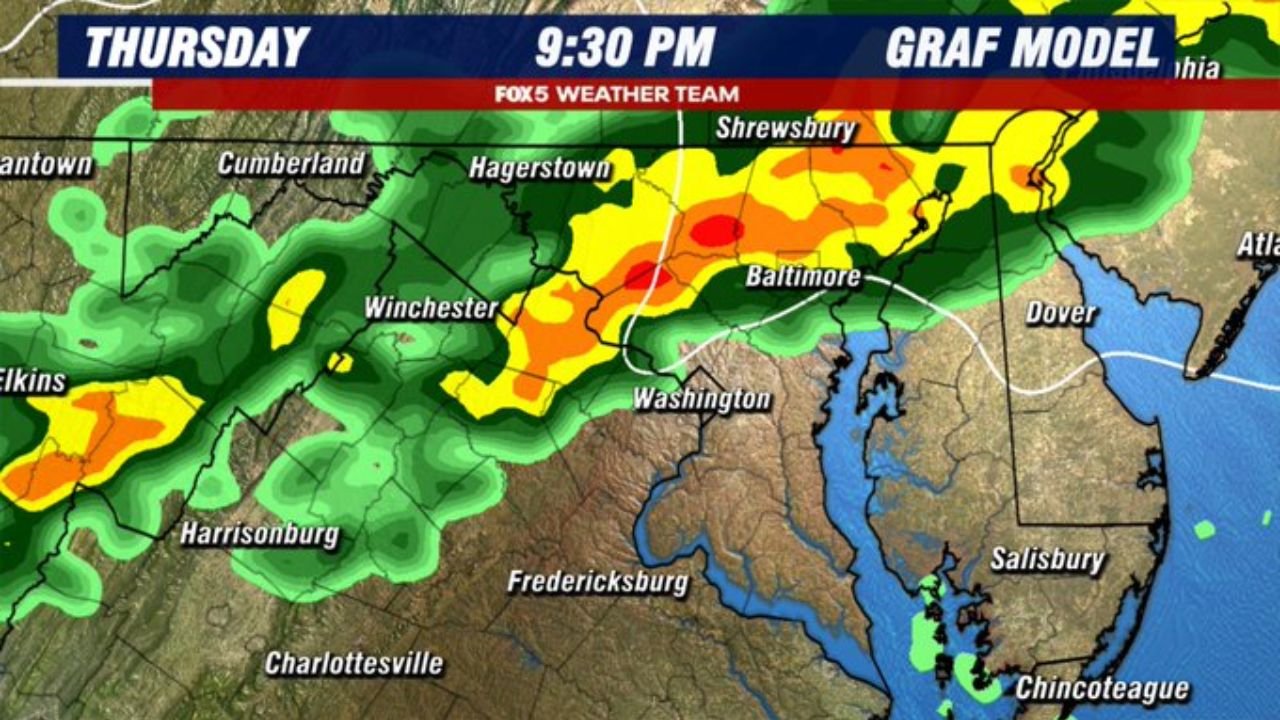
WASHINGTON, D.C. — Early signs of spring thunderstorm activity could arrive across parts of the Mid-Atlantic Thursday evening, as several weather models suggest scattered thunderstorms developing near Washington, Baltimore, and surrounding communities.
Meteorologists say the setup features enough mid-level warmth and atmospheric energy for storms to form, though the environment is not expected to support severe weather. The storms that do develop could still produce brief downpours and loud thunder, particularly later in the evening.
Forecast guidance from multiple weather models — including the HRRR, GRAF, and NAM models — all indicate the possibility of thunderstorms forming across portions of Maryland, northern Virginia, and eastern West Virginia.
Forecast Models Show Storm Development Thursday Evening
Weather models show storms potentially forming between roughly 7:30 PM and 10:00 PM Thursday, primarily along a corridor stretching from the Appalachian Mountains eastward toward the Baltimore and Washington metropolitan areas.
Cities that could see scattered storms include:
- Washington, D.C.
- Baltimore, Maryland
- Winchester, Virginia
- Hagerstown, Maryland
- Fredericksburg, Virginia
- Cumberland, Maryland
According to simulated radar imagery from the HRRR and GRAF models, a narrow band of thunderstorms may develop near the mountains before drifting east toward the Interstate 95 corridor later in the evening.
While the NAM model appears less aggressive, it still shows isolated pockets of showers and thunderstorms forming across parts of the region.
Atmospheric Inversion May Limit Storm Strength
Meteorologists note that an inversion layer is expected to develop later in the evening, which should prevent storms from growing into severe thunderstorms.
An inversion occurs when a layer of warm air sits above cooler air near the ground, effectively limiting the vertical growth of storms.
Because of this atmospheric cap, forecasters say any thunderstorms that do form will likely remain below severe limits, producing mainly brief rain showers, lightning, and thunder.
However, the inversion may also cause thunder to sound louder than usual, as the atmosphere can help carry sound farther across the region.
Loud Thunder Possible Despite Limited Storm Strength
Even though storms are expected to remain weak, meteorologists say thunderstorms could still be noisy for those directly under the storm cells.
Lightning and thunder often occur in early spring storms when warm air begins interacting with cooler atmospheric layers, even if storms do not reach severe levels.
Residents across the Baltimore–Washington corridor and nearby communities may notice brief bursts of thunder Thursday evening as storms move through.
No Severe Weather Expected
Forecasters emphasize that severe weather is not expected with this system, and no widespread damaging winds, large hail, or tornado threats are anticipated.
Instead, the storms are expected to be short-lived and scattered, typical of early spring setups where the atmosphere is beginning to warm but still lacks stronger instability.
The majority of communities may only experience brief rain showers or passing clouds, while a few areas could hear thunder or see lightning.
Early Spring Weather Pattern Emerging
The possibility of thunderstorms is another signal that the Mid-Atlantic region is transitioning into the spring weather pattern, when warmer air begins to interact more frequently with passing weather systems.
These early-season thunderstorms often remain weak but can still produce dramatic skies and occasional thunder during evening hours.
Meteorologists will continue monitoring updated model guidance to determine whether storm coverage increases or decreases as the system approaches.
For continued updates on regional weather developments, storm forecasts, and severe weather alerts across the United States, visit ChicagoMusicGuide.com.